July 27, 2026 • Neil Hayes • 12 min reading time • Prices verified June 25, 2026
Bike Security on a Budget: Chain Locks, Cable Locks, and Combination Locks for Cyclists Who Actually Lock Up
Locking your bike sounds simple — snap a lock on, walk away. But if you’ve ever returned to find your ride gone, or if you’re now spending real money on a cargo bike or electric-assist hauler, you already know that not all locks are equal, and the difference between “locked” and “actually secure” can cost you hundreds. A chain lock is exactly what it sounds like: a steel chain with a padlock or integrated lock that wraps around your bike frame and a fixed object. A cable lock substitutes braided steel cable for chain — lighter and more flexible. A combination lock refers to the locking mechanism itself (a dial or push-button code rather than a key) and can be built into either format. This article sorts through each category, names the real tradeoffs, and tells you when spending more is worth it and when a lighter lock is genuinely the smarter call.
| EDITOR'S PICKMaster Lock Black and Yellow Py… | Budget pickSportneer Bike Lock: 5 Digit Co… | |
|---|---|---|
| Type | Cable | Chain |
| Length | 6 ft | 3.2/3.6/4 ft |
| Thickness | 3/8 in | 4/6 mm |
| Locking | Key | Combination |
| Combination digits | — | 5 |
| Price | $24.62 | $13.99 |
| See on Amazon → | See on Amazon → |
Chain Locks: Where Durability Shows Up in Owner Reviews
Chain locks earn their reputation on longevity. Among the brands that generate repeat-purchase behavior, the Sportneer chain lock is a standout case worth examining. Reviewers who bought the Sportneer in 2020 are still posting favorable updates years later — an unusual signal in a category where budget hardware often fails within 18 months. That sustained owner loyalty, captured across aggregated product reviews, suggests the chain itself holds up rather than corroding or seizing under regular outdoor exposure.
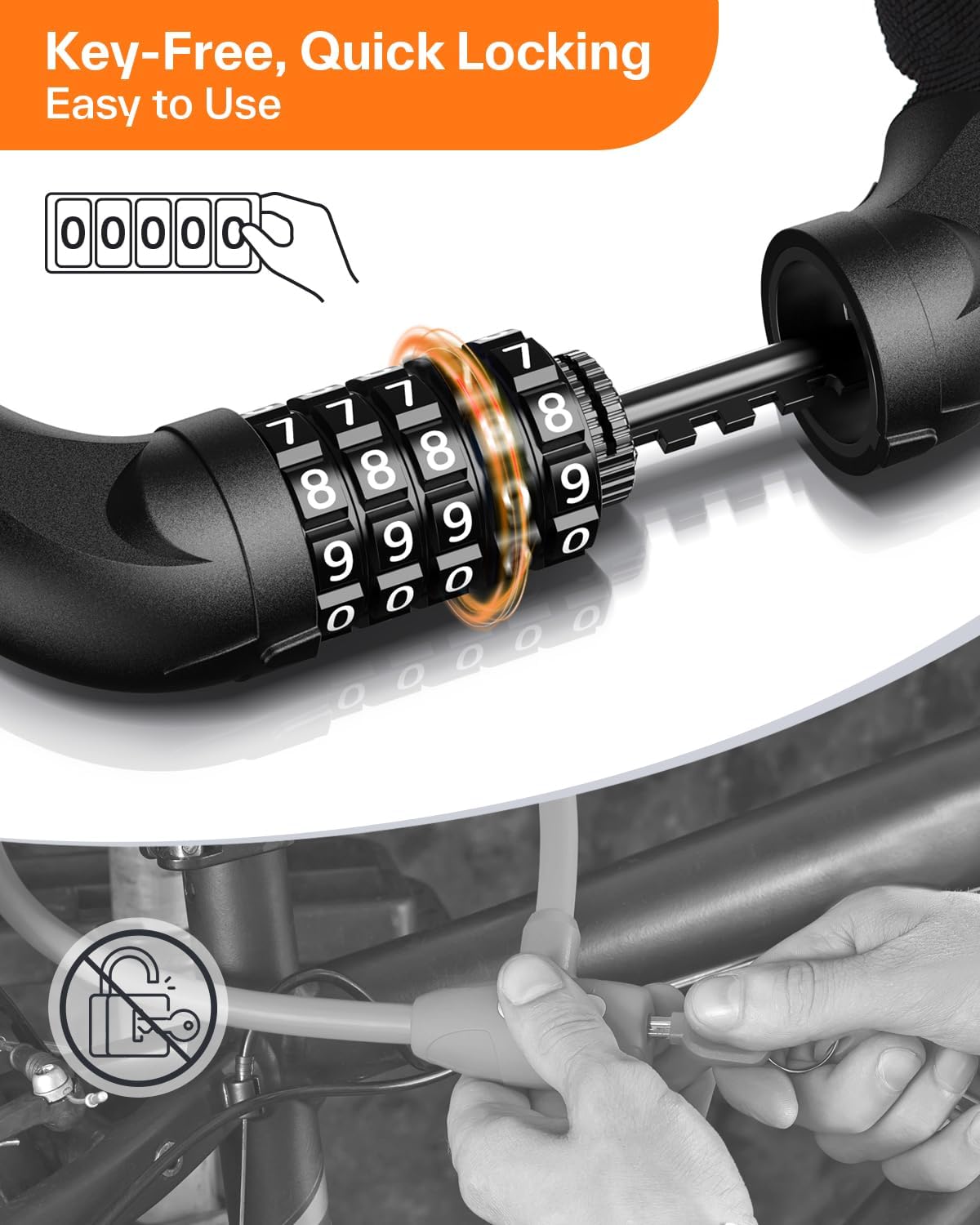
Two specific details that Sportneer owners flag repeatedly: the soft outer sleeve wrapped around the chain links, and the combination-style locking mechanism. The sleeve matters more than it sounds. On bare-chain locks, the chain drags against your top tube and dropout every time you coil it, and over a season it leaves gouges in painted aluminum or powder coat. On a cargo bike with a $3,000–$4,500 frame investment — a Tern GSD, a RadWagon 4, an Xtracycle — that’s a non-trivial cosmetic issue. Multiple Sportneer owners call out the sleeve as a specific reason they’d buy again, and it’s the kind of quiet feature that separates a well-thought-out product from a raw commodity chain.
The tradeoff at this tier: chain locks are heavy. A usable-length chain lock — long enough to thread through your frame, both wheels, and around a rack post — typically runs 2–4 lbs. For a cargo bike rider who’s already hauling kids or freight, that weight lives on the bike all day. Build that into your carry calculus.
Chain Lock Length: Getting the Sizing Right
BikeRadar’s guide “How to Choose a Bike Lock” (2024) notes that a chain needs to reach from your rear dropout (the slot where the rear axle sits), around a fixed anchor point like a bike rack post, and back to your frame — typically a minimum of 3.5 feet (roughly 1 meter) for a solo bike locked to a standard U-shaped rack. If you’re locking a cargo bike with a longer wheelbase, or threading through both wheels, 4–5 feet is more realistic. Buy short and you’ll find yourself locked only to your own wheel, which protects nothing.
Chain Lock, Cable Lock, and Combination Lock: Head-to-Head Comparison
The three lock formats serve meaningfully different roles. The sections below break them down by tier so you can match your lock to your bike’s actual value and your most common locking environment.
Budget-Tier Option: Cable Lock for Secondary Use
The Master Lock Python cable lock is the reference product in the cable-lock conversation because it is widely owned and widely reviewed. Outside Online’s “The Best Bike Locks for Every Kind of Cyclist” (2025) places cable locks clearly in a secondary-deterrent role rather than a standalone security solution, and the Python fits that framing precisely.
What it does well: it is flexible enough to thread through spaces that defeat a rigid lock, it is lightweight, and it is genuinely useful when you need to secure something irregularly shaped — a helmet, a cargo bag, a bike rack attachment, or a trailer hitch — to a vehicle or rack. What it does not do: stop a determined thief with a pair of cable cutters, which can defeat a standard 3/8-inch cable in seconds.
One genuinely useful owner-reported feature: the key-alike custom ordering option. Master Lock and similar brands allow you to order multiple locks keyed to the same key, so a household with a cable lock, a padlock, and a door lock can operate all of them from one key. For families running multiple bikes with multiple locks, this is a workflow improvement worth requesting at purchase.
When a cable lock is the right call:
- As a secondary lock alongside a chain or U-lock (a rigid U-shaped hardened-steel lock), to secure a front wheel your primary lock can’t reach
- For lower-value equipment in low-risk environments — a kid’s bike outside a grocery store during a 10-minute stop
- For non-bike gear — RV equipment, cargo bags, rack attachments, trailer hitches — where flexibility matters more than cut resistance
Sportneer
$13.99
In stock on Amazon
Check price on AmazonMid-Tier Option: Combination Chain Lock for Regular Commuters
The Sportneer combination chain lock occupies the mid-tier position where daily usability and meaningful deterrence overlap. Bicycling Magazine’s “The Best Bike Locks, Tested and Reviewed” (2025) frames combination chain locks at this price point as appropriate primary protection for bikes in the $300–$800 range when used in conjunction with a secondary lock for higher-value setups.
The combination mechanism on the Sportneer removes the key-juggling friction that frustrates riders making multiple stops per day. Wirecutter’s “The Best Bike Lock” (2025) notes that combination locks win on convenience for riders who lock and unlock multiple times daily, even though keyed locks offer slightly better pick resistance at equivalent price points. For a cargo bike commuter making 4–6 stops on a delivery route, the combination format is a practical advantage.
Owner accounts indicate the Sportneer uses a standard combination-reset procedure — typically: set the dials to your current code, press and hold the reset button or depress the shackle in the open position, set your new code, then release. The exact steps vary by model year, so consult the physical manual that ships with the unit rather than relying on a generic procedure.
The sleeve-wrapped chain protects paint on expensive frames. The weight (typically 2–3 lbs for a mid-length model) is the honest tradeoff — it lives on the bike, so account for it in your cargo load.

Master
$24.62
In stock on Amazon
Check price on AmazonPremium Approach: Hardened U-Lock as Primary Anchor
For e-bikes and cargo bikes valued at $1,000 or more, Wirecutter’s “The Best Bike Lock” (2025) and Bicycling Magazine’s “The Best Bike Locks, Tested and Reviewed” (2025) both reach the same conclusion: a hardened-steel U-lock is the correct primary lock, and chain or cable locks serve as secondary coverage rather than the anchor point.
A quality hardened U-lock in the 2–3 lb range delivers substantially higher cut and leverage resistance than a budget-tier chain lock of equivalent weight. The U-lock secures the rear wheel and frame to a fixed anchor; a chain or cable then covers the front wheel. PeopleForBikes’ “Bicycle Theft Prevention Guide” (2024) reinforces this layered approach, noting that two locks of different types are meaningfully harder to defeat than one lock of any single type — a thief equipped for bolt cutters may not be carrying an angle grinder, and vice versa.
For a Tern GSD, Yuba Spicy Curry, or RadWagon at $3,000–$4,500, the premium approach means:
- A hardened U-lock through the rear triangle and rear wheel to a fixed rack
- A Sportneer-class chain lock through the front wheel and back to the same anchor
- For trailers: a secondary cable or horseshoe lock (a D-shaped rigid lock designed for trailer hitch points) securing the trailer arm to the bike frame
BikeRadar’s “How to Choose a Bike Lock” (2024) puts the minimum chain length for a cargo bike with an extended wheelbase at 4–5 feet (1.2–1.5 meters) to thread through both wheels while still reaching the anchor point — longer than you’d instinctively buy.
Master
$24.62
In stock on Amazon
Check price on AmazonTrailer-Specific Locking: An Underserved Problem
Here is a topic that almost never gets addressed in generic bike lock guides: locking your cargo trailer separately from your bike. A quality cargo trailer runs $200–$600; a Thule Chariot Cross in multi-sport configuration is $2,500. If a thief cannot grab the bike because it is U-locked to a rack, the trailer is still vulnerable — unhitch it and walk away.
PeopleForBikes’ “Bicycle Theft Prevention Guide” (2024) notes that trailers and cargo attachments are frequently overlooked as theft targets precisely because owners assume the bike lock covers everything. It does not.
Practical trailer-locking setup:
- Primary U-lock or chain lock: bike frame + rear wheel to fixed anchor
- Secondary cable lock or short chain: trailer hitch arm to bike frame or rack
- For high-value trailers: a dedicated horseshoe lock through the trailer’s frame or axle
The cable lock that is insufficient as a standalone bike lock becomes legitimately useful in role #2 — securing a trailer hitch is a lower-stakes application where cable cut resistance matters less than coverage. This is the honest use case for the Master Lock Python: not as a primary, but as the lock that stops an opportunistic grab of a $500 trailer while your U-lock handles the bike.
Frequently Asked Questions
Is a combination chain lock actually secure enough for an e-bike worth $1,000 or more?
For an e-bike at $1,000 or more, a combination chain lock alone is generally not sufficient. Both Bicycling Magazine’s “The Best Bike Locks, Tested and Reviewed” (2025) and Wirecutter’s “The Best Bike Lock” (2025) support this framing. At this value level, the recommended approach is layering: a hardened-steel U-lock as your primary lock secured to frame, rear wheel, and fixed anchor, with a chain lock as a secondary covering the front wheel. The chain lock’s value in this setup is covering what the U-lock cannot reach, not replacing it.
How long should a bike chain lock be to reach around most bike rack fixtures?
BikeRadar’s “How to Choose a Bike Lock” (2024) points to 1 meter (roughly 3.5 feet) as a workable minimum for a standard bike at a standard rack. For cargo bikes with extended rear racks or long wheelbases, budget for 4–5 feet (1.2–1.5 meters) to thread through both wheels and still reach the anchor point comfortably. Buying short forces compromise — buy longer than you think you need.
Can I reset the combination on the Sportneer lock if I forget it?
Owner accounts indicate the Sportneer uses a standard combination-reset procedure: set the dials to your current code, press and hold the reset button or depress the shackle in the open position, set your new code, then release. The exact steps vary by model year. Consult the physical manual that ships with the unit. If you inherit a Sportneer without the manual, the manufacturer’s support contact is the cleanest path to the reset sequence.
Is the Master Lock Python cable useful as a primary bike lock or only as a secondary deterrent?
Consistent with Outside Online’s “The Best Bike Locks for Every Kind of Cyclist” (2025), the Python cable is a secondary deterrent, not a primary lock. Its 3/8-inch cable can be defeated quickly by a motivated thief with basic tools. Use it to secure accessories, cover a wheel your primary lock cannot reach, or lock a trailer hitch. Do not rely on it alone for a bike you would actually miss.
Should I lock my bike trailer separately from my bike?
Yes, particularly for trailers above $200 in value. A trailer hitch is easy to unhitch from a locked bike. A secondary cable threaded from the trailer arm to the bike frame or rack raises the effort bar enough to push most opportunistic thieves toward easier targets. For premium trailers, a dedicated horseshoe lock through the trailer frame is the right call.
What is the lightest lock option that still provides meaningful theft deterrence?
Among locks with real deterrent value, a compact hardened-steel U-lock is typically the best weight-to-security ratio. Wirecutter’s “The Best Bike Lock” (2025) consistently places quality U-locks in the 2–3 lb range while offering substantially higher cut resistance than a cable of equivalent weight. If you need to minimize carry weight, a short U-lock paired with a lightweight cable for secondary coverage is a more sensible combination than a single long chain.
The Decision Frame: If X, Then Y
- If you’re locking a cargo bike or e-bike worth $1,000 or more: Lead with a hardened U-lock, use a chain or cable as a secondary for wheel coverage. The Sportneer chain earns its role here as the secondary, not the anchor. Master — $24.62
- If you’re locking a lower-value bike in a low-risk environment for short stops: A combination cable lock is a proportional response. The Master Lock Python is honest about what it is — use it in that context. Sportneer — $13.99
- If you’re running a cargo trailer: Budget for a secondary lock dedicated to the trailer hitch. A cable lock that is wrong for a primary application is exactly right here. Master — $24.62
- If you’re managing multiple locks across a household or fleet: The key-alike ordering option on Master Lock products is a real workflow improvement — one key for all hardware is worth requesting upfront.
- If weight is a hard constraint (bikepacking, loaded touring): A compact U-lock beats a long chain on security-per-pound. Choose U-lock plus short cable over chain alone.
The cyclists who actually lock up — consistently, on every stop — are the ones whose bikes do not get stolen. The right lock is the one you will use every time, not the one rated highest in a lab scenario. Match the lock to the context, layer where the stakes are high, and do not leave the trailer out of the decision.