August 5, 2026 • Neil Hayes • 10 min reading time • Prices verified June 25, 2026
Cargo Bike Trailers for Grocery Runs and Urban Errands: The Sub-$200 Buyer's Real Guide
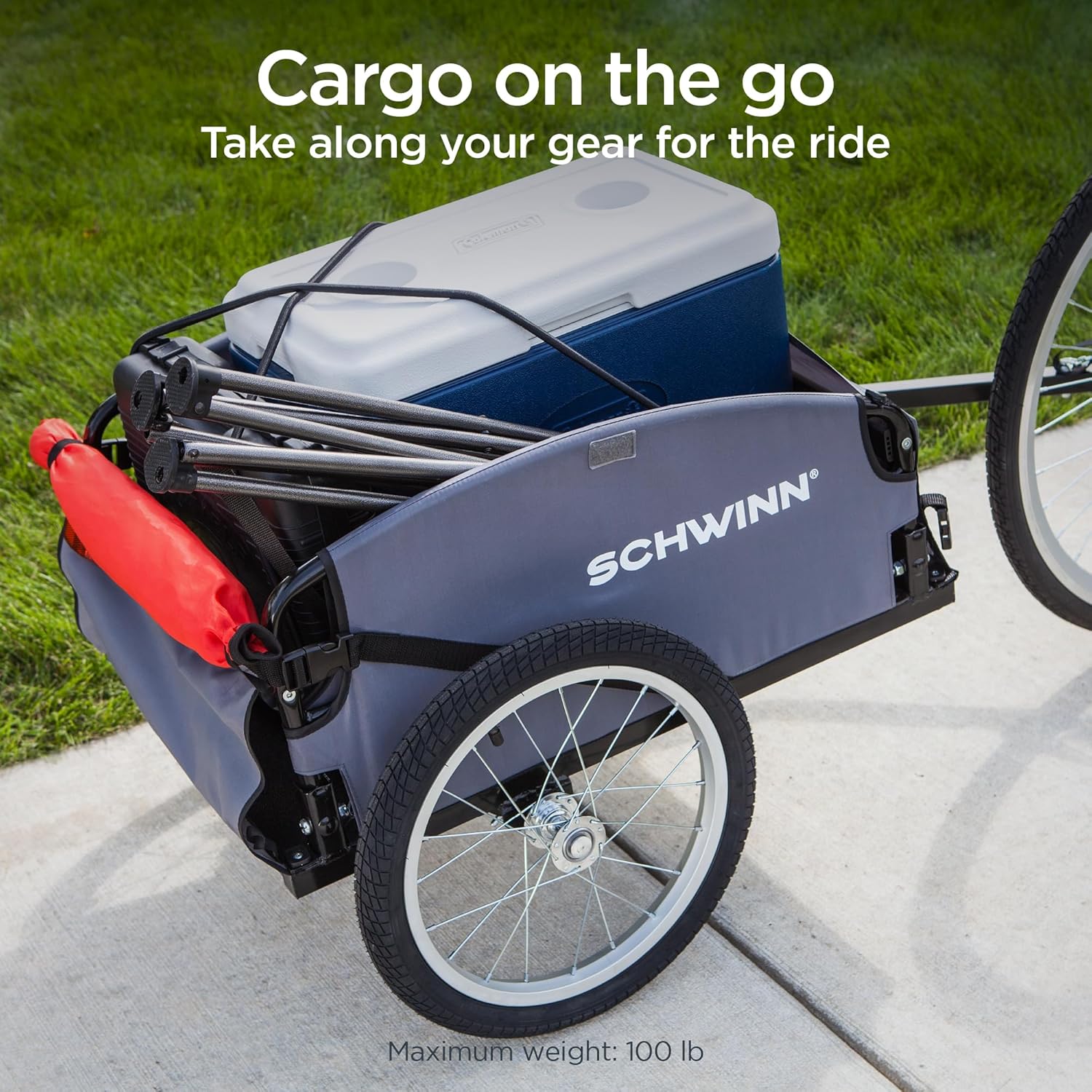
A cargo bike trailer — a two-wheeled, towable box that attaches to the rear of your bicycle — can turn a routine grocery run into a car-free errand. You ride to the store, load the trailer instead of your panniers (saddlebags), and haul everything home. At the sub-$200 price point, these trailers are primarily single-purpose utility haulers: fabric or plastic-box bodies, folding frames, and a hitch (the mechanical connector) that clamps to your rear wheel axle. They are not child-carrying trailers, and they are not the same category as a $3,500 Tern GSD cargo bike — but for shoppers who already own a bike and want to stop making two grocery trips or borrowing a car, they solve a real problem at an accessible price. This guide synthesizes owner reviews, published manufacturer specifications, and known quality patterns to help you pick the right one — or know when to walk away from a particular model.
| EDITOR'S PICKSchwinn Daytripper Bike Cargo T… | Mid-tierRetrospec Rover Hauler Bike Car… | Budget pickAosom Bicycle Cargo Trailer wit… | |
|---|---|---|---|
| Capacity | 100 lb | 80lb | — |
| Wheel size | 16-Inch | — | 16in |
| Foldable | ✓ | ✓ | — |
| Universal | ✓ | ✓ | — |
| Fabric | — | Weather-Resistant | — |
| Cover | — | — | Waterproof |
| Price | $179.99 | $159.99 | $104.99 |
| See on Amazon → | See on Amazon → | See on Amazon → |
The Convertible Design: Why It Changes the Whole Use Case
The biggest innovation in this price bracket is the convertible cargo trailer — a design where the cargo box detaches from the trailer frame and converts into a rolling shopping cart with its own set of wheels. Aosom owners have provided some of the clearest real-world documentation of this workflow: one frequently cited review describes riding to the grocery store, unhooking the cart body at the bike rack, rolling the cart through the aisles just like a store cart, loading it, then reattaching it to the trailer frame for the ride home. That’s the pitch in its most honest form, and it genuinely works.
A few practical caveats worth naming before you commit to this design:
The cart is a grocery-store cart, not a Costco flatbed. The detachable box on most convertible trailers in this range runs roughly 16–18 inches wide and 20–22 inches long. Standard grocery store aisles accommodate it, and reviewers consistently report that it fits through checkout lanes without drama. The limiting factor is the cart’s height — most are deeper than they are wide, which makes loading heavy items awkward compared to a wide, shallow basket.
The hitch connection point matters at re-attachment. If you’re detaching and reattaching the box in a store parking lot with one hand on your bike, the latch design matters more than it looks on a product photo. Aosom’s latch mechanism gets reasonable marks in owner reviews for one-handed use. This is the kind of detail you’ll want to search specifically in aggregated owner feedback before buying.
Xspec’s convertible design earns similar praise, but owners introduce an important caveat: the trailer works well after an initial break-in period, and fit tolerances can be tight out of the box. One owner’s honest account — widely repeated in reviews — documents using a Dremel rotary tool to widen the hitch receiver slot to fit their e-bike’s slightly non-standard axle mount. That’s not catastrophic, but it’s a real modification story, not a fringe edge case. If you’re riding a mainstream e-bike with a standard quick-release rear dropout, you’re likely fine. If you’re on a thru-axle setup (more on that below), test the hitch compatibility before assuming it works.
Brand-by-Brand Patterns: What Owners Are Actually Reporting
This section is not a lab test. It’s a pattern synthesis from aggregated owner reviews, cross-referenced against published manufacturer specs. Take it as directional intelligence, not certification.
Aosom sits at the center of the convertible-cart category, and its owner base is large enough to surface consistent feedback. The detachable cart workflow is genuinely functional. Frame durability over multi-year use is the open question — the steel frames are lighter-gauge than premium brands, which is how they hit this price point.
Xspec owners confirm the convertible concept works, and the design quality is comparable to Aosom. The Dremel modification story is the single most important piece of owner intelligence in this category. It means the hitch fit is tight enough that non-standard dropout geometries — common on purpose-built e-bikes — may require adaptation. This is not a dealbreaker, but it should be a verification step, not an assumption.
PEXMOR owners document a specific and repeatable quality-control issue: missing hardware at unboxing, requiring a trip to a hardware store before first use. People for Bikes’ urban cycling infrastructure reporting underscores how first-ride experiences shape long-term behavior adoption — a trailer that requires a hardware run before it can be assembled represents a real friction point, not just a minor inconvenience. Treat the PEXMOR missing-hardware pattern as a known QC risk for this brand, budget an extra 30 minutes for inventory-checking your hardware bag on arrival, and keep a receipt.
At least one creative PEXMOR buyer noted in their review that the plastic cargo box felt flimsy enough that they planned a plywood-lined interior upgrade before the first use. That’s honest owner signal: the plastic body works, but it’s not rigid under lateral load. If you’re hauling glass bottles or stacking boxes, a plywood liner or internal dividers are worth planning for.
VEVOR produces the most specific and consistent praise for towing dynamics in this price tier. Owners describe the trailer in unusually concrete terms: “doesn’t bounce,” “no sway,” “quiet on pavement.” That level of specificity in unprompted reviews — across multiple purchase dates — suggests the VEVOR frame geometry and wheel tracking are genuinely tuned better than the price implies. BikeRadar’s cargo trailer buying guide identifies frame geometry as the primary variable in towing stability, which aligns with what VEVOR owners are reporting. For urban commuters who will be hauling on mixed surfaces, this stability advantage is meaningful.
Ktaxon assembly gets consistent praise — reviewers describe clear instructions and a straightforward build process. The honest flag here is thin long-term data: Ktaxon is a newer entrant in this category with a shorter owner review timeline. Assembly quality at day one is well-documented; durability at month 18 is not. If you need a trailer this season and plan to evaluate longevity yourself, Ktaxon is a reasonable bet. If you need documented multi-year durability before committing, wait for the data to accumulate.
By the Numbers: Sub-$200 Cargo Trailer Specs at a Glance
| Model | Rated Capacity | Typical Street Price | Convertible Cart | Notable Owner Flag |
|---|---|---|---|---|
| Aosom (convertible) | 80–100 lbs rated | $120–$160 | Yes | Cart-in-store workflow confirmed |
| Xspec (convertible) | 80 lbs rated | $130–$160 | Yes | Hitch mod needed for some e-bikes |
| PEXMOR | 100 lbs rated | $100–$140 | Some models | Missing hardware at unboxing (known) |
| VEVOR | 100 lbs rated | $140–$180 | No | Best towing stability reports in tier |
| Ktaxon | 80 lbs rated | $110–$150 | Some models | Assembly praised; long-term data thin |
Prices reflect U.S. market conditions as of mid-2026. Rated capacities are manufacturer-published figures.
Frequently Asked Questions
Will a cargo trailer attach to an e-bike with a thru-axle or non-standard rear dropout?
This is the most underreported compatibility problem in this category. Most sub-$200 trailers are designed for traditional quick-release axles — the kind with a skewer that protrudes slightly on each side. Thru-axles, which are common on mid-drive e-bikes and performance-oriented cargo bikes, use a different diameter bolt that passes completely through the hub. The hitch receivers on trailers like Xspec and Aosom are typically sized for 9–10mm quick-release protrusions. A thru-axle adapter may bridge the gap, but owner accounts — including the Dremel story — confirm this is not automatic. Electric Bike Review’s cargo accessory compatibility guide recommends measuring your axle end-cap diameter before purchasing any trailer hitch-dependent accessory. If your e-bike uses a thru-axle, contact the trailer manufacturer for explicit compatibility confirmation before ordering.
Can I fit a week’s worth of groceries in a sub-$150 trailer?
Realistically, no — not for a household of more than two people. A typical sub-$150 trailer in this category offers roughly 10–14 cubic feet of interior volume, which accommodates a moderate single shopping trip: think four to six reusable bags of groceries. The rated weight capacity (80–100 lbs) is not the binding constraint; volume is. A week of groceries for a family of three would require multiple trips or a larger trailer. For a solo urban commuter or a couple supplementing (not replacing) other grocery strategies, the volume fits the use case reasonably well.
Is the detachable box on convertible trailers actually useful inside a store?
Owner accounts say yes, with one condition: the cart needs to roll smoothly on whatever floor surface your store uses. Most accounts describe standard grocery store tile as fine. Warehouse-style floors with expansion joints or outdoor market surfaces are more variable. The cart’s wheel diameter — typically 4–6 inches on detachable-cart designs — determines how it handles floor irregularities. Larger wheels roll over gaps; small casters catch them. Check the spec sheet for wheel size on the detachable cart portion, not just the trailer wheels.
What is the real usable capacity of a trailer rated at 80 or 100 lbs?
Owner pattern across this category suggests treating the rated capacity as a structural maximum, not a practical target. Loading a trailer to its rated weight on a bicycle creates a heavy tail that affects braking distance and low-speed handling. Most experienced owners report hauling 40–60 lbs as their practical comfort ceiling for regular riding — enough for a meaningful grocery run, less than the rated spec. Bicycling.com’s bike trailer coverage consistently notes that weight distribution within the trailer (keeping heavy items low and centered) matters as much as total weight for ride feel.
Do air-filled trailer tires require a separate pump or adapter?
Yes, and this catches buyers off-guard more than it should. Most sub-$200 cargo trailers use pneumatic tires (air-filled, like a bicycle tire) with Schrader valves — the same type used on car tires and many bike tires. If your bike pump has a Schrader adapter (most floor pumps do), you’re covered. If you only own a Presta-only pump (common on road bikes), you’ll need an adapter. Check your pump before the trailer arrives. Some trailers in this tier ship with foam-filled or solid rubber tires that require no inflation; check the product listing specifically.
How do I keep trailer contents dry in rain without a dedicated cover?
Most sub-$200 trailers ship with either a fabric cover or a basic plastic box body — neither is reliably waterproof for sustained rain. The practical solutions owners use: a fitted polyethylene tarp cut to box dimensions, a bungee-secured contractor bag as a liner, or a purpose-cut foam camping pad inside the box to cushion and a trash compactor bag over the load. Purpose-built waterproof trailer covers exist as aftermarket accessories; sizing varies by trailer brand, so measure your box dimensions before ordering. If you ride in a frequently rainy climate, the VEVOR’s more rigid box construction is slightly more amenable to cover-fitting than the softer-sided Aosom designs.
The Decision Rule
If your primary use is the in-store cart workflow and you’re on a standard quick-release bike: Aosom’s convertible design is the most documented option for this specific use case, with the deepest owner review base confirming the detach-roll-reattach workflow.
If towing stability on imperfect pavement is your top priority and you don’t need the detachable cart: VEVOR’s owner accounts are unusually specific about smooth towing, and that consistency across reviewers is meaningful signal for a trailer in this price bracket.
If you’re on an e-bike with a non-standard dropout or thru-axle: verify axle compatibility before purchasing any trailer in this tier — don’t assume the hitch will fit. The Xspec Dremel story is a real-world warning, not an anomaly.
If you’re considering PEXMOR: check your hardware bag completely before throwing away the packaging, and plan for a possible hardware store run. The product works; the QC process introduces a first-use friction risk that’s worth anticipating rather than discovering at 7pm when the store is closed.
If Ktaxon appeals on price and assembly reviews: it’s a reasonable current-season bet, with the honest caveat that long-term durability data is still accumulating. Buy with a clear return window and inspect hardware on assembly day.