August 17, 2026 • Neil Hayes • 10 min reading time • Prices verified June 25, 2026
Heavy E-Bike Hitch Racks with Ramps: What 200-lb Capacity Really Means on the Road
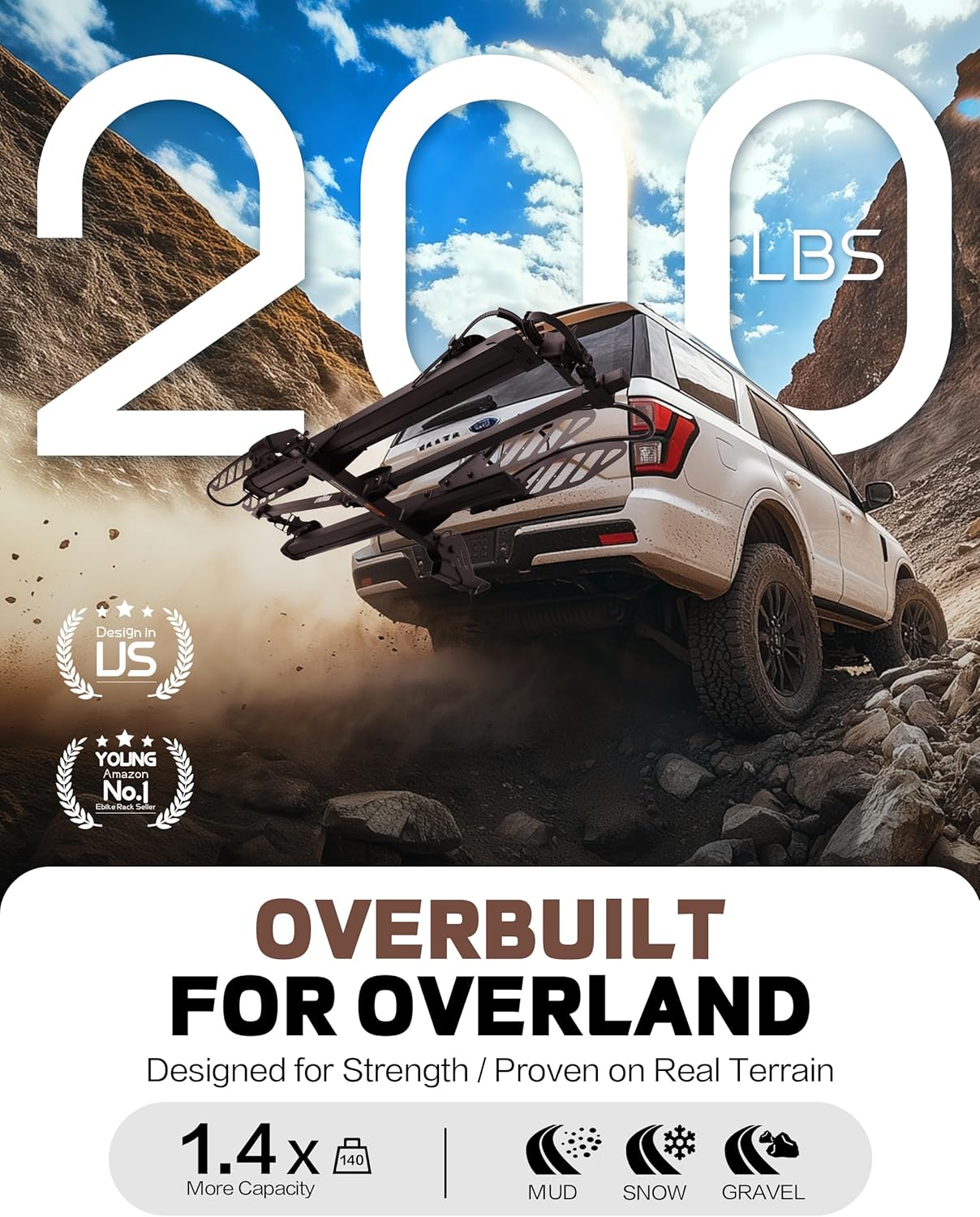
Electric bikes (e-bikes — bicycles with a built-in battery and motor) are heavier than they look. A mid-range electric cargo bike can easily tip the scales at 65–80 lbs on its own, and some long-tail models used for grocery runs or child transport push past 100 lbs. That creates a real problem when you want to take your e-bike somewhere by car: most traditional hitch bike racks (the platforms that bolt to the tow receiver on the back of your vehicle) were designed for 30–40 lb road bikes, not machines that weigh as much as a large dog or a small motorcycle engine. A new category of heavy-duty hitch racks has emerged to fill that gap, nearly all of them rated for 200 lbs of total platform capacity and equipped with loading ramps — folding or sliding channels that let you roll a heavy bike up to the rack instead of hoisting it. This article breaks down what that 200-lb rating actually means in practice, flags the purchasing traps that catch buyers by surprise, and compares the leading options based on published specifications and documented owner experience.
What “200-lb Capacity” Actually Covers — and What It Doesn’t
The 200-lb figure printed on a rack’s spec sheet refers to the total static load the platform is rated to hold — not the tongue weight your hitch receiver needs to support, not the dynamic load during highway driving, and not the weight of the rack itself subtracted from the vehicle’s hitch rating.
Here’s why each of those distinctions matters:
Static vs. dynamic load. A rack may hold 200 lbs sitting in your driveway and still experience stress concentrations during braking, acceleration, or highway crosswinds that exceed what the spec was designed around. BikeRadar, in its 2024 hitch rack stability and highway-speed transport feature, notes that rear-platform racks carrying heavy loads oscillate noticeably at speeds above 60 mph without secondary stabilization — a real consideration for anyone transporting two 70-lb e-bikes on an interstate run.
Rack self-weight eats into your vehicle’s tongue weight budget. Tongue weight (TW) is the downward force that a loaded hitch receiver can handle, rated by your vehicle manufacturer. Most 200-lb-capacity e-bike racks weigh between 45 and 65 lbs themselves. Add two 75-lb bikes and you’re pushing 200 lbs of tongue weight before a single accessory bag goes on. PeopleForBikes, in its 2024 e-bike weight and infrastructure survey, reports that the average class-1 and class-2 e-bike weighs 58–72 lbs — meaning a two-bike load on a heavy rack routinely approaches the tongue weight limit of a standard Class III hitch (2-inch receiver, typically rated 350–500 lbs tongue weight on SUVs and minivans, but as low as 200 lbs on smaller crossovers).
By the numbers — a realistic two-bike scenario:
| Item | Weight |
|---|---|
| Rack (typical heavy-duty ramp rack) | 52 lbs |
| E-bike #1 (mid-drive commuter) | 68 lbs |
| E-bike #2 (cargo longtail) | 82 lbs |
| Total tongue weight demand | 202 lbs |
Check your owner’s manual tongue weight limit before you buy anything. This is the single most common mistake documented in ElectricBikeReview.com forum threads on hitch rack compatibility (2024–2025).
The Ramp Design Rabbit Hole: What Owner Data Actually Shows
Ramps sound like a straightforward convenience feature. In practice, they’re where most of the meaningful variation between racks lives — and where buyers with specific needs get burned by marketing that smooths over engineering tradeoffs. The four products below represent the primary options owners are choosing between in this category, organized from premium long-distance use cases down to budget-constrained buyers.
CRAVAT CyberRack
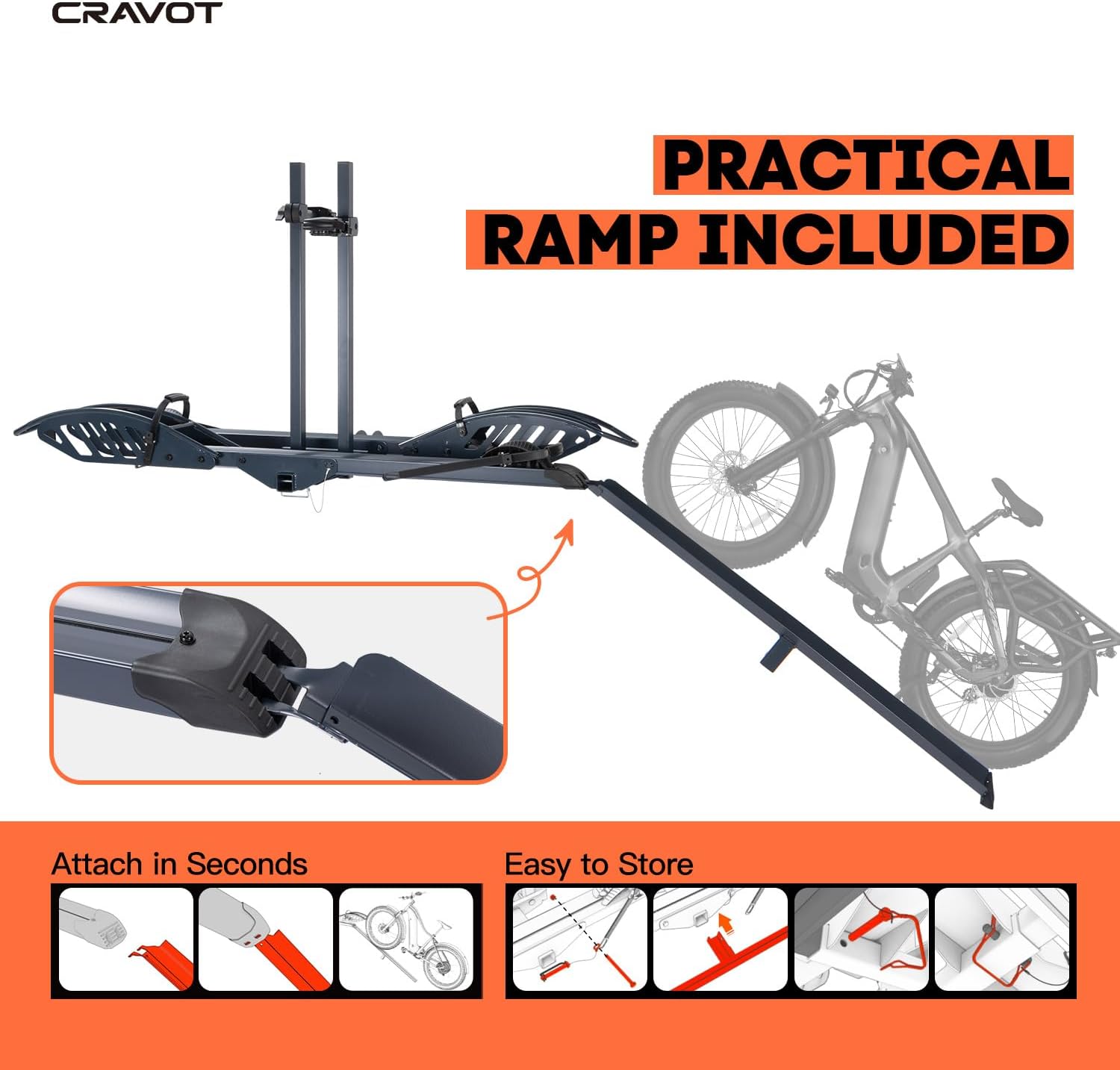
Among racks with detailed long-term owner documentation, the CRAVAT CyberRack has accumulated some of the most useful field accounts. One owner logged a 400-mile round trip with two loaded e-bikes and reported zero rattle, no rack movement, and both bikes arriving in the same position they were loaded in — a strong signal that the platform’s anti-wobble design works as claimed under sustained highway use. A second owner, a 70-year-old rider who specifically called out the ramp loading system as a genuine quality-of-life improvement for solo riders, flagged a different issue: the rack itself is heavy enough that mounting it to the hitch receiver is a two-person job. That’s not a deal-breaker, but it’s a real-world constraint that solo riders should factor into their routine. If you load bikes at home with a helper and park at a trailhead, the solo-mounting challenge mostly disappears. If you’re routinely swapping the rack in and out of a vehicle alone, it’s worth pausing on.
Young
$299.99
In stock on Amazon
Check price on AmazonYoung Electric Rack
Reviewers of the Young Electric rack are broadly positive — the platform is stable, the ramp deployment is straightforward, and it handles fat-tire e-bikes without the clearance issues that dog narrower racks. The consistent complaint across aggregated reviews, though, is the absence of any integrated ramp storage solution. When the ramp isn’t in use, there’s nowhere purpose-built to put it. Owners are improvising with bungee cords, cargo nets, and zip ties — workable, but a notable oversight on a rack positioned at the premium end of the category. Bicycling.com’s 2025 buyer guide, “Best Bike Racks for Cars,” consistently flags integrated storage as a differentiating feature worth paying for in heavy-duty platforms. The Young Electric rack is a strong platform for fat-tire applications; buyers simply need to accept that the ramp-storage gap is a DIY problem they’ll inherit.
CRAVOT
$254.15
In stock on Amazon
Check price on AmazonWildroad Hybrid Carrier
The Wildroad hybrid carrier earns genuine praise from family travelers who need to move both cargo and bikes. The distinction that gets missed in listing language — and that owners are explicit about in reviews — is that the rack cannot carry cargo and bikes simultaneously. It’s a convertible design, not a dual-purpose one. You set it up for one use or the other before you leave. This sounds obvious when stated plainly, but the listing language on several retail pages implies simultaneous use, and multiple buyers have flagged receiving the product expecting otherwise. If your use case genuinely requires hauling cargo and bikes in the same trip, this rack doesn’t solve it. If you want a single platform that handles both needs across different trips, it earns its price.
CRAVOT
$254.15
In stock on Amazon
Check price on AmazonTrailV2 Plus
The TrailV2 Plus delivers a compelling spec-to-price ratio and owners generally report solid highway performance. The caveat: at least one documented reviewer received the rack with missing hardware and undrilled mounting holes on arrival — a quality-control miss that required contacting the manufacturer before first use. That’s not a systemic indictment of the product, but it does mean buyers should open the box and inventory all components before the delivery window closes and before installation day arrives. Build quality on e-bike accessories in this price tier varies by production batch; this one has enough positive long-run reviews to remain a reasonable pick, but the out-of-box inspection step matters more here than with the premium options.
Wildroad
$246.49
In stock on Amazon
Check price on AmazonThe Tilt-With-Bikes-Loaded Expectation: A Purchasing Trap
This one deserves its own section because it shows up repeatedly in negative reviews and is directly traceable to listing language, not product failure.
Many heavy-duty hitch racks are marketed with a “tilt-away” or “fold-down” feature that lets you access your vehicle’s trunk or hatchback without removing bikes. What the listings frequently understate or omit is the weight threshold at which that tilt feature is functional. Designed for standard bikes, the tilt mechanism works fine. Loaded with two 70-lb e-bikes — 140 lbs of payload before the rack’s own weight — the physics change dramatically. Most tilt mechanisms on 200-lb-capacity racks require unloading the bikes first, or at minimum dropping to a single-bike load, before the tilt is manageable without risking the rack, the bikes, or the person operating it.
BikeRadar’s 2024 hitch rack stability and highway-speed transport feature specifically notes that rear-access tilt features on heavy-duty platforms should be treated as “bikes-off convenience features, not bikes-on access features.” The FAQ answer is simple: assume you cannot access your trunk with e-bikes loaded unless the manufacturer explicitly specs the tilt as rated for full payload, confirmed in a source outside the marketing copy.
Frequently Asked Questions
Can I open my trunk or hatchback with e-bikes loaded on a hitch rack? Almost certainly not with a full two-e-bike load. The tilt-away feature most racks advertise is functional at low bike weights. With two e-bikes totaling 120–160 lbs, the mechanism either won’t move or risks damaging the hinge under the torque. Treat trunk access as requiring bike removal and you’ll never be caught off-guard.
How heavy is a typical 200-lb-capacity e-bike rack itself, and can one person mount it? Most heavy-duty ramp racks in this category weigh between 45 and 65 lbs. Mounting to a 2-inch hitch receiver requires lifting the receiver bar and aligning the pin — manageable for many adults, but genuinely difficult solo at the heavier end of that range. The experience documented by the 70-year-old CRAVAT CyberRack owner is representative: the loading ramp helps enormously with the bikes, but the rack-mounting step is where solo operation breaks down. A second person for that step is worth planning for.
Do ramp racks work with fat-tire e-bikes up to 5 inches wide? Most racks in this category accommodate tires up to 4 inches wide with standard cradles. Fat-tire compatibility to 5 inches typically requires either a rack specifically rated for it (check the manufacturer’s published tire-width spec) or an optional wide-cradle accessory. The Young Electric rack receives consistent positive notes for fat-tire clearance in owner reviews; confirm published specs before purchasing for a 5-inch tire application.
Will my bike stay stable at highway speeds without adding extra straps? The integrated strapping systems on quality racks in this category are designed to hold at highway speed — but “designed to” and “will in every configuration” are different claims. BikeRadar’s 2024 hitch rack stability feature recommends adding at least one secondary strap at the frame for any load exceeding 60 lbs per bike, regardless of what the rack’s integrated arms claim. It’s a five-second addition and meaningful insurance.
What tongue weight do I need for a two-e-bike rack on a 2-inch receiver? Budget for at least 300 lbs of rated tongue weight to carry two mid-weight e-bikes safely, accounting for the rack’s self-weight. Many compact crossovers and smaller SUVs are rated at only 200–250 lbs tongue weight — meaning a two-e-bike setup exceeds their hitch capacity. Confirm your vehicle’s tongue weight rating in the owner’s manual, not just the trailer tow rating (those are different numbers).
Is a bolt-on hitch pin worth adding if my rack doesn’t include one? Yes, consistently, without reservation. A standard hitch pin uses a basic cotter clip that can work loose over time and road vibration — a real concern with heavy dynamic loads. A bolt-on anti-theft hitch pin (threaded receiver pin with a nut, often locking) eliminates rack wobble from pin slop and prevents casual theft of the rack itself. ElectricBikeReview.com forum threads on hitch rack compatibility (2024–2025) repeatedly surface this as a sub-$20 upgrade that owners wish had come standard.
The decision frame: If you’re transporting two e-bikes over long distances and need reliability data from real owners rather than manufacturer claims, the CRAVAT CyberRack earns the most documented field confidence for sustained highway use. If fat-tire clearance is your priority and you can solve the ramp-storage gap with a bungee cord, the Young Electric rack is a strong mid-tier platform. If you need cargo-or-bikes flexibility across different trips — not simultaneously — the Wildroad hybrid carrier fits that specific use case well. And if budget is the primary constraint, the TrailV2 Plus delivers, but open the box carefully before your installation day.