August 10, 2026 • Neil Hayes • 11 min reading time • Prices verified June 25, 2026
The E-Bike Hitch Rack Weight Problem: What 200 and 300 Pound Capacity Costs You
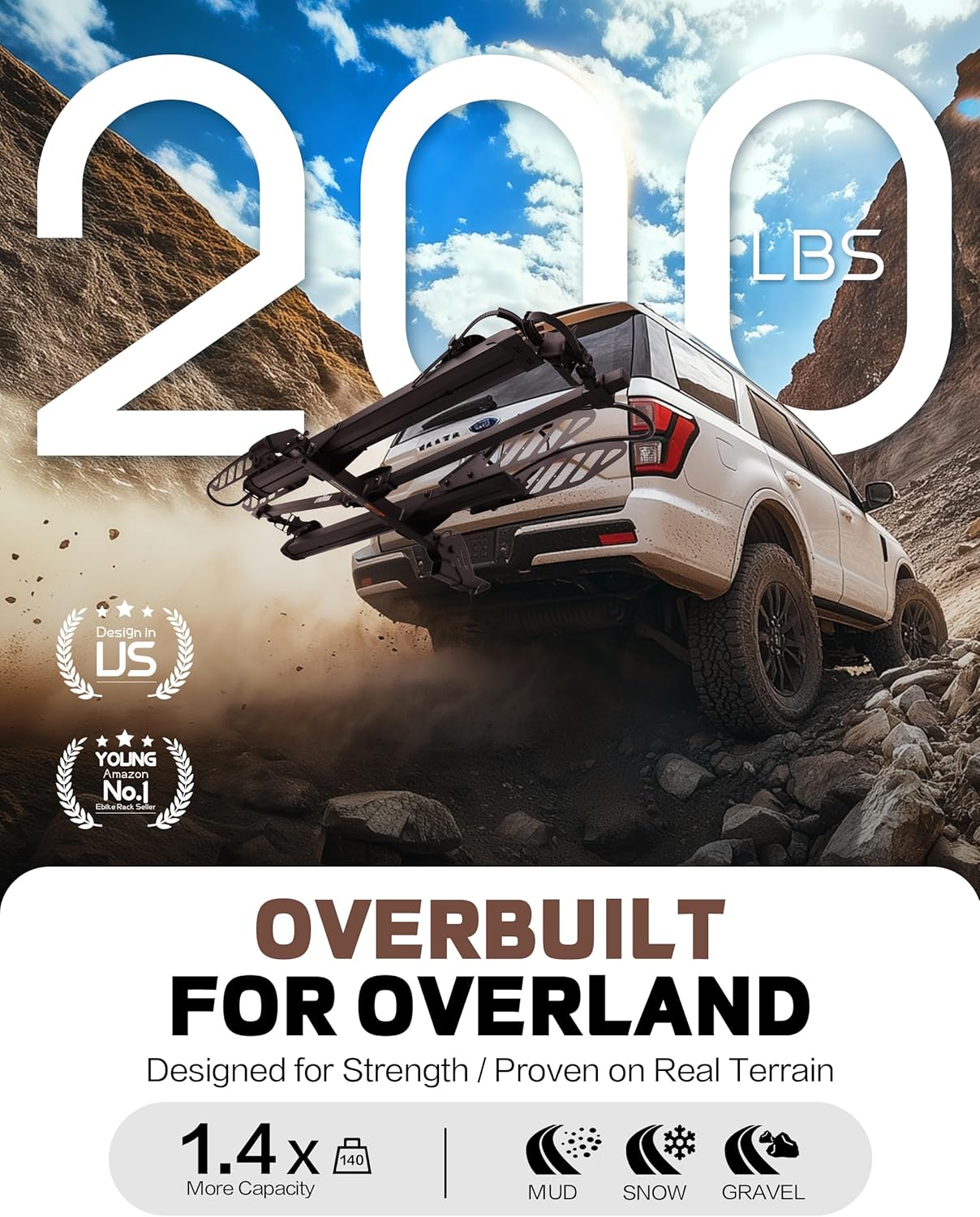
A hitch rack is the metal platform bolted into the tow hitch receiver — the square metal socket under your bumper — that carries bikes on the back of your vehicle. For a standard bicycle weighing 20–28 pounds, almost any rack works. But modern electric cargo bikes and electric-assist commuter bikes routinely weigh 55–90 pounds, and that changes the math on almost every rack decision: which capacity rating you need, whether the rack can still tilt down to let you open your trunk or hatch, whether a loading ramp is genuinely useful or just marketing copy, and whether one adult can realistically mount and use the whole system without a second set of hands. This article works through all of it — rack weight ratings, the tilt-with-load problem, and the real-world quality issues that show up across the CRAVOT, Young Electric, TrailV2 Plus, and Wildroad lines — so you can make a clear decision before you buy.
Why E-Bike Weight Breaks the Old Rack Playbook
The numbers from PeopleForBikes.org’s 2025 E-Bike Market Data Report make the problem concrete: average e-bike weight across all categories has climbed steadily, with cargo e-bikes — the Tern GSD, RadWagon 4, and their peers — routinely landing between 65 and 90 pounds. Two of those bikes on a standard 2-bike rack means you’re asking the system to handle 130–180 pounds of bike, plus the rack’s own dead weight, all cantilevered off your hitch receiver.
Traditional bike racks — designed for 25-pound road bikes — are typically rated at 35 pounds per bike, or 70 pounds total. Bicycling.com’s review of the best hitch bike racks noted that most budget and mid-range racks simply aren’t engineered for e-bike loads, and that buyers routinely discover this mismatch only after a rack wobbles on the highway or fails at the mounting point.
The practical decision tree for e-bike owners comes down to three capacity tiers:
- Sub-100 lb total: Designed for conventional bikes; avoid for e-bikes
- 100–150 lb total: Adequate for one lighter e-bike; marginal for two
- 200–300 lb total: The relevant range for e-bike owners; tilt and mounting complexity rise sharply
The 200-pound and 300-pound capacity racks are the ones e-bike owners actually need to evaluate — and they’re where the interesting tradeoffs live.
The Tilt-With-Load Problem: What Listings Don’t Always Tell You
Here is the most practically important and underreported issue in this category: many high-capacity racks advertise a tilt-down feature but cannot tilt when loaded bikes are on them.
A tilt-down rack is designed so that after you load your bikes, you can tip the whole rack platform downward — rotating it away from the vehicle — to access your trunk or rear hatch. For SUV and hatchback owners, this is essential. Without it, loaded bikes block the entire rear opening.
Owners of the Young Electric 200-pound-capacity rack have flagged this discrepancy in aggregated reviews: the rack does not tilt with bikes loaded, despite product listing language that implies otherwise. This is not a minor inconvenience. If you own an SUV or hatchback and park somewhere that you’ll need to access your cargo hold — a trailhead, a grocery run midway through a trip, any situation where the rear opening matters — a rack that won’t tilt under load effectively locks you out of your own vehicle’s storage.
BikeRadar’s guide to heavy e-bike transport addresses this directly, noting that the hinge mechanism and locking pin design determine whether a rack can support lateral load during tilt. At 200-plus pounds of combined bike weight, the torque on that hinge is substantial. Many rack manufacturers either limit or prohibit tilt-under-load for liability and structural reasons — but don’t always communicate this clearly at the point of sale.
What to ask before you buy: Request the manufacturer’s written specification on whether the tilt function is rated for use with loaded bikes. If the answer isn’t in the spec sheet, treat the tilt feature as non-functional for your use case.
ElectricBikeReview.com’s transport coverage reinforces this point: the gap between marketing language and engineering spec is widest on tilt functionality, and it’s the feature buyers most regret not verifying in writing before purchase.
Four Racks Compared: CRAVOT, Young Electric, TrailV2 Plus, and Wildroad
The comparison below covers the four hitch rack lines most frequently evaluated by e-bike owners in the 200–300 pound capacity tier. Each section closes with a tier marker reflecting where the product sits in the market.
CRAVOT
Across aggregated owner reviews, the CRAVOT line generates consistent praise for one specific thing: stability over distance. Owners independently report completing 400-mile round trips and multi-day drives without wobble, rack loosening, or hitch slap — the rattling back-and-forth motion that plagues lighter-duty racks at highway speeds. The bolt-on hitch pin design, rather than a simple pin-and-clip, gets credited for this behavior in owner accounts.
The tradeoff is rack weight itself. One 70-year-old CRAVOT owner gave the rack five stars for performance while simultaneously describing it as “almost too much to carry and mount solo.” That tension — high confidence in road performance, genuine physical difficulty in installation — runs through CRAVOT ownership accounts as a consistent theme. Published specs for high-capacity hitch racks in this segment run 45–65 pounds for the rack hardware alone. That’s a meaningful lifting task before you’ve moved a single bike.
If you’re physically managing the rack alone regularly, build the weight spec into your evaluation before buying. The CRAVOT rewards users who can manage the installation — and punishes those who underestimate it.
Young
$299.99
In stock on Amazon
Check price on AmazonYoung Electric
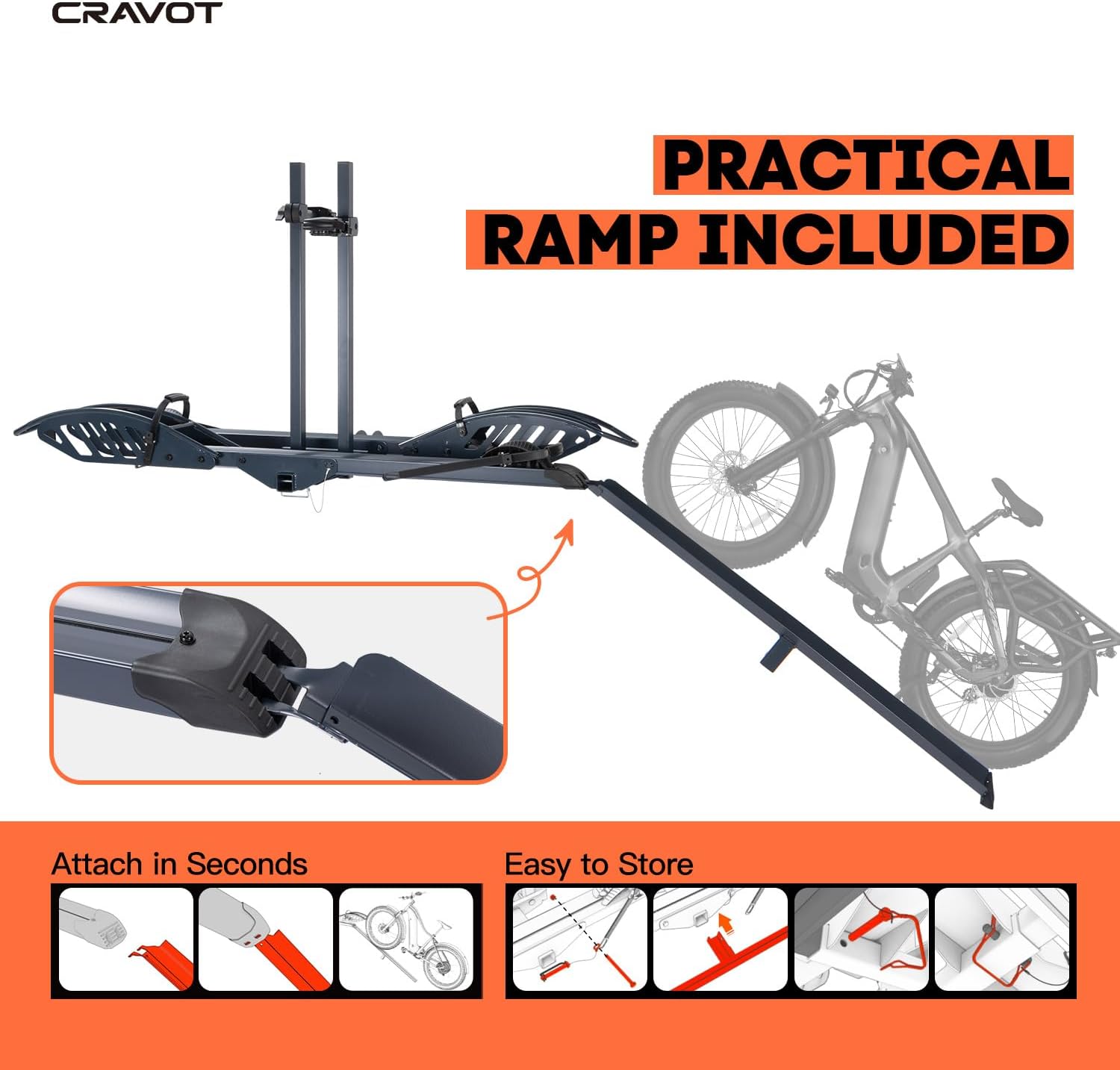
The Young Electric 200-pound-capacity rack offers a ramp-assisted loading system aimed at solving the heaviest part of the e-bike transport problem: getting the bike onto the rack without lifting it straight up. Owner sentiment around the ramp function is generally positive — rolling a 70-pound e-bike up a ramp is meaningfully easier than muscle-pressing it over a wheel tray.
The tilt-under-load issue described above is the significant warning flag for this line, and it is not a minor one for the hatchback and SUV market. Prospective buyers using those vehicle types should verify this spec directly with the manufacturer before purchase. The Young Electric lands in the mid-tier capacity range and is best suited for buyers with a single e-bike, a flat loading environment, and a vehicle with a trunk rather than a hatch.
CRAVOT
$254.15
In stock on Amazon
Check price on AmazonTrailV2 Plus
The TrailV2 Plus sits in an interesting position: good core structure, but owner reports flag a quality control inconsistency worth knowing about. Specifically, buyers have described receiving units with missing hardware and undrilled mounting holes for secondary lift components — meaning the rack arrives incomplete for its full feature set out of the box.
ElectricBikeReview.com’s notes on the e-bike accessory category observe that QC inconsistencies at this price point are not unusual, but they are particularly consequential for a product where every bolt matters for safety. If you buy the TrailV2 Plus, plan to do a full hardware audit on arrival and have a way to source replacement or missing hardware promptly if needed. The price point makes it appealing as a budget entry into the high-capacity segment, but the QC variability introduces real uncertainty.
Trailer
$19.99
In stock on Amazon
Check price on AmazonWildroad Hybrid
The Wildroad generates genuine enthusiasm in its niche: buyers who want a cargo-carrying platform for road trips or van-adjacent use, with occasional bike transport capability. Owner sentiment is warm on the concept, and the hybrid design is genuinely useful for a specific kind of buyer.
The functional constraint that owners confirm: the bike rack posts must be physically removed to use the cargo sides. The rack cannot simultaneously carry bikes and function as an open cargo platform. It is a sequential-use system, not a simultaneous-use system. For buyers who see that hybrid function as the primary reason to buy, this is the clarifying fact — you are choosing one mode at a time. BikeRadar’s framework for evaluating multi-use rack systems applies here: flexibility claims should always be stress-tested against the actual configuration steps required in the field.
CRAVOT
$254.15
In stock on Amazon
Check price on AmazonThe Ramp Question: Useful Tool or Checklist Item?
A loading ramp — a fold-out or slide-out incline that lets you wheel a heavy e-bike up onto the rack rather than lifting it — sounds like a straightforward win. In practice, owner experience is more nuanced.
Ramps work well when the surface is level and the ramp angle is shallow enough to manage the weight. At steeper angles — a function of rack height off the ground, which varies by vehicle — a 70-pound e-bike on a narrow ramp still requires meaningful control strength. You are guiding the bike, not just rolling it. Owners report that a ramp makes solo loading realistic for most adults, but not effortless, particularly with cargo bikes that have wide tires or awkward weight distribution.
Ramp storage is the other practical question: once the bikes are loaded, the ramp typically stores either folded under the rack platform or clipped to the side frame. Confirm this in the product specs before you assume the loaded configuration is clean and compact. A ramp that hangs below the rack and drags on parking lot inclines is a real failure mode, not a hypothetical one.
Matching Rack Capacity to Your Actual Bikes
Manufacturer-published weight specs give you the baseline. A Tern GSD S10 is rated at approximately 77 pounds unloaded. A RadWagon 4 spec sheet puts it at 72 pounds. A Lectric XP Cargo comes in around 65 pounds. These are starting points — add accessories, cargo bags, or a child seat and you are higher.
For two e-bikes in the 65–80 pound range, a 200-pound total capacity rack is marginal. The math: 75 plus 75 equals 150 pounds of bike, leaving 50 pounds of margin. That is thin. A 300-pound-rated rack gives you 150 pounds of margin on the same two bikes — a meaningfully safer working range. The cost of the higher-capacity rack is real, but so is the cost of exceeding a weight rating on a loaded vehicle at 70 mph.
Bicycling.com’s rack testing framework treats the safety margin question as primary: the rated capacity is the ceiling, not the target. Buying a rack whose ceiling is also your floor is a bad engineering position to be in.
Frequently Asked Questions
Can I load a 75-pound e-bike onto a hitch rack by myself using the ramp? Based on owner accounts, solo loading with a ramp is achievable for most adults but requires physical effort and a level surface. A 75-pound bike will not roll itself — you are managing the balance and speed of the ascent. Owners consistently describe ramp-assisted loading as meaningfully easier than direct lifting, but not effortless.
Will the rack tilt with two e-bikes loaded so I can open my hatchback? This depends entirely on the rack model, and you must verify it per product. As documented in owner reviews of the Young Electric 200-pound rack, tilt-with-load functionality is not guaranteed even when the listing implies it. Ask specifically: “Is the tilt mechanism rated for use with fully loaded bikes?” before purchasing if this matters for your vehicle type.
Does the rack fit fat tires up to 5 inches wide? Fat-tire compatibility varies by rack. The relevant spec is the wheel tray or cradle width. Many racks in the 200–300 pound capacity range are designed with e-bikes in mind and accommodate 4–5 inch tires, but verify the published spec on the specific model — do not assume.
How heavy is the rack itself, and can one person mount it on the hitch? High-capacity racks in this segment typically weigh 45–65 pounds. Solo mounting is possible but physically demanding, particularly for users at the lower end of strength or with back limitations. The CRAVOT owner feedback on this point is worth taking seriously.
Is a 2-inch hitch receiver required, or will a 1.25-inch work? All high-capacity e-bike racks in the 200–300 pound range require a 2-inch receiver. A 1.25-inch receiver — common on smaller crossovers and some sedans — is not rated for this load and is structurally incompatible with the larger shank these racks use. Verify your vehicle’s receiver size before purchasing.
The decision rule: If you are carrying one e-bike under 65 pounds and drive an SUV where hatch access matters, a 200-pound rack with confirmed tilt-under-load functionality is your target. If you are carrying two e-bikes, or any bike over 65 pounds, or you drive a hatchback and need the tilt to work every time, a 300-pound-rated rack is the right capacity floor — and the tilt-under-load spec is the first thing to verify in writing before you buy.