July 30, 2026 • Neil Hayes • 10 min reading time • Prices verified June 25, 2026
The Real-World Folding Fat-Tire E-Bike Review: Assembly Struggles, Weight Surprises, and Who Should Buy One
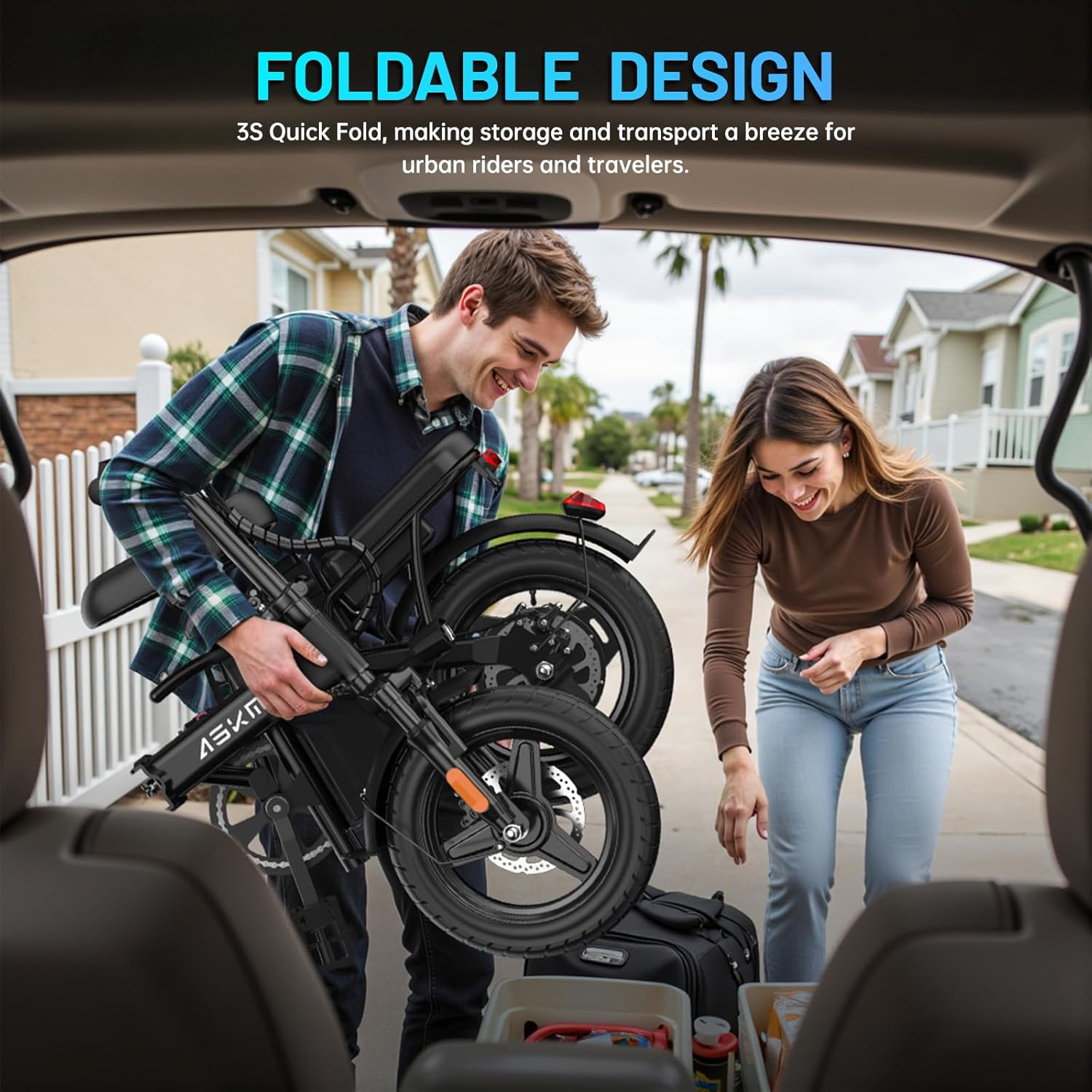
A folding fat-tire e-bike combines three ideas into one machine: an electric motor (so you pedal less when you want to), oversized “fat” tires (typically 3.5–4 inches wide versus a standard 1.75-inch tire, for cushion and traction on rough surfaces), and a frame that hinges in the middle so the whole thing compresses for storage or car-trunk transport. For a first-time buyer, the appeal is obvious — big-ride capability without needing a dedicated garage spot. But the category also attracts some of the most enthusiastically mixed owner reviews you’ll find in the e-bike world. People love how these bikes feel. They are frequently surprised by how heavy they are and how long they take to assemble. This article synthesizes what owners of ESKUTE, EUY, and EUYBIKE models consistently report — the genuine highs and the genuine friction points — so you can decide whether this form factor is the right match for your situation before you spend $600–$1,200 on one.
What Owners Actually Experience: The Consistent Duality
The single clearest pattern across aggregated owner reviews on Electric Bike Review’s folding e-bike category and elsewhere is what one ESKUTE owner described almost word-for-word as a two-column list: fun, easy to ride, powerful, and fits in the trunk on one side; unclear instructions, very heavy, and confusing locking mechanism on the other — and then a recommendation to buy it anyway. That duality isn’t a fluke. It repeats across brands.
The Ride Quality: Genuinely Good News
On the positive side, the consensus is hard to dismiss. Owners consistently report:
- Motor punch that surprises them positively. Most models in this segment ship with 500W–750W hub motors. On flat pavement in pedal-assist mode (where the motor adds power as you pedal rather than replacing your effort entirely), owners describe the feeling as “effortless” and “addictive” in forum posts cited by Electric Bike Review’s aggregated summaries.
- Fat tires that genuinely smooth out rough pavement. BikeRadar’s buyer’s guide on folding electric bikes notes that 4-inch fat tires act as a passive suspension system on broken asphalt and gravel, which is one reason urban riders on older city streets consistently rate ride comfort higher than comparable bikes with narrower tires.
- Foldability that actually works for trunk storage. Multiple ESKUTE and EUY owners specifically call out fitting the folded bike into a sedan or SUV trunk as a use case that worked as advertised. This is not universal in the folding e-bike category — some “folding” bikes fold only in theory — so the positive pattern here is worth noting.
The Weight Problem: The Most Consistent Complaint Across Brands
Here is where the math matters. Bicycling.com’s fat-tire e-bike feature flags that fat-tire folding models carry a weight penalty from three compounding sources: the fat tire rims and rubber, the folding hinge hardware (which must be beefy to be safe), and the battery and motor assembly. The result is that most models in the ESKUTE/EUY/EUYBIKE segment weigh between 55 and 68 pounds (25–31 kg) fully assembled.
By the numbers:
- Typical folding fat-tire e-bike: 55–68 lbs
- Typical non-fat-tire folding e-bike: 40–50 lbs
- Weight a car trunk lift requires (solo): most adults manage 40–50 lbs comfortably; 65 lbs is a two-person or ramp job for most people
The pattern in owner reviews is not that the weight ruins the bike — it clearly doesn’t, since the same reviewers recommend it. The pattern is that the listed weight on product pages consistently understates what buyers perceive when they lift it. Outside Online’s budget e-bike guide from 2025 notes this is a category-wide issue: shipping weights include packaging, actual bike weights vary by configuration, and buyers often encounter a 3–5 lb discrepancy between spec-sheet numbers and what they feel. If you are buying one of these bikes specifically to haul it up stairs to a third-floor apartment, do the honest math on the heaviest plausible figure before ordering.
Assembly: Where the Experience Diverges Most Sharply
Assembly is where budget-tier folding fat-tire e-bikes earn their most pointed criticism — and it’s worth disaggregating the complaint into its component parts, because they have different solutions.
Instruction Quality
Across ESKUTE and EUYBIKE owner reviews aggregated on Electric Bike Review, the most common assembly complaint is not that the bikes are technically hard to assemble — most owners complete the job in 60–90 minutes — but that the included instructions are either translated poorly, missing steps, or illustrated at a level of detail that assumes mechanical familiarity most first-time owners don’t have. BikeRadar’s folding e-bike buyer’s guide recommends treating budget-brand assembly instructions as a starting checklist, not a complete guide, and supplementing with brand-specific YouTube walkthroughs before touching a wrench.
Tool Quality: A Specific and Distinct Problem
One complaint that gets lost inside the general “assembly was hard” sentiment is worth naming separately: the included tools are frequently inadequate for the hardware they’re meant to drive. One ESKUTE owner specifically documented that the hex keys (Allen wrenches) included in the box were soft enough to strip bolt heads on first use — a problem that goes beyond inconvenience. A stripped bolt on a handlebar stem or stem clamp is a safety issue, not just an annoyance.
The fix is simple and costs almost nothing: buy a $12–$20 set of quality hex keys (a T-handle set is ideal for the torque these fasteners need) before assembly day. Do not try to assemble these bikes with the included tools alone.
What You Actually Need Beyond the Box
A practical assembly toolkit for any folding fat-tire e-bike in this segment:
- T-handle hex key set (metric, 4mm–8mm covers most fasteners)
- Adjustable wrench or 15mm pedal wrench for pedal installation
- Torque wrench (optional but recommended for stem and seatpost clamp — typically 6–8 Nm)
- Floor pump with a Schrader valve gauge — fat tires need precise PSI (usually 5–15 PSI, not 60+ like road tires)
Customer Service: A Genuine Bright Spot
Consumer Reports’ 2025 electric bike reliability and owner satisfaction survey notes that small-brand e-bike customer service is one of the most variable factors in the ownership experience — and the pattern in EUY and ESKUTE reviews bucks the budget-brand stereotype in a meaningful way. EUY resolved a missing component issue through a few email exchanges without requiring a return. An EUYBIKE owner who received a visibly bent fork on delivery reported a replacement offer within an hour of contacting support. These are not universal experiences — every brand has negative service stories too — but the frequency of positive service mentions in this specific product segment is higher than you’d expect at this price point, and it’s worth factoring into purchase confidence.
The Puncture-Resistant Fat Tire Question
EUYBIKE owners raise a specific and legitimate concern: one owner reported a flat tire early in ownership on a tire marketed with puncture-resistant language. This is worth unpacking. “Puncture-resistant” in budget fat-tire marketing typically refers to a reinforced belt layer under the tread — it reduces puncture risk, it does not eliminate it. Bicycling.com’s fat-tire feature notes that at the 5–15 PSI pressures fat tires run, a sharp object still penetrates if it hits at the right angle. The tire is more resistant than a standard thin tire, but no budget fat tire in this segment is tubeless (where sealant self-repairs small punctures) unless explicitly stated and verified in specs.
If puncture resistance is critical for your use case (delivery routes, rough gravel), budget separately for a can of tube sealant or a tubeless conversion kit.
Who Should and Shouldn’t Buy a Folding Fat-Tire E-Bike
Buy one if:
- You live in an apartment or have no dedicated outdoor bike storage, and the folded dimensions (typically 40” × 27” × 28”) fit a closet, hallway, or building storage room
- Your rides are mostly flat to moderately hilly, under 20 miles per outing
- You want car-trunk portability for weekend trail access without a roof rack
- You’re comfortable doing a 60–90 minute assembly project with quality tools
Think carefully if:
- You need to carry it up more than one flight of stairs solo — 60+ lbs is a real physical challenge repeatedly
- You have a specific long-distance commute need (see the battery range FAQ below)
- You’re under 5’4” and considering a 20-inch wheel model (see FAQ)
Frequently Asked Questions
How far can I realistically ride on a 10Ah battery in pedal-assist mode? Most manufacturers rate 10Ah / 36V packs (360Wh) at 20–40 miles of range. That range is real — at the top end, in low assist on flat ground with a light rider. Electric Bike Review’s aggregated owner data consistently shows real-world range landing in the 18–28 mile band for mixed-terrain, moderate-assist riding by a 170–190 lb rider. Plan around 20 miles as your conservative working figure and treat anything above that as a bonus.
Can a folding fat-tire e-bike actually fit in an apartment without a dedicated storage space? Apartment Therapy’s small-space bike storage guide notes that folded dimensions matter more than wheel size for hallway or closet storage. Most folding fat-tire e-bikes collapse to roughly 40 inches long × 26–28 inches tall. That fits in a standard closet alongside other items if you can manage the weight to roll it in. A hallway wall hook is not realistic — these bikes are too heavy for standard wall mounts rated under 50 lbs.
Is a 14-inch or 20-inch wheel folding e-bike suitable for riders under 5’4”? BikeRadar’s folding e-bike buyer’s guide recommends 14-inch wheel models for riders under 5’2”, where standover height (the clearance between the top tube and your inseam) is the binding constraint. Most 20-inch folding fat-tire models have a minimum seat height that fits riders down to about 5’2”–5’3”, but the reach to the handlebars can feel stretched. If you’re in that height range, verify the minimum saddle height and handlebar reach in the spec sheet before ordering.
What tools do I actually need for assembly beyond what is included? See the assembly section above: T-handle hex keys, a pedal wrench, and a floor pump are the non-negotiables. The included tools in budget-brand kits are frequently too soft for the torque these fasteners need and risk stripping bolt heads.
Are fat tires on budget e-bikes truly puncture-resistant or just marketed that way? They are marketed accurately but commonly misunderstood. A puncture-resistant belt layer meaningfully reduces flat frequency — it does not eliminate it. At the low PSI fat tires run, the tire conforms around obstacles rather than pinch-flatting, which is one real advantage. But a sharp object at the right angle still penetrates. Budget a tube of sealant into your ownership plan.
What should I do if my e-bike arrives with a bent or damaged component? Document everything before touching it: photograph the box damage, the component in question, and the serial number on the frame. Contact the brand’s support email with photos attached before attempting to ride or further assemble. As the EUYBIKE fork replacement case shows, responsive brands in this segment have moved toward fast replacement offers — but you need documentation to trigger that process. Do not attempt to straighten a bent fork yourself; that is a safety-critical component.