July 11, 2026 • Neil Hayes • 11 min reading time • Prices verified June 25, 2026
Portable Electric Bike Pumps for Cyclists: Fast Inflate Claims vs. Real Tire Pressure Accuracy
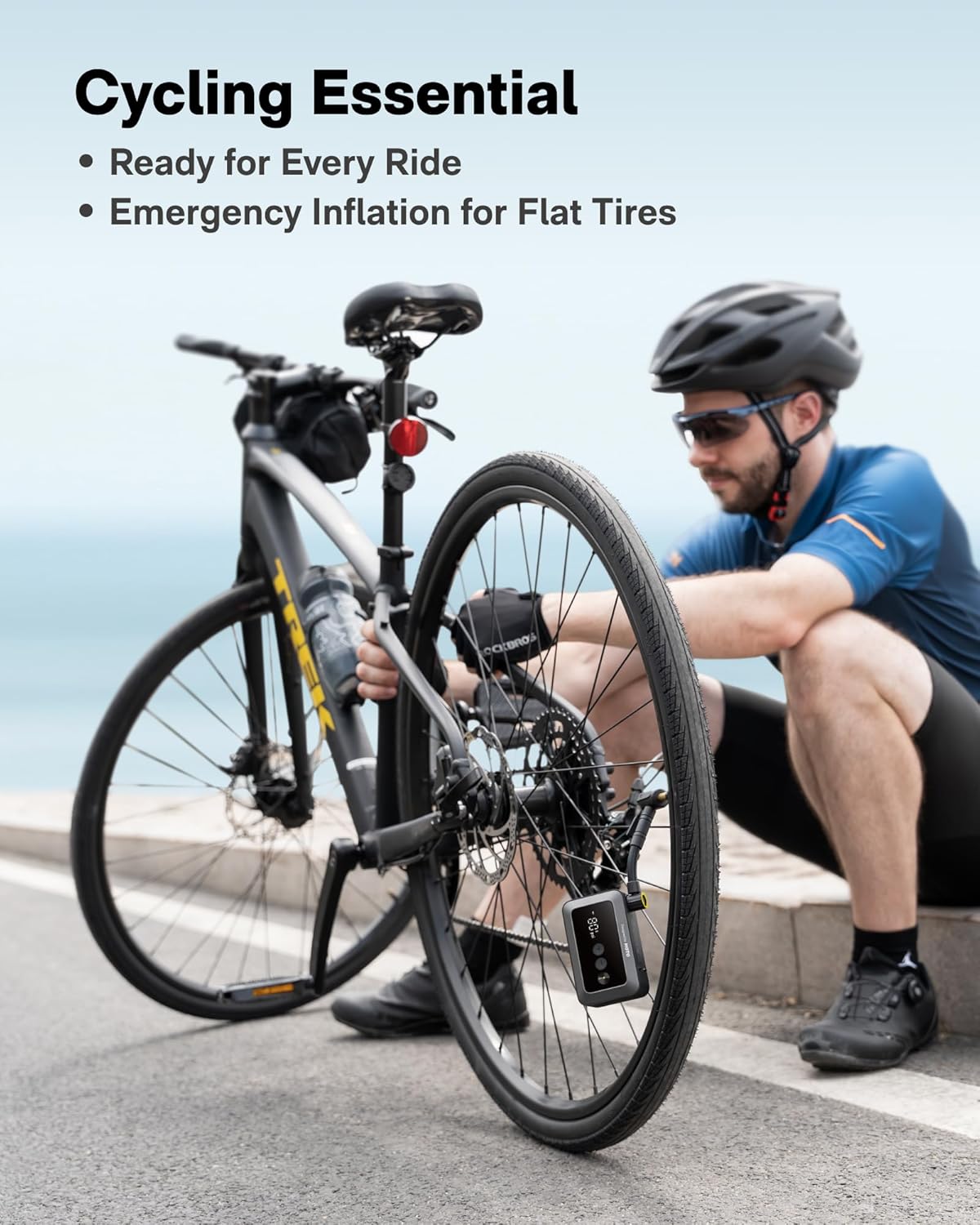
A portable electric bike pump is exactly what it sounds like: a small, battery-powered device — typically fitting in a jersey pocket or handlebar bag — that inflates your tires automatically to a pressure you dial in, then shuts off on its own. PSI (pounds per square inch) is the standard unit for measuring tire pressure; road bike tires usually run 80–110 PSI, gravel tires 35–60 PSI, and fat e-bike tires 10–25 PSI. The marketing pitch is compelling: set a number, press a button, walk away. But the real question riders are asking before spending $50–$100 is whether the built-in pressure gauge is actually trustworthy — or whether you’ll still need a separate gauge to verify the reading. This article works through what the evidence from real owners suggests, where these pumps genuinely shine, and the specific setup mistakes that generate the most negative reviews — so you can make the call with clear eyes.
What “Accuracy” Actually Means for a Mini Electric Pump
When a pump’s spec sheet says “±1 PSI accuracy,” that number sounds reassuring, but it needs context. A 1 PSI error at 15 PSI (fat bike territory) is less than 7% — effectively invisible to your ride feel. The same 1 PSI error at 100 PSI on a road tire is under 1%, which is excellent by any standard. The problem is that some mini pumps drift outside that claimed tolerance at higher pressures, where road and gravel riders care most about consistency.
The most methodologically credible data point in owner-generated reviews comes from a Fanttik X9 Ace owner who explicitly tested six tires across three different bikes, then compared the pump’s gauge reading to a calibrated precision gauge after each fill. Their finding: accuracy within 1 PSI across all six tires. That’s a meaningful data point — not a casual observation, but a deliberate comparison using a reference instrument. It tracks closely with the manufacturer’s published ±1 PSI specification, and it’s the benchmark against which other pumps in this category should be judged.
By contrast, lower-cost mini electric pumps in the $25–$40 range routinely show 3–5 PSI variance at road bike pressures, a pattern documented in aggregated verified-purchase owner feedback and consistent with guidance in the RoadBikeRider.com article “Tire Pressure FAQ,” which notes that even modest pressure variance changes handling and rolling resistance measurably on a road bike. That’s the gap you’re paying to close when you step up to a premium option.
The Feature That Actually Matters: Auto-Shutoff at Target Pressure
Speed claims dominate the marketing — “inflates a road tire in 90 seconds” — but experienced buyers quickly learn that raw speed is the least important differentiator. What Fanttik X9 Ace owners consistently cite as the purchase-justifying feature is the ability to dial in a target pressure and have the pump stop automatically when it reaches that number.
That’s a genuinely different workflow than any manual pump. With a floor pump, you’re checking the gauge every 10–15 strokes, stopping, reading, continuing. With an auto-shutoff electric pump, you enter 85 PSI, attach, press start, and walk away. The pump stops. You detach. Done. Owners describe this as “the thing that makes it actually useful every single morning,” not just an emergency trail tool.
This behavioral pattern — using the pump daily at home as a floor pump replacement, not just carrying it for emergencies — shows up repeatedly across Fanttik owner reviews. Buyers aren’t just purchasing trail insurance; they’re evaluating whether a quality mini electric pump can eliminate a piece of gear from their routine entirely. For commuters and cargo bike riders who don’t want a floor pump taking up space, the answer is increasingly yes.
The HOTO Portable Air Pump earns similar daily-use loyalty, with owners specifically praising build quality described as “not just good, but great” — language that suggests buyers in this segment are doing their homework before purchasing. Reviews of the HOTO frequently mention YouTube pre-purchase research, which signals a considered buying process, not impulse purchasing. People who spend 45 minutes watching comparison videos before buying tend to have reasonable expectations, and HOTO’s satisfaction rate reflects that.
Three Tiers Worth Knowing Before You Buy
Understanding where a pump sits in the market helps you calibrate expectations before reading a single review. The category breaks into three meaningful tiers based on accuracy, build, and battery capacity.
Budget Tier: Under $40
Budget mini electric pumps in this range can handle low-pressure tires — fat bikes, cargo bikes running 15–20 PSI — with reasonable accuracy. At road bike pressures above 80 PSI, however, owner feedback patterns consistently show 3–5 PSI variance, which is outside the tolerance most road cyclists consider acceptable. Battery life typically covers two to four standard 700c tires per charge, and build quality reflects the price point. Bicycling.com’s “Best Bike Pumps” buyer’s guide notes that adapter management is the most common failure point across the mini pump category at every price level, but cheap pumps add the complication of less precise gauge circuitry on top of that. If you’re a casual rider topping off a single mountain bike before weekend trail rides and you own a separate calibrated gauge, a budget pump does the job.
Fanttik
$37.96
In stock on Amazon
Check price on AmazonMid-Tier: $40–$65
Mid-tier pumps close most of the accuracy gap. Published specifications at this level typically claim ±1.5 PSI, and owner feedback generally corroborates that within 0.5 PSI — meaning real-world performance is close to the claim rather than well outside it. Battery capacity increases to four to six tires per charge. Auto-shutoff is present and reasonably reliable, though some owners report occasional overshoot of 1–2 PSI on the first tire of a session before the pump’s internal temperature stabilizes. BikeRadar’s “Best mini pumps and CO2 inflators” roundup identifies this tier as the sweet spot for gravel riders who want genuine portability without sacrificing meaningful accuracy.
HOTO
$39.87
In stock on Amazon
Check price on AmazonPremium Tier: $65–$100+
This is where the Fanttik X9 Ace and the HOTO Portable Air Pump operate. The owner-verified accuracy data for the Fanttik X9 Ace — ±1 PSI across six tires tested against a calibrated reference gauge — represents the strongest real-world data point available in this category. At this tier, auto-shutoff behavior is consistent across sessions, battery capacity covers four to six road tires or one to two full fat-tire inflations from flat, and USB-C charging is standard. The HOTO distinguishes itself on build quality and considered industrial design; the Fanttik distinguishes itself on documented gauge accuracy. Both earn credible daily-use recommendations from commuter and cargo bike owners who’ve retired their floor pumps entirely.
HOTO
$39.87
In stock on Amazon
Check price on AmazonThe Setup Problem Nobody Warns You About
The single largest driver of negative reviews for both the Fanttik X9 Ace and the HOTO — and this is critical context for any buyer — is valve adapter confusion, not pump failure.
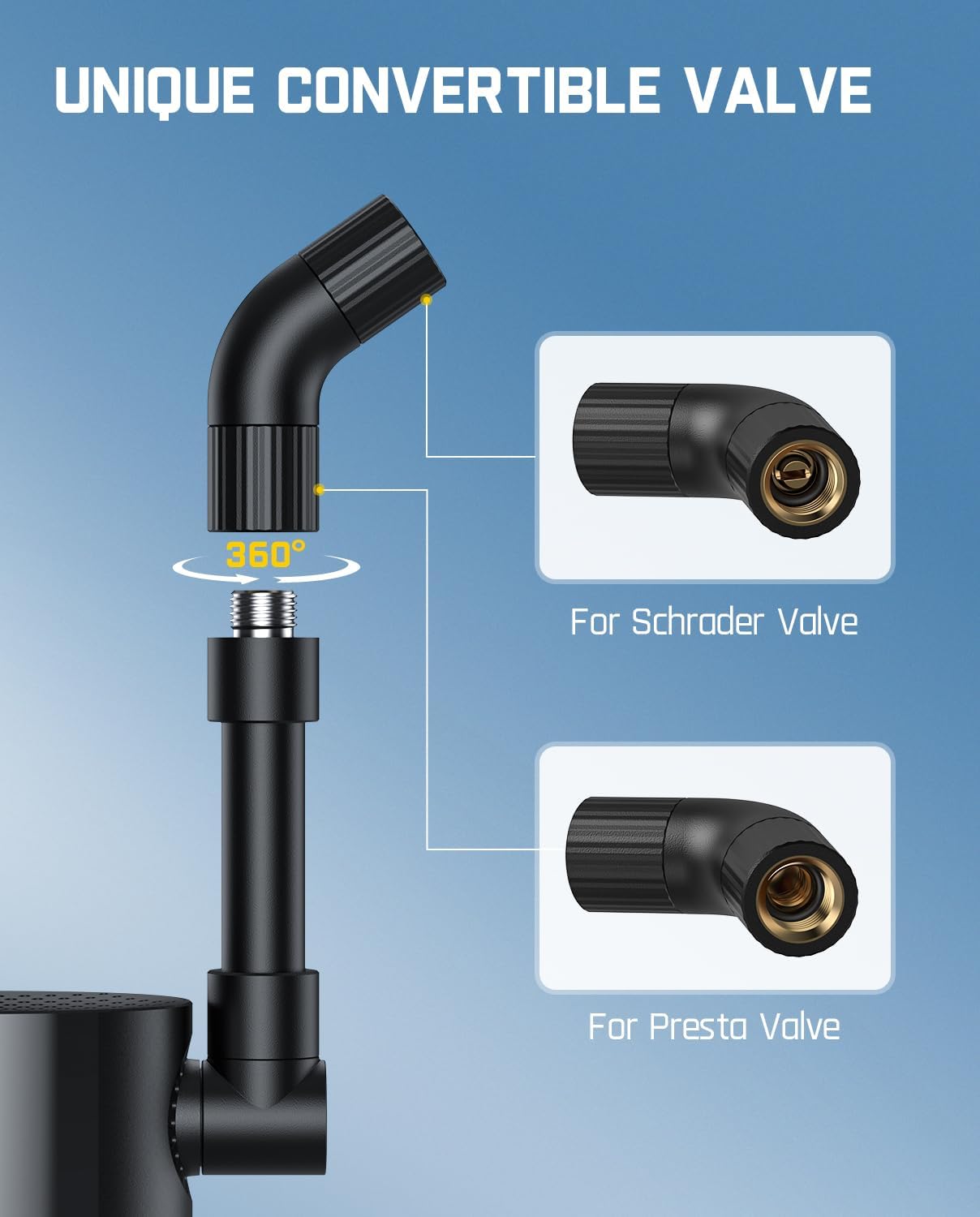
Both Presta and Schrader valves are common on bike tires. Presta valves (the narrow ones with a small locknut at the top) are standard on road and gravel bikes; Schrader valves (the wider, car-style valves) appear on most mountain bikes, fat bikes, and cargo bikes. Mini electric pumps typically include adapters for both, but the adapter must be oriented correctly — and neither pump makes this intuitive out of the box.
On the Fanttik X9 Ace, a meaningful percentage of one-star reviews describe the pump “not working” or “losing air instead of adding it.” In nearly every traceable case, the issue is the adapter being threaded in reverse or the Presta valve locknut not being loosened before attachment. Bicycling.com’s “Best Bike Pumps” buyer’s guide and BikeRadar’s “Best mini pumps and CO2 inflators” roundup both identify adapter management as the most common failure point across the mini pump category — not the pump mechanism itself.
For the HOTO, a separate quirk generates its own new-user friction: the pump powers on by swinging the hose out from its stored position. There’s no obvious power button. Multiple owners report spending several frustrated minutes trying to locate an on switch before discovering this mechanism — usually after watching a YouTube video or reading the manual’s second page.
Setup tips before you inflate anything:
- Loosen the Presta valve locknut (the small brass nut at the tip) before attaching the adapter
- Confirm the adapter is threaded fully onto the valve, not just seated against it
- On the HOTO, swing the hose out fully to activate the pump — it won’t respond to button presses with the hose stowed
- Test on a low-pressure tire first (MTB or cargo bike) before trusting the adapter connection on a 100 PSI road tire
By the Numbers: Mini Electric Pump Benchmarks
| Metric | Premium tier | Mid-tier | Budget tier |
|---|---|---|---|
| Pressure accuracy | ±1 PSI (owner-verified) | ±1.5–2 PSI | ±3–5 PSI at road pressures |
| Max rated pressure | 100–120 PSI | 100 PSI | 80–100 PSI |
| Tires per charge | 4–6 standard road tires | 4–5 standard road tires | 2–4, degrades faster |
| Inflation time (700×25c, 80 PSI) | ~90–120 seconds | ~110–150 seconds | ~120–180 seconds |
Sources: published manufacturer specifications; aggregated owner review patterns; ElectricBikeReview.com tire pressure and maintenance guidance for e-bikes, 2024; RoadBikeRider.com “Tire Pressure FAQ,” 2024.
Frequently Asked Questions
Is the pressure gauge on a mini electric pump accurate enough for road bike tires above 80 PSI?
Based on available owner data, a premium mini electric pump like the Fanttik X9 Ace can achieve ±1 PSI accuracy at road pressures — within the tolerance most riders and mechanics consider acceptable. Budget options under $40 are more likely to drift 3–5 PSI at the top of their range. If you’re running 100+ PSI on a narrow road tire and you’re sensitive to pressure variation, carrying a small mechanical gauge to verify isn’t paranoid — it’s prudent. RoadBikeRider.com’s “Tire Pressure FAQ” consistently notes that even 5 PSI variance changes handling and rolling resistance measurably on a road bike.
How many bike tires can I inflate on a single charge?
Premium mini electric pumps are generally rated for 4–6 standard 700c road bike tires per charge. In practice, owners with multiple bikes report getting through a full pre-ride check for two or three bikes before needing to recharge via USB-C. Fat bike tires and cargo bike tires consume significantly more volume per inflation — expect 1–2 full inflations from flat on a fat tire before the battery flags.
Does it work with both Presta and Schrader valves without buying extra adapters?
Yes — both the Fanttik X9 Ace and the HOTO include adapters for both valve types in the box. No additional purchase is required. The Schrader adapter is the simpler connection; the Presta adapter requires the locknut on the valve to be loosened first, which is the step most new users miss.
How do I know if the adapter is in the right orientation if it’s not working?
If the pump is running but tire pressure isn’t rising — or you can hear air escaping — the adapter is almost certainly not seated correctly. For Presta valves: confirm the small locknut at the tip of the valve is fully loosened (counterclockwise), then thread the adapter clockwise until snug. You should feel slight resistance from the valve core. If the adapter spins freely without resistance, it’s not engaging. For Schrader, the pin inside the adapter should depress the valve’s center pin — a loose or partial connection lets air bleed backward.
Can it fully inflate a flat fat tire on an e-bike, or just top off?
It can fully inflate from flat, but expect the battery to work hard. ElectricBikeReview.com’s tire pressure and maintenance guidance for e-bikes notes that a typical 26×4.0 fat bike tire holds roughly four to five times the air volume of a 700×25c road tire. Owners using mini electric pumps on cargo bikes and fat-tire e-bikes consistently report successful full inflations from flat, but often with only one such fill per charge. If you’re a cargo bike commuter relying on this as your only inflation tool, keep the pump charged — and consider a spare USB-C cable in your bag.
Should I keep my floor pump, or can this replace it entirely?
The honest answer depends on your setup. For a single-bike commuter with a cargo bike or gravel bike who wants minimal gear at home, a premium mini electric pump with reliable auto-shutoff and ±1 PSI accuracy is a legitimate floor pump replacement. Multiple Fanttik owners explicitly describe switching to this as their only pump, at home and on the road. However, if you’re maintaining three or more bikes in regular rotation — a common scenario for families running a cargo bike, trailer bike, and kids’ bikes — a floor pump is faster for bulk inflations and has no battery to manage. The practical recommendation: one or two bikes in regular rotation, the premium mini electric can stand alone; three or more, keep the floor pump and carry the mini electric as your trail backup and travel tool.
The Decision Frame
If pressure accuracy and auto-shutoff are your primary criteria and you’re running a single road, gravel, or cargo bike, owner evidence favors the Fanttik X9 Ace as the benchmark for this category — the ±1 PSI owner-verified accuracy is the strongest data point available, and the auto-shutoff workflow genuinely changes how you interact with tire inflation daily.
If build quality and considered design feel matter as much as function — and you did your YouTube research before buying — the HOTO earns its reputation, once you’ve internalized the swing-hose power mechanism.
Either way: the setup step that makes or breaks the experience is the valve adapter. Get that right on the first tire, and the rest of the pump’s promise follows.