June 11, 2026 • Neil Hayes • 8 min reading time • Prices verified June 25, 2026
The 2-in-1 Cargo Trailer and Pushcart: Who Actually Needs the Convertible Design
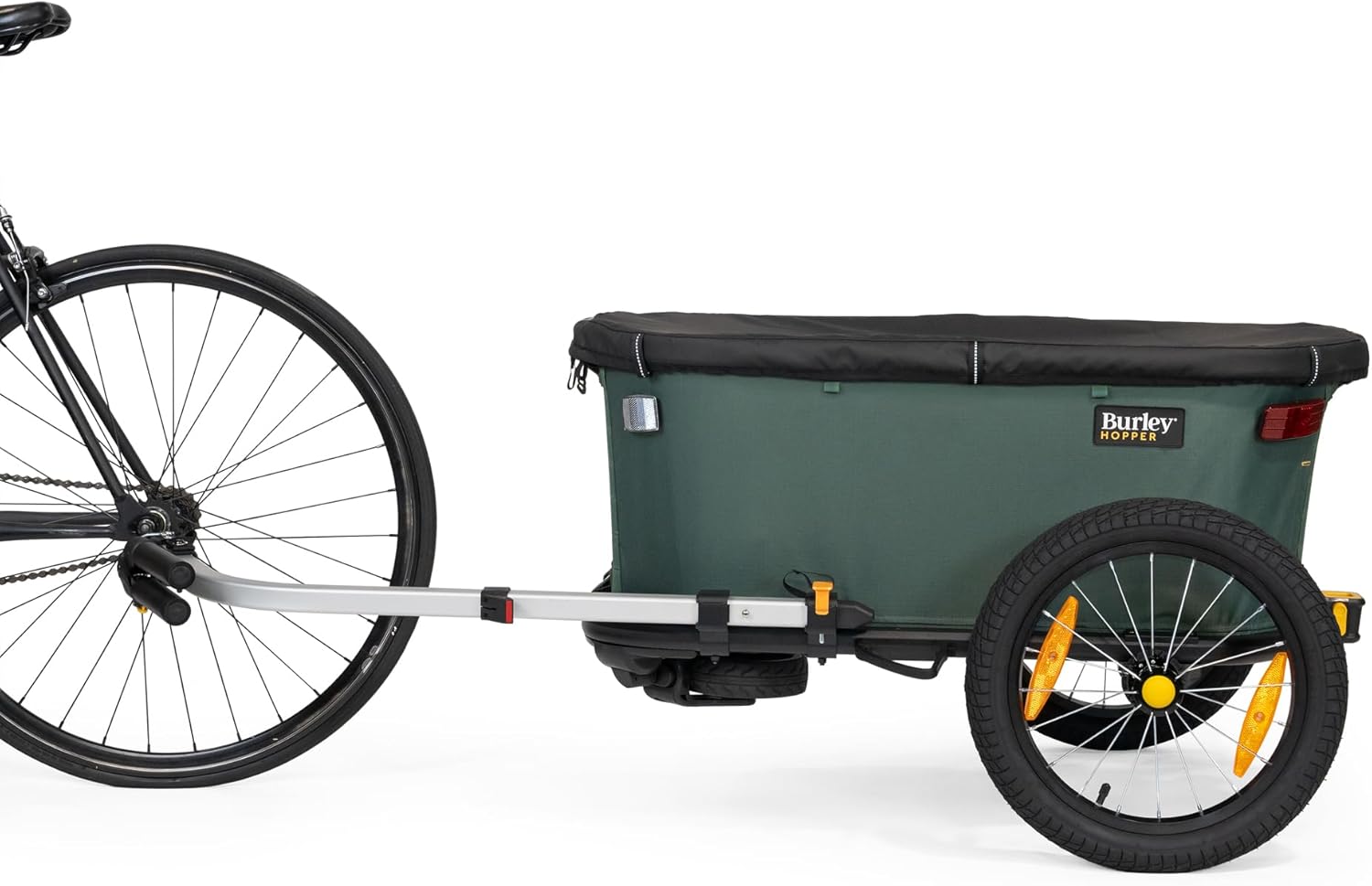
A cargo trailer is simply a wheeled box or platform you tow behind a bicycle. A 2-in-1 convertible cargo trailer goes one step further: it ships with a handle bar or stroller-style push frame, so you can detach it from the bike hitch and roll it on its own wheels — through a farmers market, across a parking lot, or down a grocery-store aisle. For some buyers, that flexibility is genuinely transformative. For others, it adds weight and cost for a mode they’ll use twice and forget. This guide exists to separate those two groups clearly. By the end, you’ll have a concrete decision rule — not a vague “it depends” — based on how your actual route and lifestyle break down.
| EDITOR'S PICK[Burley Hopper | Compact Cargo B…](https://www.amazon.com/dp/B0F2315Q8L?tag=greenflower20-20) | Mid-tier[Xspec 2-in-1 Bike Cargo Trailer…](https://www.amazon.com/dp/B0CV4M9M6T?tag=greenflower20-20) | Budget pick[Aosom Bicycle Cargo Trailer wit…](https://www.amazon.com/dp/B0CZY4HRKX?tag=greenflower20-20) | |
|---|---|---|---|
| Conversion type | Trailer & stroller wagon | 2-in-1 trailer & pushcart | Trailer only |
| Removable box | — | ✓ | ✓ |
| Waterproof cover | — | ✓ | ✓ |
| Wheel size | — | — | 16" |
| Parking brake | ✓ | — | — |
| Rigid floor | ✓ | — | — |
| Price | $599.95 | $149.99 | $104.99 |
| See on Amazon → | See on Amazon → | See on Amazon → |
What the Convertible Design Actually Gives You (and What It Costs)
The mechanics are straightforward: a standard tow-only cargo trailer weighs between 14 and 22 lbs (6.4–10 kg) for a mid-size single-wheel-track design. A convertible trailer carrying the same rated cargo load adds roughly 3–6 lbs for the push handle, stroller linkage hardware, and reinforced hitch pivot that has to tolerate both tow forces and the offset load of hand-pushing. That weight penalty matters on a cargo bike where every added pound on a non-motorized trailer is a pound you pedal.
The cost gap is meaningful too. Burley Design’s published spec sheets put their tow-only Flatbed cargo trailer at around $350–$400. Convertible designs with equivalent cargo capacity — think the Burley Coho XC in its cargo-plus-pushcart configuration, or the Thule Chariot Cross 2 in multi-sport mode with the strolling kit — regularly land in the $550–$900 range at 2026 MSRP. The Thule Chariot Cross 2 multi-sport package, which Outside Online’s 2025 buyer’s guide consistently calls one of the most versatile child-and-cargo platforms available, lists above $2,500 when fully kitted.
By the numbers — typical mid-size convertible vs. tow-only:
| Spec | Tow-Only Trailer | Convertible (bike + push) |
|---|---|---|
| Typical weight | 15–19 lbs | 20–26 lbs |
| Cargo capacity (rated) | 100–200 lbs | 80–150 lbs |
| Entry price (2026) | $300–$450 | $500–$900+ |
| Push-mode wheel diameter | N/A | 16–20 in |
Sources: Burley Design product specification sheets, 2025; Thule Group Chariot Cross 2 owner manual, 2025.
The payload reduction on convertibles is real and often overlooked. To build in structural integrity at the hitch pivot for push-mode lateral forces, manufacturers typically reinforce the frame in ways that eat into net cargo capacity. If your use case involves hauling near-max loads — think weekly bulk grocery runs or small-business delivery loops — a tow-only trailer frequently offers better numbers per dollar.
The Three Scenarios Where Convertible Actually Earns Its Keep
Here’s the critical question to ask yourself: Does my trip end where my bike ends? If yes — if you load the trailer, ride to the destination, and unload with the bike still attached — a tow-only design covers you completely. The convertible design earns its price premium only when you need to move cargo after the bike is out of the picture.
Scenario 1: Car-free errands with a last-mile gap. PeopleForBikes’ 2024 Urban Cargo Cycling Infrastructure Report documents a consistent friction point for car-free households: the distance between secure bike parking and the store entrance, market stall, or building lobby. In dense urban environments, that gap is frequently 50–300 feet but still too far or too logistically awkward to manage with panniers. A convertible trailer you can detach and wheel inside — or to a curb pickup — directly solves that gap. Owners consistently report on this pattern in long-run reviews aggregated at ElectricBikeReview.com: the push-cart mode gets used on every single grocery run, not as an edge case.
Scenario 2: Multi-child family setups where the trailer doubles as a stroller. The Thule Chariot Cross and its category peers are genuinely designed around this use case. Bicycling.com’s 2025 cargo trailer buyer’s guide notes that the Chariot Cross earns its $2,500+ price specifically because parents use the strolling configuration daily — school drop-off, park visits, weekend trail walks — while also using the tow mode for family bike rides. If both modes see consistent weekly use, the cost-per-mode math changes dramatically in the convertible’s favor.
Scenario 3: Farmers market vendors and small-event operators. This is an underserved use case in most reviews. Micro-vendors who bike to a market, set up, and need to move product between stalls or to a loading zone after the ride are exactly the buyer this design serves. Pulling a loaded trailer through a crowd on foot is genuinely dangerous and mechanically awkward; a push-cart frame with proper steering geometry makes it manageable. For this group, the convertible isn’t a nice-to-have — it’s core workflow.
When the Convertible Design Works Against You
The convertible earns a hard pass in three equally clear situations.
Heavy recurring cargo loads. If you’re routinely hauling 80–150+ lbs — think a RadWagon 4 owner who has replaced a car for grocery and supply runs — you need maximum rated payload and minimum dead weight. ElectricBikeReview.com’s 2025 RadWagon 4 owner roundup shows this pattern clearly: committed cargo-bike households treat the trailer as a pure tow accessory and optimize for capacity and durability over versatility. The push-mode hardware is dead weight on every single trip.
Long-distance or multi-hour tow routes. Every added pound in a non-motorized trailer translates directly to rider effort, especially on electric cargo bikes where the assist cuts out at speed limits or on long grades. If your typical trip is 5+ miles or includes significant elevation, the 4–6 lb weight penalty of a convertible frame compounds across the full route. For these riders, the tow-only design wins on pure efficiency.
Dedicated cargo bike fleet operations. Small-business fleet operators — urban delivery coordinators, catering support operators — almost universally report in forum discussions that convertible features go unused in fleet contexts. The push-cart mode requires a second operator or an unattended bike, neither of which fits fleet workflow. Bicycling.com’s 2025 guide explicitly notes that fleet buyers should “look past multi-sport marketing” and prioritize payload rating and hitch compatibility instead.
The Spec Details That Actually Differentiate Convertible Models
Once you’ve decided the convertible design fits your use case, the variance between models matters. Here’s what to interrogate before buying:
Push-mode wheel diameter and bearing quality. Smaller wheels (14–16 in) roll acceptably on smooth pavement but catch in sidewalk cracks and market cobblestones. Models using 20-inch push wheels — more common in the $700+ tier — roll significantly more smoothly under load. Thule’s published specifications for the Chariot Cross 2 show 16-inch strolling wheels, which reviewers at Outside Online describe as adequate for pavement but limiting on packed gravel.
Hitch pivot stiffness and backlash. A hitch that articulates freely for tight cornering while towing needs to lock down for push mode — some designs do this with a mechanical pin, others with friction tension. Loose pivot backlash in push mode creates a wandering, fatiguing push experience under load. Ask in owner forums whether the hitch locks positively; this is rarely specified in manufacturer documents.
Handlebar height and push ergonomics. Published specs almost never include handlebar height range, but owners consistently flag this in long-run reviews. A handlebar set for an average adult height (around 42–44 inches) is fine for most users; fixed bars set lower or higher cause back and shoulder fatigue quickly. If you’re outside average height, look specifically for models with telescoping or adjustable handle posts — a feature Burley includes on several convertible configurations per their current product documentation.
Weight rating consistency across modes. Read the fine print: some manufacturers publish a higher tow-mode weight rating than push-mode rating. Thule’s Chariot Cross documentation, for example, specifies different child passenger limits depending on mode. This is a safety specification, not a marketing detail — and it determines whether your actual load pattern fits the product.
The Decision Rule
If you’ve read this far, here’s the clean if/then frame:
If your cargo trip ends when your bike stops — you load, ride, and unload at the destination — buy the tow-only trailer. You’ll get more payload capacity, less rolling weight, and a lower price for identical towing performance.
If you regularly need to move cargo after the bike is parked — through a store, across a market, from a parking area to a building entrance — and that last-mile push mode will realistically happen at least once a week, the convertible’s price and weight premium pays for itself in actual workflow. For families using a trailer as a daily stroller that also clips to a bike for weekend rides, the math is even clearer: two separate products would cost more and store less efficiently than one well-designed convertible.
The buyer most likely to regret a convertible purchase is someone who bought it for a push-mode scenario they imagined using regularly but hasn’t yet built into their actual routine. If you’re buying for a hypothetical future use case, default to the tow-only design and revisit when the use case becomes concrete.
The buyer most likely to regret a tow-only purchase is a car-free urban household that keeps leaving the trailer locked to the bike while hand-carrying groceries inside. That friction is the product telling you what you actually need.
Published specifications sourced from Burley Design product documentation (2025), Thule Group Chariot Cross 2 owner manual (2025), Bicycling.com cargo trailer buyer’s guide (2025), Outside Online bike trailer review (2025), PeopleForBikes Urban Cargo Cycling Infrastructure Report (2024), and ElectricBikeReview.com RadWagon 4 owner roundup (2025). Payload and weight figures reflect manufacturer-published ratings and should be verified against current product documentation before purchase.