September 12, 2026 • Neil Hayes • 11 min reading time • Prices verified June 25, 2026
From Bike Trailer to Hand Cart: Which Removable-Box Designs Actually Deliver

If you’ve spent any time researching cargo bikes or bike trailers — the tow-behind carriers that hitch to your rear axle and haul groceries, gear, or supplies — you’ve probably noticed a growing category of budget trailers that promise a two-for-one deal: a plastic box that detaches from the trailer frame and converts into a wheeled hand cart you can roll through a store. The pitch is genuinely appealing. You ride to the market, unhitch the box, load it up in the aisles, and re-attach it for the ride home. No cargo transfer, no reloading at the curb.
The catch is that “removable box” covers a wide range of real-world performance. Some boxes actually roll smoothly on hard floors and clear typical store cart return rails. Others wobble, crack under modest load, or require tool-based modification to fit your e-bike’s hitch. People for Bikes utility cycling survey data (peopleforbikes.org, 2024) consistently shows that cargo-carrying capacity is among the top reasons riders choose cycling over driving for errands — which means equipment failures in this segment carry real practical consequences.
This article works through what owner reports and published specs reveal about the four brands that dominate this segment — Aosom, PEXMOR, Xspec, and Ktaxon — so you can match the right trailer to your actual use pattern before committing.
| EDITOR'S PICKGoplus Bike Cargo Trailer | Mid-tierAosom Bicycle Cargo Trailer wit… | Budget pickPEXMOR Bike Cargo Trailer with… | |
|---|---|---|---|
| Waterproof cover | — | ✓ | ✓ |
| Max load | 220 lbs | — | — |
| Hitch type | Universal | — | Quick release |
| Reflectors | ✓ | — | — |
| Price | $149.99 | $104.99 | $68.99 |
| See on Amazon → | See on Amazon → | See on Amazon → |
What “Removable Box” Actually Means — and Where the Design Splits
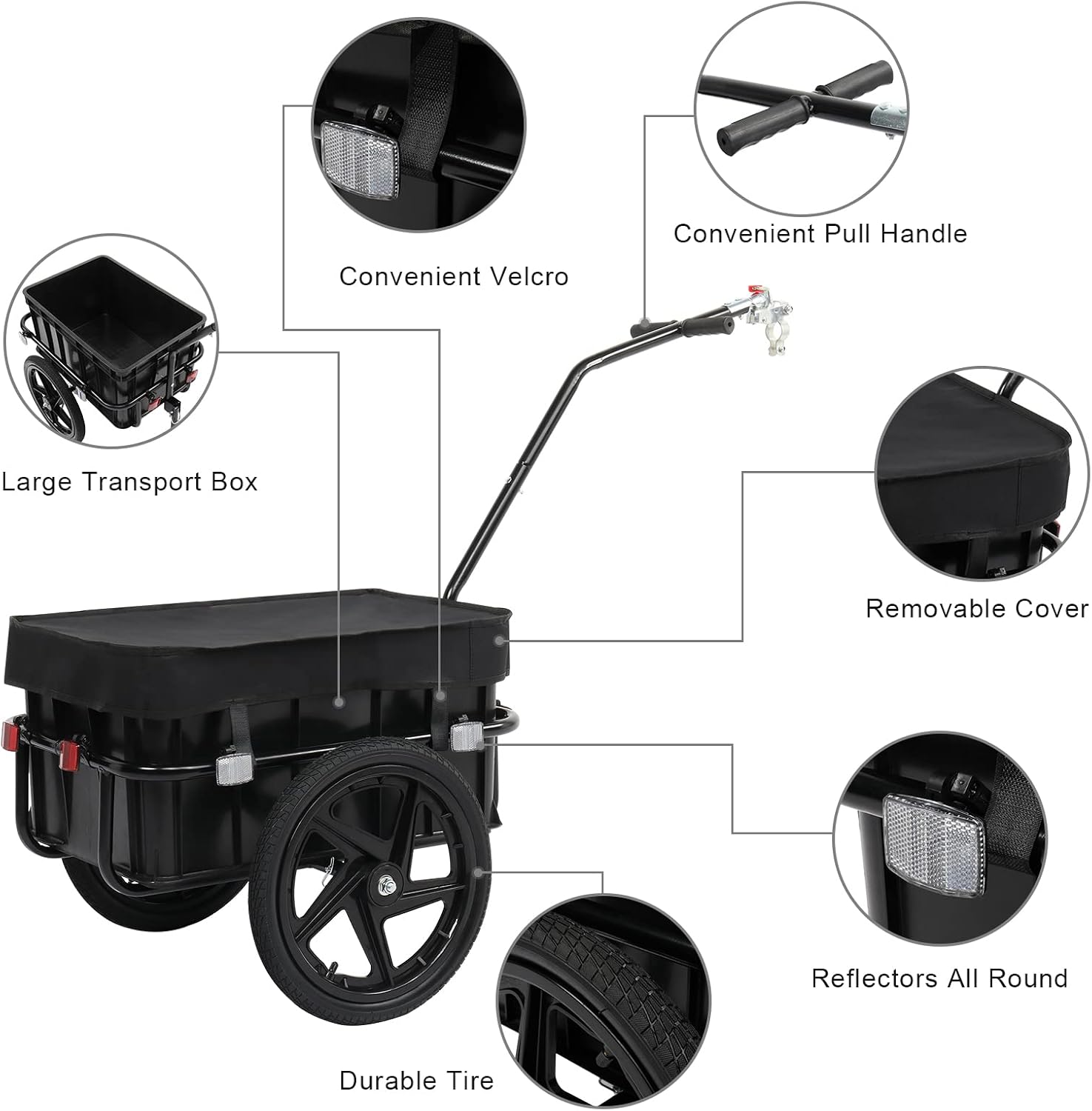
Every trailer in this category shares the same basic architecture: a steel or aluminum folding frame, a hitch arm that connects to your rear axle, and a hard plastic box that sits inside the frame on a floor plate or clip system. The box typically has its own set of small inline wheels or swivel casters on the bottom, so once you detach it from the trailer, you can push it upright as a hand cart.
The design diverges in three places that matter for real-world use:
Box attachment system. Some boxes clip to the frame floor with simple plastic tabs; others bolt down. Clip systems are faster to release but introduce play — which you’ll feel as a rattle or slight slop when towing on rough pavement. Bolt systems are more secure but slow the convert-and-go workflow that makes these trailers useful.
Caster quality and configuration. Hand-cart usability in a real store depends almost entirely on the caster wheels: their diameter, swivel range, and whether they lock. Budget casters (typically 2–3 inch diameter, non-locking) skitter on smooth tile and become nearly uncontrollable on a slight incline. Better-configured boxes use 3-inch-plus swivel casters with at least a partial lock on the rear pair. BikeRadar’s cargo trailer compatibility guide (bikeradar.com, 2024) notes that caster specification is one of the least standardized elements across budget trailer categories — a finding consistent with the owner-report pattern across all four brands reviewed here.
Box wall thickness and material. Published specs rarely disclose wall thickness in millimeters, but owner reports are explicit: most boxes in this price range (trailers sell in the $80–$160 window as of mid-2026) use injection-molded polypropylene thin enough that lateral pressure from a full grocery load — think 40 lbs of cans against one wall — produces visible flex over repeated use cycles.
Head-to-Head: The Four Brands That Define This Segment
The comparison below is organized by the tier of use case each trailer realistically serves, based on published specifications and aggregated owner-report patterns. Each subsection closes with a tier marker reflecting the buyer profile the trailer best fits.
Aosom — Best Documented for Store-Format Compatibility
Among the four brands, Aosom has generated the most operationally specific owner feedback. The detail that stands out most as useful signal: owners report testing the detached box against actual store cart rail heights at multiple retail formats, with results that split by store type rather than by the product’s inherent capability.
The specific finding, reported across multiple verified purchase reviews on the Aosom platform (Aosom.com, verified owner reviews, 2024–2025), is that the Aosom cargo box — in its standard configuration — clears cart return rails at warehouse-club-format stores (wide-aisle retailers with low-height cart corrals) but does not reliably clear the elevated cart return bays found at standard supermarket chains. The box stands approximately 24–25 inches tall when upright. That dimension is the key measurement to compare against your primary store before assuming the workflow will function as marketed.
Aosom’s published specs show a 66 lb (30 kg) gross payload rating for the trailer, with the box rated for approximately 44 lbs (20 kg) as a standalone hand cart — a meaningful distinction, since the trailer frame and floor plate share load when towing, but the box casters carry the full weight in hand-cart mode. Bicycling’s best bike trailers guide (bicycling.com, 2024) identifies this towing-versus-hand-cart payload split as a common source of buyer confusion across the budget trailer category.
PEXMOR
$68.99
In stock on Amazon
Check price on AmazonPEXMOR — High Frame Capacity, Low Box Confidence
The PEXMOR entry sits in a similar price bracket and shares most of the same frame geometry, but its owner review pattern tells a different story about box durability.
Across aggregated reviews (PEXMOR cargo trailer owner reviews, retail review platforms, 2024–2025), a notable subset of owners describe plans — or completed projects — to replace the stock plastic box with a custom plywood enclosure. One reviewer’s documented rationale was explicit: the stock plastic felt too thin to survive weekly grocery use, so they rebuilt the box in plywood immediately after receiving the trailer.
A buyer replacing a primary component before first use is not a niche complaint — it is a signal that the stock solution does not meet the use case it is marketed for. Plywood replacement boxes can work well (Baltic birch at 9mm or 12mm is lighter than it sounds and far more rigid than the stock polypropylene), but that is a fabrication project, not a plug-and-play purchase. Budget accordingly.
Published specs for PEXMOR show a 176 lb (80 kg) trailer payload — a number that refers to the total towing capacity of the frame and hitch assembly, not the box’s standalone capacity as a hand cart. The frame may handle 80 kg. The plastic box walls will not, and PEXMOR does not publish a separate hand-cart capacity rating.
PEXMOR
$68.99
In stock on Amazon
Check price on AmazonXspec — Capable Frame, Non-Standard Axle Warning
The Xspec trailer raises an issue that applies across this entire category but is documented most specifically in Xspec owner reports (Xspec bike trailer owner reviews, retail review platforms, 2024–2025): hitch compatibility with non-standard rear axles on e-bikes.
One owner’s documented experience involved modifying the Xspec hitch arm with a rotary tool to open up the quick-release skewer slot enough to fit an e-bike with an oversized rear axle. Here is why this happens at a design level:
Standard bike trailers ship with a hitch sized for a 5mm quick-release skewer or a 9mm solid axle. Most traditional bikes and entry-level e-bikes use one of these standards. Mid- and higher-spec e-bikes — including many hub-motor cargo bikes and several performance-oriented models reviewed by Electric Bike Review (electricbikereview.com, 2024) — increasingly use thru-axles (typically 12×148mm) or oversized solid axles that do not fit the standard hitch slot without modification. Electric Bike Review’s cargo accessory compatibility guidance explicitly flags thru-axle hitch incompatibility as one of the most common buyer errors when pairing budget trailers with modern e-bikes.
The rotary-tool modification described by the Xspec owner works in practice but removes material from a load-bearing component. The correct pre-purchase step for any e-bike owner is to verify rear axle standard (QR 5mm, solid 9mm, or thru-axle 12×148mm) against the trailer hitch specification, then contact the manufacturer for a compatible adapter before ordering. This is not an Xspec-specific failure — it is a category-wide compatibility gap. Xspec’s published payload is 110 lb (50 kg) for the trailer frame.
Aosom
$104.99
In stock on Amazon
Check price on AmazonKtaxon — Light Weight, Handling Adjustment Required
Ktaxon occupies the lightest end of this segment. Published weight for the frame and box combined is approximately 13–15 lbs, which is genuinely useful for storage and hitching — but owner reports (Ktaxon cargo trailer owner reviews, retail review platforms, 2024–2025) flag a handling quirk that does not appear in any spec sheet: the trailer is so light when empty that riders report forgetting it is attached and taking corners too sharply.
This matters for the specific use pattern these trailers are designed for. Riding to the store empty and back loaded means the handling character changes significantly on return. Without the inertial damping of 30–40 lbs of groceries, an empty Ktaxon trailer responds more abruptly to directional changes. Owners describe clipping curbs and misjudging turn radius at intersections because the visual and tactile feedback of towing is low when the box is empty.
The practical adjustment: ride the outbound leg as if the trailer were loaded, and plan your corner entry points accordingly. Ktaxon’s published payload matches Aosom’s at 66 lb (30 kg) for the trailer frame, with no separate hand-cart rating published.
PEXMOR
$68.99
In stock on Amazon
Check price on AmazonPayload Reality vs. Published Specs
The table below summarizes the gap between published trailer payload — which reflects frame and hitch capacity — and the practical hand-cart limits reported by owners across review platforms. These figures are drawn from manufacturer spec sheets and aggregated owner report patterns (Aosom.com verified reviews 2024–2025; PEXMOR, Xspec, and Ktaxon owner reviews, retail review platforms, 2024–2025).
| Model | Trailer payload (published) | Box hand-cart rating (published) | Owner-reported practical limit |
|---|---|---|---|
| Aosom | 66 lb / 30 kg | ~44 lb / 20 kg | 35–40 lb before flex |
| PEXMOR | 176 lb / 80 kg | Not separately rated | Wall flex flagged at moderate grocery loads |
| Xspec | 110 lb / 50 kg | Not separately rated | ~40 lb before caster instability |
| Ktaxon | 66 lb / 30 kg | Not separately rated | Light-load use; empty-trailer handling flagged |
The consistent pattern: trailer frame payload ratings are not a proxy for box hand-cart capacity. These are different load paths with different failure modes.
Frequently Asked Questions
Will the removable box fit under a standard grocery store shopping cart return? It depends on the store format, not just the box dimensions. Aosom owner reports are the most specific: the box clears warehouse-club cart rails but may not clear elevated cart return bays at standard supermarket chains. The box height when upright (approximately 24–25 inches) is the key measurement. Verify against your specific store before assuming the workflow operates as marketed.
How do I attach these trailers to an e-bike with a non-standard axle? Check your rear axle standard first — quick-release (5mm), solid 9mm, or thru-axle (typically 12×148mm on cargo and performance e-bikes). Most budget trailers ship with a standard QR hitch. If your e-bike uses a thru-axle or oversized solid axle, contact the trailer manufacturer for a compatible adapter before purchase. Electric Bike Review (electricbikereview.com, 2024) identifies this as one of the most common compatibility errors in the budget trailer segment.
How long does the plastic box last with weekly grocery use? Owner report patterns suggest 12–24 months of weekly use before visible cracking or wall deformation at load points, varying significantly by load distribution. Stacking dense canned goods against one wall is harder on the plastic than distributing weight across the floor. PEXMOR reviews flag early-onset flex most explicitly; Aosom reviews suggest slightly better durability at comparable loads.
Can I replace or upgrade the stock plastic box? Yes, and several PEXMOR owners have done exactly this, rebuilding in Baltic birch plywood using the existing floor plate and attachment points. Measure the frame’s interior floor dimensions and interior width before sourcing replacement material. A 9mm plywood rebuild adds rigidity without prohibitive weight and is the most commonly documented owner modification in this category.
Does the trailer track straight, or does it sway when the box is loaded unevenly? These trailers use a single-point hitch, which means lateral load imbalance translates into yaw — a side-to-side pull or lazy swing at speed. Owners riding at 12 mph or above with asymmetric loads note perceptible sway. Center your heaviest items and keep loads below 35 lbs for the smoothest tow behavior.
The Decision Framework
If your primary store is a warehouse-club format, you’re on a standard quick-release axle, and you’re hauling 30–40 lbs of groceries weekly: Aosom is the most thoroughly documented option in this segment, with the clearest published distinction between trailer payload and hand-cart capacity, and the most store-format-specific owner feedback.
If you’re on a mid-spec or higher-spec e-bike with a thru-axle or non-standard rear axle: resolve the hitch compatibility question with any manufacturer before purchasing anything in this category. The Xspec axle-modification experience is a warning that applies to all four brands.
If you need the box to handle more than 40 lbs regularly, or you want the hand-cart function to remain robust over a 2–3 year horizon: budget for a plywood box rebuild at the time of purchase, or evaluate trailers in the $200–$350 range with aluminum or reinforced composite enclosures — a tier that Bicycling (bicycling.com, 2024) identifies as offering meaningfully better enclosure longevity for high-frequency cargo use.
The removable-box trailer is a real solution for the right rider. Match your store format, your bike’s axle standard, and your load profile to what the design actually delivers — not to what the listing implies.