June 12, 2026 • Neil Hayes • 10 min reading time • Prices verified June 25, 2026
Budget Folding E-Bikes Under $800: What You Actually Get and What You're Giving Up
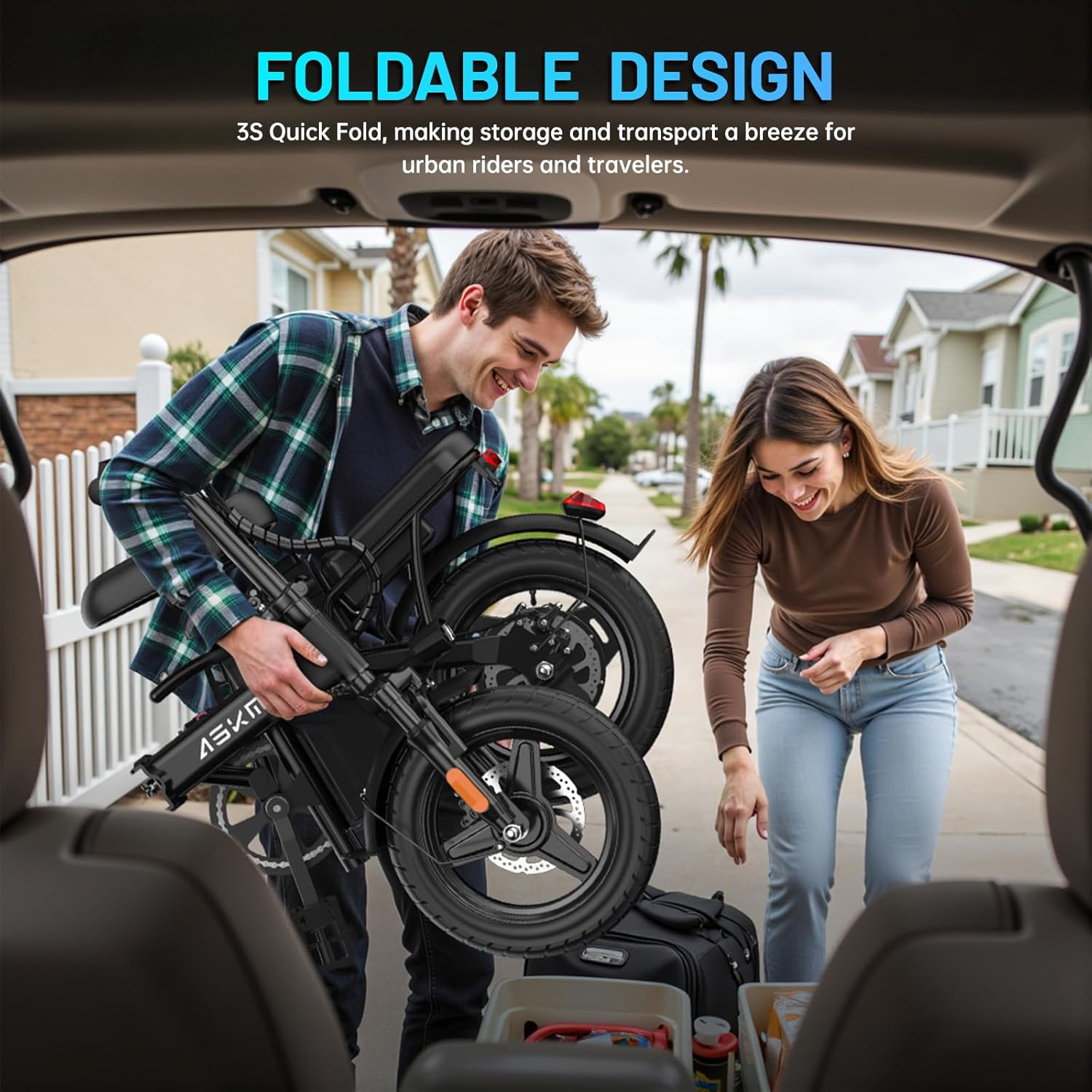
A folding e-bike is exactly what it sounds like: a pedal-assist electric bicycle (meaning the motor helps you pedal rather than replacing pedaling entirely) with a hinged frame that collapses down to roughly the size of a large suitcase. The appeal is obvious — you can stash one in an apartment, throw it in a car trunk, or carry it onto a commuter train. The sub-$800 tier has exploded since 2024, with dozens of brands shipping directly from overseas warehouses to your door. That convenience comes with real tradeoffs, and a few of those tradeoffs involve safety, not just comfort. This article maps exactly what you can and cannot expect from a budget folding e-bike in 2026 — the genuine surprises, the predictable disappointments, and the specific issues you should verify before your first ride.
| EDITOR'S PICK[ESKUTE Electric Bike for Adults](https://www.amazon.com/dp/B0FLDRS5KN?tag=greenflower20-20)… | Mid-tierFolding Electric Bike for Adults | Budget pickFoldable Electric Bike for Adul… | |
|---|---|---|---|
| Motor (peak) | 1200W | — | 700W |
| Battery | 48V 13Ah | 374.4Wh | 48V 10/20Ah |
| Range (miles) | Up to 55 | — | 30-60 |
| Top Speed (mph) | 20+ | 20 | — |
| Wheel Size | 20"×3.0" | 20"×3.0" | 14" |
| Speeds | 7 | 6 | — |
| Price | $509.00 | $349.99 | $198.00 |
| See on Amazon → | See on Amazon → | See on Amazon → |
What the Spec Sheet Gets Right (and What It’s Hiding)
At this price point, the numbers on the product listing look surprisingly competitive. A typical sub-$800 folding e-bike will advertise a 48V 10Ah lithium battery, a 350W–500W hub motor, Shimano or Shimano-equivalent gearing, hydraulic or mechanical disc brakes, and a claimed range of 35–60 miles. Some add 4-inch fat tires — wider tires originally designed for sand and snow that also cushion bumps on rough pavement — as a selling point.
By the numbers: what a 48V 10Ah battery actually delivers
| Claimed range | Real-world PAS 2 range (per owner reports) | PAS 5 / throttle-heavy range |
|---|---|---|
| 35–60 miles | 20–30 miles | 12–18 miles |
| Battery capacity | 480Wh nominal | ~400Wh usable |
| Charge time | 4–6 hours | per manufacturer spec |
PAS 2 means Pedal Assist Level 2 — a mid-range setting where the motor contributes meaningfully but you’re still doing a fair amount of the work. Aggregated owner reviews on Electric Bike Review consistently put real-world PAS 2 range at roughly half the manufacturer’s optimistic maximum claim, which assumes flat terrain, a light rider, low speeds, and ideal temperatures. In hilly urban riding with a rider over 180 lbs, owners regularly report landing in the 18–22 mile range. That’s still useful for a last-mile commute or errand run, but it’s not a car replacement.
The Shimano drivetrain surprise is worth naming directly. At least one reviewer documenting sub-$700 models expressed genuine surprise at finding a Shimano rear derailleur — a Japanese-made component with a reputation for reliable shifting — on a bike in this tier. BikeRadar’s budget e-bike buyer’s guide notes that budget brands have gotten meaningfully better at sourcing name-brand drivetrain components as a differentiator, even when they cut costs elsewhere. If you see “Shimano 7-speed” in a listing, it’s likely accurate, but verify whether it’s a Shimano derailleur paired with a Shimano shifter or a hybrid setup with off-brand levers — the latter degrades the shifting experience noticeably.
The motor and battery are where budget brands consistently underdeliver relative to their claims. Consumer Reports’ 2024 overview of e-bike battery safety notes that budget lithium packs often lack the cell-level quality controls and battery management systems (BMS — the circuit that prevents overcharging and overheating) found in packs from established brands. That doesn’t mean every budget battery is dangerous, but it does mean the margin for error is thinner.
The Safety Issues You Need to Know About
This section covers two distinct documented issues, and they require different levels of concern.
The EUYBIKE Fat Tire Inflation Pattern
Multiple reviewers purchasing the same EUYBIKE fat tire model on the same Amazon listing have reported tires exploding when inflated to the manufacturer’s stated PSI. This is not a single outlier complaint — it’s a pattern corroborated across several reviews of the same ASIN, which makes it a documented quality-control failure, not a freak incident. The likely mechanism: budget fat tire tubes and casings (the outer rubber) sometimes have inconsistent wall thickness, and a stated maximum PSI of, say, 30 PSI may exceed what the actual tube can handle safely.
What to do: For 4-inch fat tires on any budget e-bike, owners and industry practice consistently recommend starting inflation at 10–15 PSI and testing before adding more. The correct range for most 4-inch fat tires in urban/pavement use is 10–20 PSI — far below what road bike tires require, and often below what the listing states. Bicycling.com’s guidance on fat tire pressure notes that lower pressure actually improves comfort and traction on most surfaces these tires are designed for. Do not inflate to the maximum printed on the sidewall without first confirming that maximum is realistic for the tube inside.
The Geleisen Folding-Mechanism Wiring Warning
One owner’s review of a Geleisen folding e-bike includes an explicit warning: “DO NOT FOLD” — specifically because folding the bike disconnected internal wiring, and when the bike was unfolded, reconnecting wires caused visible sparking. This account belongs to a single reviewer and has not been confirmed as a brand-wide defect or independently verified by a testing organization. It should not be read as proof that all Geleisen bikes have this problem, or that all folding e-bikes have this problem.
It should, however, be read as a serious prompt: wiring that runs through or near a folding hinge is a genuine design challenge, and budget manufacturers do not always execute it well. Before you fold and unfold any new budget e-bike for the first time, visually inspect where the wiring runs through the hinge. If cables appear pinched, abraded, or stressed at the fold point, do not operate the bike until you’ve addressed it. This is a pre-ride check that takes 60 seconds and is worth doing every few months even on bikes that seem fine initially.
Consumer Reports’ e-bike safety guidance specifically flags wiring integrity and battery management as the two most consequential variables in budget e-bike safety — not because budget bikes are universally dangerous, but because variance in manufacturing quality is higher at this price point.
Customer Service as a Real Differentiator
In a segment where most brands feel interchangeable on paper, post-purchase support has emerged as a genuine point of separation. ESKUTE is the clearest example: owners across multiple review threads describe receiving replacement parts shipped proactively, without argument, including in one documented case where a rider sought support after a crash. That level of response is rare in any consumer electronics category, and it’s exceptional at this price point.
Why does this matter for your buying decision? Because on a $600–$800 e-bike, you should expect to need something within the first 12 months — a brake adjustment, a replacement tube, a cable that frays, a display that glitches. The brands that respond well to those requests effectively extend the product’s useful life. The brands that go silent or demand photos, videos, proof of purchase, and weeks of back-and-forth turn a minor inconvenience into a reason to trash the whole bike.
Before you buy, search the brand name plus “customer service” or “warranty claim” in review aggregators. A pattern of owner sentiment in either direction is more predictive than the warranty document itself. PeopleForBikes’ 2025 e-bike market data notes that after-sales support quality is now one of the top three decision factors reported by repeat e-bike buyers — which tells you experienced owners have learned this lesson the hard way.
Assembly Instructions: Annoying to Actually Dangerous
Across nearly every brand in this tier, assembly instruction quality is a universal complaint. The severity, however, ranges from “frustrating but fine” to “potentially dangerous if you follow the instructions as written.”
The frustrating-but-fine version: diagrams that don’t match the actual hardware, steps presented out of logical order, torque specifications missing entirely. Annoying, but an experienced assembler works around it.
The potentially dangerous version: instructions that show brake cable routing incorrectly, or that don’t clearly communicate which bolts require threadlocker (a liquid adhesive that prevents bolts from vibrating loose — relevant for any fastener under mechanical stress on a moving vehicle). If you have any uncertainty about brake setup, stem bolt torque, or wheel retention, take the assembled bike to a local bike shop for a pre-ride safety check. Most shops will do a quick safety inspection for $20–$40, and on an $800 bike that’s carrying you down a hill, it’s not optional money to skip.
The “If X, Then Y” Decision Framework
If you need a genuine car-replacement vehicle for distances over 15 miles with meaningful cargo capacity, the sub-$800 folding e-bike tier is not your tier. The battery range, build durability, and load ratings don’t support that use case. Look at the $1,500–$3,000 range from established brands.
If you need a last-mile commuter — something that gets you from a train station to an office, fits under a desk, and handles light grocery runs — a sub-$800 folding e-bike can work, and brands with documented customer service (ESKUTE being the clearest current example) reduce your downside risk meaningfully.
If the listing features 4-inch fat tires, verify the recommended inflation range before your first ride and stay below 20 PSI until you’ve confirmed tube integrity.
If the bike has a folding mechanism and the brand is unfamiliar to you, inspect the wiring at the hinge point before your first fold-unfold cycle.
If assembly instruction quality concerns you and you don’t have mechanical confidence, budget $30–$40 for a local bike shop pre-ride check. It’s the single highest-value add-on purchase in this tier.
Frequently Asked Questions
What PSI should you actually inflate 4-inch fat tires to on budget e-bikes? Start at 10–15 PSI and work up gradually, checking for any bulging or creaking. Most 4-inch fat tires on budget bikes are correctly inflated between 10 and 20 PSI for pavement use. Do not inflate to the maximum sidewall rating without first confirming your tube can handle it — the EUYBIKE pattern demonstrates this is not a theoretical concern.
Is it safe to fold and unfold these bikes regularly without checking the wiring? Based on at least one owner’s documented experience with a Geleisen model, regular visual inspection of wiring at the hinge point is warranted. Before each folding session, glance at the cable routing through the hinge. If you see fraying, pinching, or heat discoloration, stop and have it assessed before riding.
How far will a 48V 10Ah battery actually go in real-world PAS 2 riding? Owner reports aggregated on Electric Bike Review consistently put real-world PAS 2 range at 20–30 miles under typical conditions — a rider around 150–180 lbs, mixed terrain, moderate temperature. Heavier riders, hills, and cold weather all reduce this meaningfully.
Can a 14-inch folding e-bike fit in a car trunk without full disassembly? A folded 14-inch e-bike typically measures roughly 35–40 inches long, 15–18 inches wide, and 24–28 inches tall depending on the model. That fits in most SUV cargo areas and many hatchback trunks but may require folding down rear seats in compact sedans. Check the folded dimensions in the spec sheet against your vehicle’s cargo opening width — the limiting factor is usually the width of the cargo opening, not total volume.
What should you check before your first ride on a budget folding e-bike? Brake lever engagement (both brakes should engage firmly before the lever reaches the handlebar), wheel retention (quick-release or thru-axle fully tightened), stem bolt torque (no rotation or wobble when you push down on the handlebars), tire pressure, battery charge indicator, and wiring at the fold hinge if applicable.
How do budget folding e-bike warranties compare and what do they actually cover? Most brands in this tier offer a 1-year limited warranty on the frame and electrical components, with 90 days on consumables like tires and tubes. What they cover on paper matters less than how they respond in practice. Owner reviews consistently indicate that ESKUTE’s actual warranty response has been stronger than the document suggests; other brands have shown the opposite pattern. Research owner warranty claim experiences before purchasing, not after.