June 17, 2026 • Neil Hayes • 8 min reading time • Prices verified June 25, 2026
Protecting Your Longtail Investment: Cargo Bike Covers for Tern GSD, RadWagon, and Yuba
A longtail cargo bike is exactly what it sounds like: a bicycle with an extended rear frame — the “longtail” — that creates a large platform for carrying children, groceries, work gear, or just about anything else you’d otherwise haul in a car. If you’ve spent $2,500 to $5,000 or more on a Tern GSD, a RadWagon 4, or a Yuba Mundo, you already know these aren’t ordinary bikes. They’re heavy, complex machines with electric motors, integrated wiring, proprietary battery systems, and load-bearing hardware that can’t be easily replaced at your local bike shop. That investment deserves real protection when the bike isn’t in use. This guide focuses on cargo bike covers — the fabric or polyester shells that slip over a parked bike to shield it from rain, UV radiation, bird debris, and the general punishment of outdoor storage — and walks through what separates a cover that actually works from one that quietly accelerates the damage it’s supposed to prevent.
Why Standard Bike Covers Almost Always Fail on Longtails
Most covers sold at sporting goods stores or online are sized for a conventional road or hybrid bicycle: roughly 68–72 inches long and narrow through the midsection. A Tern GSD in its most compact configuration still measures approximately 73 inches (185 cm) with the rear platform; a fully decked-out RadWagon 4 with running boards and a deck pad runs closer to 80 inches (203 cm) from axle to axle. A Yuba Supermarché — the European-style box-front longtail hybrid — stretches even further.
The practical consequence is that a standard cover will bunch up around the motor area, leave the rear wheel and cargo deck exposed, and trap moisture underneath where it can’t escape. Bicycling Magazine’s electric cargo bike maintenance features note that standing water and condensation trapped beneath an ill-fitting cover are more corrosive to electrical connections and frame joints over time than simple rain exposure without any cover at all. A cover that ends mid-bike is actively counterproductive.
Longtails also present unusual silhouette challenges that flat-cut covers can’t accommodate:
- Rear cargo racks and side panels. Tern GSD owners who use the manufacturer’s DoubleKick stand and low-rider pannier rails report that most covers snag on the rack hardware and tear at the seams within weeks. Owners consistently report this in long-run ownership discussions aggregated by Electric Bike Review.
- Integrated battery placement. The RadWagon 4 positions its battery mid-frame in a downtube-integrated location; the Tern GSD uses a removable battery in the rear hub zone. Either location creates a shape that most generic covers weren’t cut to clear.
- Motor bulge. Mid-drive and hub-drive motors add 2–4 inches of girth at specific points in the frame. A cover that doesn’t account for this will either pull tight and stress the material or pool at the bottom and channel water toward the motor casing.
The Specs That Actually Matter When You’re Buying
Once you accept that longtail sizing requires a dedicated search, the field narrows significantly. Here’s what to evaluate in order of practical importance.
Dimensions (and why you need both length and width)
Cover manufacturers typically publish one number: length. That’s necessary but insufficient. You need covered length (axle to axle plus any rack overhang), covered height (from ground level to the highest point, whether that’s a child seat, a handlebar bag, or a Thule Yepp Maxi seat), and covered width at the widest cargo point.
By the numbers — common longtail dimensions to cover:
| Bike Model | Approx. Length | Approx. Height (no child seat) | Notes |
|---|---|---|---|
| Tern GSD S10 | ~73 in / 185 cm | ~46 in / 117 cm | Compact longtail; fits tighter spaces |
| RadWagon 4 | ~80 in / 203 cm | ~48 in / 122 cm | Standard longtail geometry |
| Yuba Mundo v6 | ~84 in / 213 cm | ~47 in / 119 cm | Long deck; widest footprint |
Any cover you consider should exceed the length column by at least 4–6 inches to allow for hem overlap at ground level without pulling tight across the top.
Material and Breathability
The tension in cover design is between waterproofing and breathability. A fully sealed polyester cover — say, 210D Oxford polyurethane-coated fabric — will block rain effectively but will also trap condensation from overnight temperature drops, creating interior humidity that attacks electrical connectors, corrodes steel frame joints, and encourages mold in any soft goods attached to the bike (seat padding, Thule Cargo Pack liners, child seat fabrics).
Wirecutter’s outdoor bike storage guide specifically recommends covers with woven or mesh ventilation panels at the lower hem, which allow moisture to escape without creating a direct rain ingress point. For e-cargo bikes specifically, this is non-negotiable. Look for:
- 210D–300D polyester or nylon outer shell for UV resistance and tear strength (heavier is not automatically better — 300D+ can be unnecessarily stiff in cold weather)
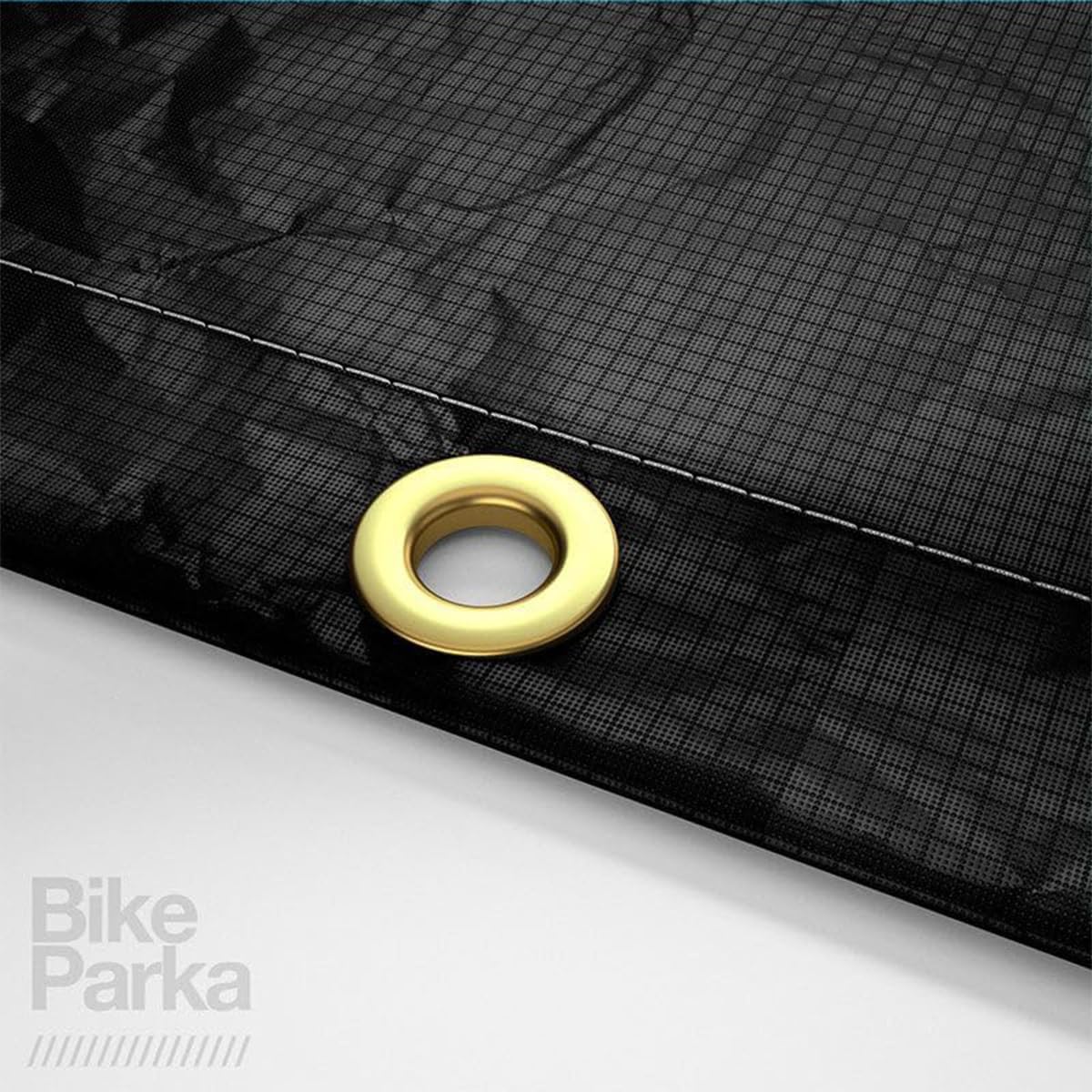
- Taped or heat-welded seams at the top panel and any zipper entry points
- Vented lower hem rather than a fully cinched elastic bottom
- UV inhibitor coating, often listed as “UV-resistant” or a specific UPF rating — UV degrades both the cover fabric and anything it’s pressing against over a full season
Security Integration
A cover on a $4,000 cargo bike is also a concealment device. Wirecutter and Electric Bike Review reader discussions both note that a cover with integrated tie-down loops or lock-pass eyelets — small reinforced holes through which you can thread a cable or chain lock without removing the cover — is worth prioritizing. This lets you cover and lock simultaneously rather than choosing between visibility reduction and security access.
Fit Considerations by Model
Tern GSD
The GSD’s party trick is its folding capability and compact geometry, but that compactness also means the rear rack system — particularly when configured with the Atlas Cargo Hold or running-board extensions — creates a boxy, asymmetrical rear profile. Tern’s own care documentation recommends removing the battery before long-term outdoor covered storage and storing it at a charge between 30–80 percent. That’s practical advice regardless of cover choice, but it also means your cover needs to be removable and re-applicable without drama, since you’ll be accessing the battery zone regularly.
Owners in long-run Electric Bike Review forum discussions consistently flag that the GSD’s dual kickstand (the DoubleKick) holds the bike at a slight rear lean, which causes some covers to slide toward the front wheel. Covers with a front tie-down strap that anchors to the fork or front axle are the better fit here.
RadWagon 4
Rad Power Bikes’ own storage FAQ recommends against leaving the RadWagon 4 uncovered in sustained sun exposure, specifically citing potential degradation of the wiring harness and brake hose UV coating over multi-season outdoor use. The RadWagon’s longer deck and the optional Caboose child seat add meaningful height and rear-profile bulk — covers sized for the base bike often don’t account for the Caboose’s molded back panel.
If your RadWagon runs a Caboose or any third-party child seat (Thule Yepp, iBert, etc.), measure the actual height from ground to the top of the seat back and add 3 inches before shopping covers. Most RadWagon-compatible covers are listed at approximately 84-inch length to clear the full deck.
Yuba Mundo
The Yuba Mundo v6 is the longest of the three and generates the most varied accessory configurations — Bread Basket panniers, Monkey Bars, the Baguette seat system, GoGo Kidz adapters. Yuba’s care documentation doesn’t prescribe a specific cover, but owner community sentiment (aggregated from Electric Bike Review’s Yuba-specific threads) points toward commercial-grade bicycle storage covers — the kind used by touring cyclists or small fleet operators — as the only category that reliably clears the full Mundo footprint. These typically run 90 inches or longer and are available in 150D–200D ripstop nylon construction.
The Decision Framework
Here’s the honest decision map based on published specs and owner-reported patterns:
If you park outdoors year-round in a wet or UV-intense climate — Pacific Northwest rain, Florida sun, coastal humidity — prioritize a cover with taped seams, a UV-inhibitor coating, and a vented lower hem. Don’t cheap out on seam quality; a $25 cover from a generic brand will fail at the top seam before the first rainy season ends. Budget $55–$90 for something that will actually last two to three seasons.
If you park in a covered space but still outdoors (carport, building overhang, parking garage) — UV and direct rain are less urgent; breathability becomes the primary concern. A lighter-weight 150D cover with good ventilation and secure tie-downs is the right trade. Budget $35–$60.
If storage is primarily indoor (garage, hallway, basement) — a cover’s main job is dust and abrasion protection. Material weight and waterproofing are irrelevant; fit and ease of application matter most. A lightweight nylon option in the $25–$40 range does the work.
If your bike carries a child seat — add the seat height to your measurement before every search, size up one tier from what the length alone suggests, and verify that the cover’s front-to-rear hem clearance accommodates the extended deck. No child seat brand — Thule, iBert, Hamax — is small enough to ignore when sizing a cover.
The Tern GSD’s compact geometry makes it the easiest of the three to cover; the Yuba Mundo’s length and accessory flexibility make it the hardest. The RadWagon 4 sits in the middle in both dimensions. In all three cases, the $45–$75 purpose-built longtail cover range — products explicitly marketed for electric cargo or longtail bikes — outperforms both generic covers and improvised solutions like tarps, which create their own airflow and abrasion problems.
A $4,500 cargo bike deserves a $60 cover. The math there is simple. The harder part is finding one that actually fits — and now you know exactly what to measure.