May 20, 2026 • Neil Hayes • 9 min reading time • Prices verified June 25, 2026
Hauling Groceries, Gear, and Everything Else: Cargo Bike Trailers That Actually Work
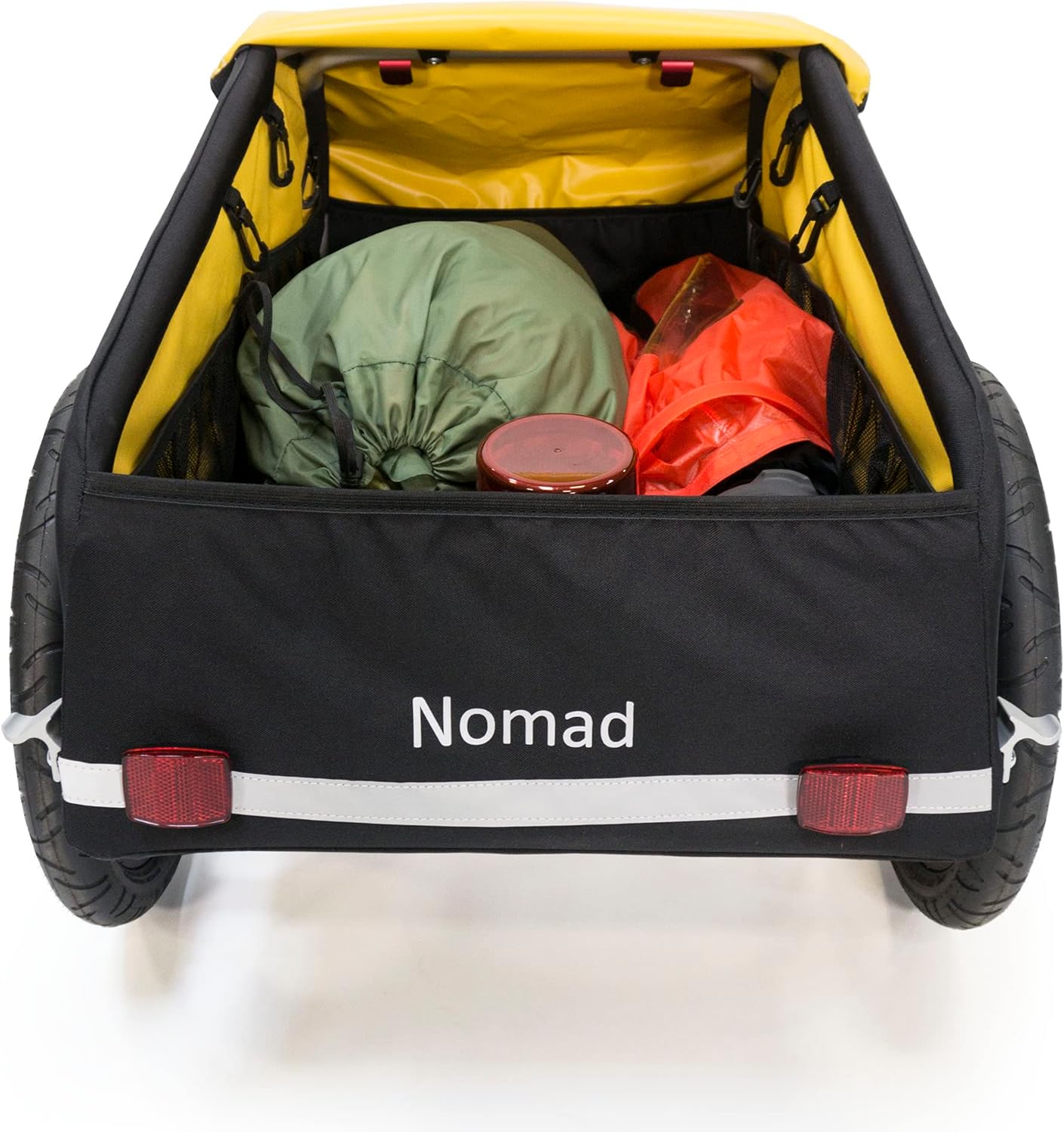
A cargo bike trailer is exactly what it sounds like: a two-wheeled platform you hitch to the back of a bicycle — standard, electric, or cargo — and use to carry things that won’t fit in a rack bag or panniers (the saddlebag-style pouches that clip to a rear rack). We’re talking a full week of groceries, a folded camping tent, a dog crate, a case of water bottles, or a combination of all four. For urban households trying to cut car trips, or families who’ve already invested in an electric cargo bike and want to push its utility further, the right trailer can shift the calculus from “almost car-free” to “actually car-free.” This guide is for readers who already understand the basics of cargo cycling and are now comparing specific trailer options — matching rated payload, hitch compatibility, folded dimensions, and real-world owner feedback to a purchase decision that’s already in motion.
What You’re Actually Deciding Between
Before comparing model names, it helps to name the three functional categories of cargo trailer on the market in 2026:
1. Platform/flatbed trailers. Open deck, minimal sidewalls, designed for bulky or irregularly shaped loads — lumber, coolers, event gear. Maximum flexibility, minimum weather protection.
2. Box trailers. Enclosed or semi-enclosed cargo area, often with a hard shell or roll-top cover. Best for groceries, parcels, fragile items. The format most people picture when they hear “cargo trailer.”
3. Convertible trailers. Designed to swap between cargo mode and child/pet mode. Higher price, broader utility. The Thule Chariot Cross is the canonical example of this category — though its child-transport ratings are its headline, its cargo deck is genuinely usable as a standalone hauler.
Most buyers in the $300–$900 range are choosing between a dedicated box trailer and a convertible. The tradeoffs between those two categories drive most of the decision math.
The Specs That Actually Govern Your Decision
Payload Rating
Manufacturer-published payload ratings — not loaded gross weight, not frame weight, payload — are the controlling number. If a trailer is rated for 100 lbs / 45 kg, that includes everything inside: groceries, gear, the cargo bag itself, your dog. BikeRadar’s cargo trailer buyer’s guide notes that a meaningful number of owners exceed published payloads in short-haul urban use without immediate failure, but the risk shifts from “trailer breaks” to “hitch system fatigues” over time, particularly on steel quick-release axle hitches under repeated load cycling.
Published payload benchmarks across common models (2025–2026 spec sheets):
| Trailer | Rated Payload | Cargo Volume | Approx. Price |
|---|---|---|---|
| Burley Flatbed | 100 lbs / 45 kg | Open deck | ~$350 |
| Aosom Elite II | 88 lbs / 40 kg | ~14 cu ft | ~$180–$220 |
| Thule Chariot Cross (cargo kit) | 99 lbs / 45 kg | ~550L deck | ~$2,500 |
| Burley Coho XC | 60 lbs / 27 kg | Soft bag | ~$430 |
| Wike Large Cargo | 110 lbs / 50 kg | ~23 cu ft | ~$500–$600 |
The Wike Large Cargo’s published 110 lb payload puts it at the top of the dedicated cargo category for 2025–2026. Outside Online’s 2024 cargo trailer roundup flags it as a consistent choice for grocery-and-bulk-goods haulers who don’t need multi-sport versatility.
Hitch System and Bike Compatibility
This is where owners most frequently report friction in first-year use. There are two dominant hitch standards:
- Axle-mount hitches clamp to the rear axle of your bike. They’re compatible with most bikes that have a standard quick-release or thru-axle (with an adapter). Rated towing forces are typically higher than frame hitches.
- Frame hitches mount to a dropout or rack mount point. Slightly easier to remove, but compatibility narrows with e-bike-specific rear dropouts — a real issue for RadWagon 4 and Tern GSD owners.
Electric Bike Review’s long-term RadWagon 4 owner roundup (2025) surfaces repeated notes from owners discovering that generic axle-mount hitches require adapter kits for the RadWagon’s 12mm thru-axle rear hub. The adapter usually costs $15–$30 and solves the issue, but it’s worth confirming before purchasing any trailer if you’re towing behind a mid-drive or hub-drive e-cargo bike.
Folded/Stored Dimensions
If you live in an apartment or store your setup in a shared garage, folded dimensions matter as much as cargo volume. The Burley Flatbed and Coho XC fold relatively compact; the Wike Large Cargo does not — owners consistently note it needs dedicated garage or basement storage. Bicycling Magazine’s 2025 trailer guide describes the Coho XC specifically as “the trailer for people who need real cargo capacity but also live in small spaces,” which is an accurate summary of the tradeoff.
Matching Trailer to Load Type — the Decision Framework
Most buyers in the practitioner tier are weighing one of three primary use cases. Here’s how the category math plays out:
Use Case 1: Grocery Replacement (Weekly Urban Shopping)
The load: 40–80 lbs of groceries, reusable bags, occasional bulk items (cat litter, case of water). Target: 2–4 shopping trips per week replaced by bike.
What matters most: Weather protection, easy loading height, secure closure, compatibility with your existing bike or e-cargo platform.
Best-fit category: Box trailer with hard or roll-top cover.
The tradeoff to name: A dedicated box trailer in the $180–$600 range gives you more cargo volume per dollar than a Thule Chariot Cross with cargo kit — but if you also have young kids or a dog and want one trailer to serve multiple roles, the Chariot earns its $2,500 price. If your use case is purely grocery hauling, spending $2,500 to get marginal cargo improvements over a $500 Wike is hard to justify on the numbers.
Use Case 2: Weekend Gear and Recreation Hauling
The load: Camping gear, sports equipment, folding chairs, coolers. Load weight varies 30–90 lbs; load shape is irregular.
What matters most: Open or convertible deck, high payload rating, stable tracking at moderate speeds.
Best-fit category: Platform or flatbed trailer, or the Chariot Cross in cargo mode.
The tradeoff to name: Open flatbeds let you bungee-strap a cooler or load a kayak paddle bag without fighting an enclosed shell. But they offer zero weather protection, and a sudden rainstorm on a 12-mile trail-head ride will destroy a sleeping bag. Either bring dry bags, or use a convertible with a roll cover.
PeopleForBikes’ 2025 e-bike infrastructure report notes a meaningful uptick in cargo cycling for recreational day trips among households in the 25–40 age bracket — the audience driving most of the Chariot Cross volume. That report doesn’t rate trailers directly, but the trend context matters: more multipurpose use is exactly why the convertible category is growing.
Use Case 3: Last-Mile Delivery or Small-Business Hauling
The load: Package delivery, market vendor goods, catering supply runs. Loads are repetitive, often at or near payload limits, daily.
What matters most: Hitch durability under load cycling, weatherproofing, ease of hitching/unhitching, total cost of ownership.
Best-fit category: Purpose-built cargo trailer from a brand that offers replacement hitch hardware and structural components.
The tradeoff to name: Consumer-grade box trailers at $180–$220 (the Aosom category) are not rated for daily commercial use. Frame welds and hitch joints fatigue faster under repeated near-capacity loads. For fleet operations running multiple bikes, the Wike or a commercial-grade option becomes the right comparison set — and at that point, per-unit price differences of $200–$300 are minor relative to downtime risk if a hitch joint cracks mid-route.
The Numbers That Govern Practical Capacity
A useful reality check on cargo volume claims:
- A standard U.S. grocery run for a family of four averages 30–50 lbs of goods (USDA food expenditure data, 2024)
- A full week of groceries for two adults typically fits inside 10–14 cubic feet of cargo space
- The Wike Large Cargo’s published 23 cu ft volume is roughly equivalent to a mid-size car trunk — in practice, that’s more space than most urban grocery trips require
- E-bike towing range penalty: owners consistently report a 10–20% reduction in assisted range when towing a loaded trailer; Electric Bike Review’s fleet-owner data on the RadWagon 4 puts average range reduction closer to 15% under 50 lb loads
Common Mistakes Buyers Make at This Stage
Over-speccing payload, under-speccing hitch compatibility. Spending energy comparing 88 lb vs. 100 lb payload ratings while ignoring whether the hitch ships with the correct axle adapter for your specific e-bike dropout. Confirm hitch compatibility first; payload second.
Ignoring folded footprint until delivery. Several buyers in long-run review threads across BikeRadar’s reader feedback sections describe the unboxing moment as the point they realized a large cargo trailer doesn’t fit through a standard apartment door in transit configuration. Measure your storage path, not just your storage space.
Treating the Thule Chariot as “basically the same as a cargo trailer.” It isn’t. The Chariot Cross is engineered to child-transport standards first — that’s why it costs $2,500. Its cargo capacity in cargo-kit mode is solid, but you’re paying a significant premium for child-safety certification, multi-sport suspension, and build quality that exceeds what most cargo-only buyers need. If you don’t have (or plan to have) young kids or a dog requiring the child/pet seat configurations, the value case for the Chariot over a $500 dedicated cargo trailer is genuinely weak.
If X, Then Y — The Decision Rule
If your primary use is grocery and urban errand replacement on an existing e-cargo or standard bike, and storage space is not severely constrained: → Wike Large Cargo is the best-documented value in the dedicated cargo category at 2026 prices.
If you need a trailer that works for both cargo hauling and child or pet transport, and your budget supports $2,000+: → Thule Chariot Cross with cargo kit is the defensible choice — you’re not overpaying for cargo capacity, you’re paying for the multi-use architecture.
If you’re running a small-business or fleet operation with daily near-capacity loads: → Prioritize hitch warranty and replacement-parts availability over headline cargo volume. The Burley commercial-adjacent options and Wike are the starting points; confirm with the vendor that structural replacement parts ship within your operational geography.
If budget is the binding constraint and loads stay under 80 lbs: → The Aosom Elite II is a legitimate starting point at $180–$220. Owners report it performs well for light grocery and gear use. It won’t last five years under daily commercial loads, but for weekend and moderate weekly use, the cost-of-entry math is hard to argue against.
The trailer category has expanded meaningfully since 2023, and the spec floors have risen across all price tiers. There’s no longer a case for buying a trailer that doesn’t fit your specific bike’s hitch interface — the information to confirm compatibility is published, and the cost of getting it wrong is two return shipments and a lost riding week.