May 20, 2026 • Neil Hayes • 11 min reading time • Prices verified June 25, 2026
Cargo Bike Trailers for Fishing, Camping, and Off-Pavement Hauling: What Holds Up
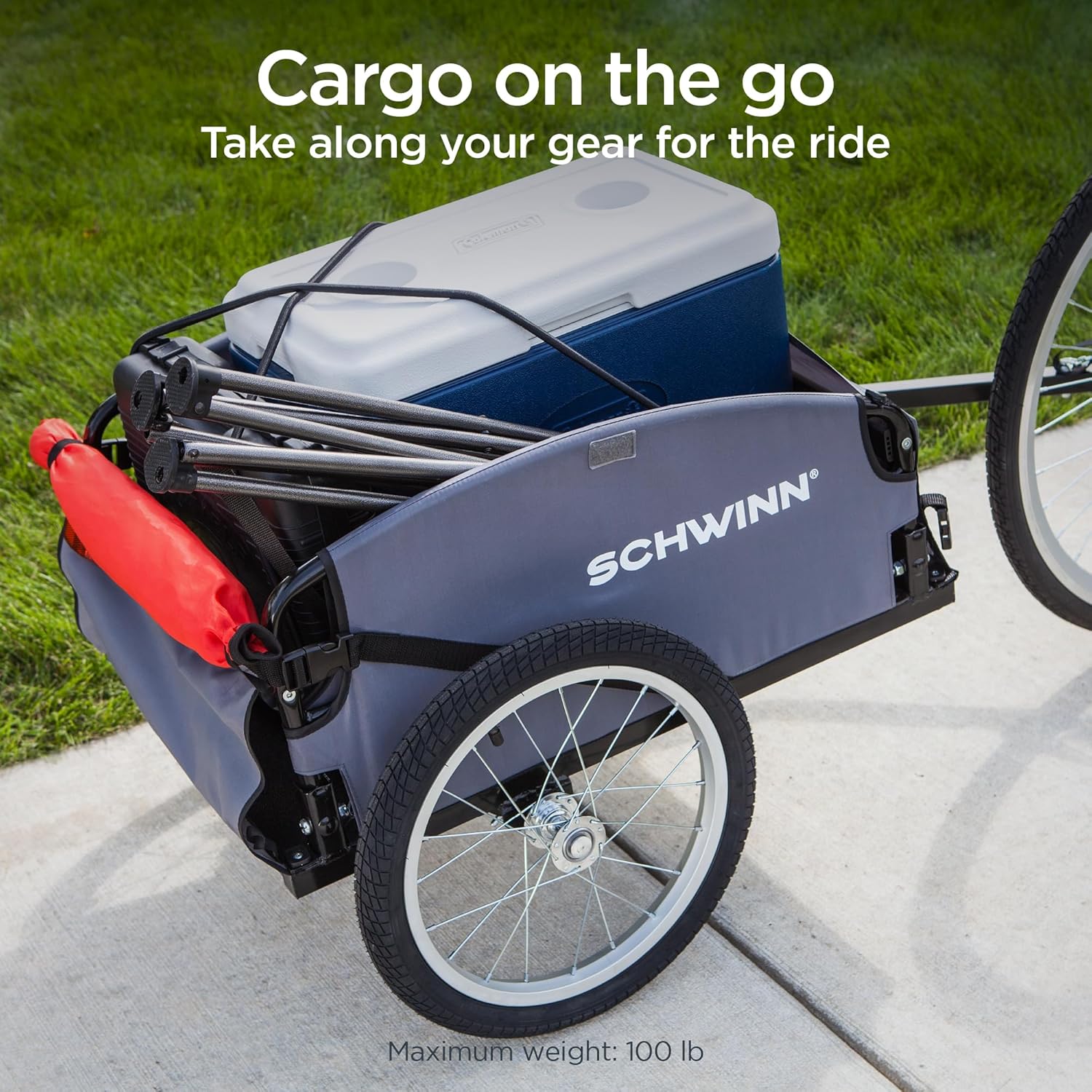
A cargo bike trailer is exactly what it sounds like: a wheeled cart that hitches to the rear of your bicycle — including electric cargo bikes (e-bikes with a motor that assists pedaling) — and lets you carry loads your bike rack alone could never handle. For most riders, trailers mean groceries or kids. But a growing segment of outdoor enthusiasts is using them for something different: hauling deer out of the woods, dragging coolers to a campsite, or running fully loaded weekend bikepacking setups down gravel trails. If that’s the use case you’re evaluating, the mainstream trailer market has some real answers — and a few genuine traps. This guide works through the trailers that show up most consistently in outdoor hauling conversations, surfaces the owner-reported failure modes, and gives you a decision framework before you commit.
| EDITOR'S PICK[Rambo Bikes Aluminum Bike Trail…](https://www.amazon.com/dp/B01BY7HTX8?tag=greenflower20-20) | Mid-tier[Schwinn Daytripper Bike Cargo T…](https://www.amazon.com/dp/B01N260A8D?tag=greenflower20-20) | Budget pick[Retrospec Rover Hauler Bike Car…](https://www.amazon.com/dp/B09383XCXK?tag=greenflower20-20) | |
|---|---|---|---|
| Weight Capacity | 300 lbs | 100 lb | 80 lb |
| Frame Material | 6061 Aluminum | — | — |
| Tire Type | 16" Fat Tires | 16" Air-Filled | — |
| Folding Frame | — | ✓ | ✓ |
| Safety Flag | — | — | ✓ |
| Interior D-Rings | — | ✓ | ✓ |
| Price | $349.99 | $179.99 | $159.99 |
| See on Amazon → | See on Amazon → | See on Amazon → |
The Outdoor Hauling Landscape: What You’re Actually Choosing Between
The trailer market splits cleanly into three tiers once you filter for off-pavement and heavy-haul intent.
Purpose-built outdoor/game trailers — products like the Rambo Game Cart — are designed from the ground up for field use. They prioritize raw capacity, flat-bed or mesh-platform load surfaces, and terrain clearance over road manners.
All-terrain touring trailers — the Burley Nomad is the canonical example — live between worlds. They’re road-capable enough for a loaded commute but have enough structure to handle gravel, light trail, and multi-day camping weight.
General-purpose cargo trailers with outdoor utility — the VEVOR, Retrospec Rover, and Bakcou fall loosely here, though Bakcou comes with important caveats. These are flat-deck or cargo-box designs that work for hauling kayaks, gear bins, or bulky outdoor equipment, with stability and speed behavior that varies considerably by model.
Knowing which tier actually matches your use case matters more than any single spec comparison, because the failure modes are completely different across categories.
The Trailers Worth Knowing in Detail
Rambo Game Cart: The Outlier That Earns Its Reputation
Rambo built their game cart for one job — dragging harvested animals and hunting gear out of backcountry terrain — and owner reports reflect that singular focus with unusual consistency. One owner documents hauling a 135-pound passenger plus additional gear across a mile of uneven terrain, and another review specifically calls out hauling a deer as the practical test case. That kind of specificity is rare in a product review pool, and it anchors the Rambo’s real-world ceiling more credibly than any spec sheet.
The design uses a two-wheel platform with a heavy-duty steel frame, oversized pneumatic tires (air-filled tires that absorb ground irregularity), and a flat deck that accepts straps, nets, or dry bags. There’s no enclosed cargo box, which means it’s exposed to rain — factor in dry bags or a cargo cover for anything moisture-sensitive.
The Rambo connects via a standard hitch receiver, which gives it broad e-bike compatibility but also means you’ll want to verify your specific hitch setup before assuming it drops-in. Manufacturer-rated capacity sits high enough for serious field use; the owner reports suggest it performs at that rating under real conditions rather than theoretical ones.
Best for: Hunters, anglers hauling coolers and equipment over dirt, anyone who needs raw load capacity and genuine terrain tolerance and doesn’t need a weatherproof enclosure.
Bakcou Trailer: Real Capability, Real Speed Limit
The Bakcou trailer is frequently recommended in e-bike hunting communities, and it carries legitimate outdoor credentials. But there’s a safety pattern in the owner review pool that warrants direct attention: at least one owner discovered — after the fact — that the trailer’s 10 mph speed limit is structural, not just conservative advice. Operating above that threshold on loaded runs resulted in the trailer tipping.
The fix documented by owners is the addition of axle extensions — hardware that widens the trailer’s stance and meaningfully increases rollover resistance at higher speeds. Without them, the narrower default axle geometry makes the trailer genuinely unstable under load once you exceed the stated speed. This isn’t a defect in the sense of a broken part; it’s a design characteristic that requires a specific modification to operate safely outside a narrow speed window.
If you’re riding predominantly on flat, slow trail with modest speeds — the intended hunting/field use case — the Bakcou performs as advertised. If you’re connecting to paved roads, riding e-bike speeds (20+ mph), or descending grades with a loaded trailer, axle extensions are not optional. Factor that into your total budget and setup before purchase.
Best for: Controlled-speed field hauling where terrain and pace stay within the 10 mph envelope, or riders who source and install axle extensions before first use.
Burley Nomad: The Touring Standard With a Fabric Caveat
The Burley Nomad occupies a different design space than the game-cart trailers above. It’s an enclosed cargo trailer — a rigid frame with a fabric cargo body — built for loaded touring and camping. Owner reports describe fitting complete two-person camping kits inside: tent, sleeping bags, pads, cooking gear, and clothing. That’s not an exaggeration of the trailer’s volume; it reflects a well-designed interior with genuine carry capacity.
The Nomad’s hitch is a Burley-proprietary coupler that installs on the rear axle of your bike. It’s smooth on pavement, tracks predictably, and handles gravel well for a loaded touring setup. Electric Bike Review’s coverage of cargo e-bike setups consistently notes that axle-mounted hitches distribute load stress more evenly than seat-post attachments under sustained heavy use, and the Nomad’s design reflects that principle.
There is a documented limitation worth flagging. A Spanish-language reviewer, writing about heavy repeated loads, noted wear holes developing in the sidewall fabric over time — rubbing damage from contact with the cargo. This isn’t a waterproofing failure per se; it’s structural wear from hard-edged gear repeatedly contacting the interior. Burley describes the Nomad as water-resistant rather than fully waterproof. That distinction is real: it handles rain splash and light precipitation well, but it is not a dry bag. Sustained rain or river crossings require additional liner protection.
Best for: Multi-day camping tours, loaded gravel and mixed-surface routes, anyone who wants enclosed carry volume for a complete outdoor kit.
VEVOR Cargo Trailer: Stability as the Headline Feature
VEVOR sits in the value end of the cargo trailer market, and the owner review pattern for their bike cargo trailer is notably consistent on one specific point: zero sway and stable road behavior. For first-time trailer buyers — or anyone who has ever white-knuckled a wobbly load behind a bike — this matters more than it might sound. Sway (the side-to-side oscillation of a trailer under speed or when braking) is the most common and most alarming characteristic of underdamped trailer designs. Owners specifically naming its absence is meaningful data.
VEVOR’s trailer is a flat-deck design, so it’s not oriented toward enclosed camping gear storage. It works well for bulky, tie-down-friendly loads: coolers, dry bags, kayak accessories, firewood, or bin-based organization. Off-pavement performance is limited by ground clearance compared to the Rambo or Bakcou, but for mixed-surface routes that are primarily paved or hardpack gravel, owner reports suggest it handles without drama.
Best for: Mixed-terrain hauling where road manners and stability matter, gear that doesn’t need weatherproof enclosure, riders who prioritize predictable behavior over maximum terrain clearance.
Retrospec Rover: The Tracking Quirk You Should Know About
The Retrospec Rover is a lighter-duty, budget-accessible cargo trailer that appears in outdoor hauling conversations primarily for its price point and accessibility. There is one recurring observation in owner reviews worth calling out directly: an off-center tracking tendency — meaning the trailer doesn’t always follow perfectly in line behind the bike and pulls slightly to one side under load.
Multiple owners have noted this, and the consistent description frames it as a design characteristic rather than a manufacturing defect. Whether that distinction changes your evaluation depends on your use case. For relaxed trail riding at moderate speed with moderate loads, the behavior is reportedly manageable. For high-speed road sections, sustained loaded grades, or precision maneuvering in tight spaces, it’s a handling quirk you’d be managing continuously.
Best for: Light outdoor hauling at casual pace, budget-constrained buyers who can accept handling idiosyncrasies, low-intensity use cases where the tracking tendency doesn’t compound.
By the Numbers
| Trailer | Published Capacity | Terrain Target | Enclosure | Key Limitation |
|---|---|---|---|---|
| Rambo Game Cart | High (field-rated) | Off-road, uneven terrain | Open deck | No weather protection |
| Bakcou | Moderate-High | Off-road/field pace | Open deck | 10 mph structural limit without axle extensions |
| Burley Nomad | Moderate | Touring/gravel | Enclosed fabric | Fabric wear under hard loads; water-resistant, not waterproof |
| VEVOR | Moderate | Paved/hardpack gravel | Open deck | Limited ground clearance off-pavement |
| Retrospec Rover | Light-Moderate | Paved/light trail | Open deck | Off-center tracking tendency |
Frequently Asked Questions
What is the realistic safe speed for towing a loaded cargo trailer behind an e-bike?
Most cargo trailer manufacturers rate their products in the 10–15 mph range under loaded conditions. The Bakcou’s owner-reported tipping incident at above 10 mph is an extreme example of what happens when you treat speed limits as conservative rather than structural. E-bikes are capable of 20–28 mph depending on class (Class 1, 2, or 3 in U.S. motor-assist categories), and many riders assume their trailer can keep up. It often cannot safely. As a working rule: treat 10–12 mph as your loaded trailer ceiling on anything but smooth, flat pavement, and verify your specific trailer’s rating before pushing it on descents.
Does a seat-post hitch attachment hold up better than an axle hitch for heavy loads?
Axle-mounted hitches are generally considered more structurally sound for sustained heavy loads. The seat-post hitch (which clamps to the post below the saddle) transfers load stress into a tube that wasn’t designed as a structural anchor point. For light urban loads it’s convenient; for camping weight or outdoor field hauling, axle mounts distribute force more favorably. BikeRadar’s cargo trailer coverage consistently notes this distinction when evaluating trailers for loaded touring use.
Can you haul a full camping kit for two people in a single bike trailer?
Yes — with the right trailer. Burley Nomad owners specifically document doing exactly this, listing complete tent, sleep, and cooking systems fitting inside. The constraints are volume (interior dimensions matter more than raw weight rating for camping gear) and weather protection. A full kit in an enclosed trailer like the Nomad handles light rain; you’ll want gear liners or dry bags inside if you’re riding in sustained precipitation.
How do you modify a trailer hitch when the hole doesn’t fit your e-bike axle?
This is a real and common problem. E-bike axles — particularly on cargo bikes — vary in diameter (common sizes are 12mm, 15mm, and 20mm thru-axles versus older 10mm quick-release standards). If your trailer hitch hole doesn’t match your axle, the options are: source an adapter sleeve from the trailer manufacturer, have a machinist turn a simple aluminum bushing, or purchase a third-party universal hitch adapter. Bakcou owners dealing with axle extension modifications have documented this process in detail. Always verify hitch compatibility with your specific bike’s axle spec before ordering.
Is the Burley Nomad actually waterproof or just water-resistant?
Water-resistant. Burley’s own documentation does not claim waterproof status for the Nomad’s fabric body, and the distinction is real in field conditions. The trailer handles road splash, light rain, and brief wet-weather riding without soaking cargo. Prolonged rain, stream crossings, or sustained downpour exposure will find the limits of the fabric. Use dry bags or a waterproof liner for anything moisture-sensitive on multi-day tours.
What happens if you exceed the stated weight capacity of a bike cargo trailer?
The consequences range from accelerated wear to structural failure depending on how far over capacity you run and under what conditions. The immediate risks are axle stress (bending or fatigue cracking), hitch coupler failure, and reduced braking performance — a heavier trailer extends stopping distance significantly. The Bakcou tipping incident is a documented example of what exceeding design parameters looks like in practice. Manufacturer ratings are not conservative suggestions; they reflect tested structural limits.
The Decision Rule
If you’re hauling game, large coolers, or bulky field equipment over genuine off-road terrain at controlled field pace: the Rambo Game Cart’s purpose-built design and owner-verified capacity ceiling make it the clear starting point.
If you’re loading a complete camping kit and riding mixed-surface touring routes: the Burley Nomad’s enclosed volume and road manners are the practical choice — buy liner bags for wet weather, and don’t push sharp-edged hard goods against the sidewall fabric.
If you’re e-biking at road speeds with outdoor gear and want stability as your primary requirement: the VEVOR’s owner-reported zero-sway behavior addresses the most common first-time trailer concern directly.
If you’re evaluating the Bakcou: source the axle extensions before your first loaded ride. The 10 mph limit is real.