June 24, 2026 • Neil Hayes • 11 min reading time • Prices verified June 25, 2026
Securing Your Load: Ratchet Straps, Bungee Nets, and Cargo Locks for Bikes and Trailers
If you’ve ever watched a grocery bag slowly tip off a rear rack mid-ride — or arrived at your destination to find that the bungee cord you stretched over your load had done absolutely nothing — you already understand why cargo securing matters. This guide covers three distinct tool categories that cargo cyclists, trailer users, and bike haulers routinely mix up: ratchet straps (webbing straps with a mechanical tightening mechanism, designed to hold heavy, stable loads firmly in place), bungee nets (elastic mesh coverings that conform to irregular loads like bags or produce), and cargo locks (everything from U-locks to cable locks to combination locks used to secure a bike or attached cargo to a fixed object). Each has a job it excels at — and a job it can quietly fail at. By the end of this article, you’ll have a clear decision framework for which product type belongs where in your setup, plus honest answers to the questions that keep coming up in owner reviews and forums.
Why the Right Tool Matters More Than You’d Expect
The pattern that emerges across aggregated owner reviews is consistent and a little humbling: buyers don’t make bad decisions because they’re careless — they make them because the product categories genuinely overlap in appearance without overlapping in function.
A ratchet strap and a bungee cord both stretch across a load. A cable lock and a dedicated wheel stabilizer strap both wrap around a bike wheel. But the failure modes are completely different.
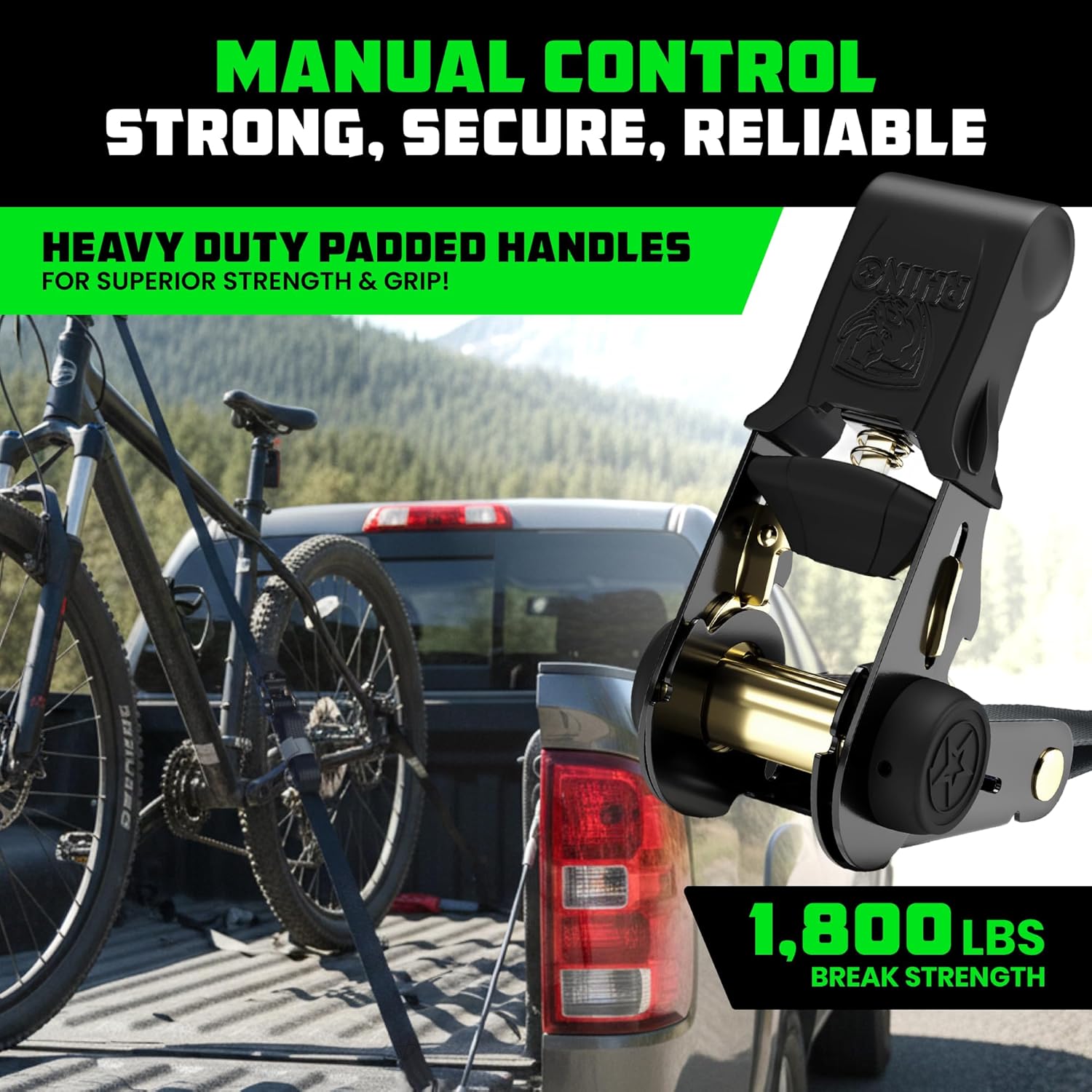
Ratchet straps are built for compressive, high-load applications. The ratcheting mechanism — a toothed spool that locks webbing in one-way increments — lets you apply and maintain tension that elastic products simply can’t sustain. Rhino USA’s 1-inch ratchet straps, for instance, are manufacturer-rated at 500 lbs working load limit (WLL), with a break strength of 1,500 lbs. Reviews across that product line include ATV haulers and e-bike carrier users in the same thread — which confirms that cargo cyclists are already shopping in powersports tie-down territory, and rightfully so when the load justifies it.
The tradeoff: ratchet straps overtighten easily, and on soft cargo (a bag of flour, a cardboard box, a child’s bicycle frame) the concentrated pressure of webbing can cause real damage. They’re also slow to rig and de-rig daily, which matters if you’re loading a cargo bike every morning.
Bungee nets are the answer to irregular, lightweight, compressible cargo — the stuff that doesn’t need to be strapped down so much as contained. One of the more instructive reviews floating through the cargo cycling community documents a 30-mile daily commuter who switched from loading panniers (saddlebag-style bags that clip to a rear rack) each morning to simply dropping items into a rear basket covered by a bungee net. The net’s elastic hooks catch the basket’s edges and the mesh conforms to whatever is stacked inside. The workflow improvement was the point — not security, not load rating. Bungee nets don’t hold a load; they hold it in. That’s a meaningful distinction.
Individual bungee cords — single elastic lines with hooks at each end — are frequently misused as the poor substitute for a bungee net. The net distributes tension across a mesh surface; a single cord creates two anchor points and a pressure ridge that shifts as the load shifts. For anything that can roll, tip, or redistribute weight while you ride, a net is almost always the better tool.
Wheel Stabilizer Straps and Bike Rack Securing: The Undersold Category
If you transport bikes on a hitch rack or roof rack — or if you’re a cyclekart builder moving a partially assembled frame to a shop — wheel stabilizer straps (also called wheel straps or wheel cradle straps) deserve a dedicated mention.
These are short, hook-and-loop or ratcheting straps designed specifically to wrap around a bike tire and anchor it to a carrier tray. They prevent the fore-aft rocking that happens when arm clamps alone hold the frame: the bike is secured at one point, but the wheel can still oscillate, fatiguing the clamp’s contact points and eventually scratching the frame.
Owner reviews consistently show that buyers who switched from improvised solutions — including bungee cords looped around spokes, zip ties, and yes, full ratchet straps across the tire — to dedicated wheel stabilizer straps are uniformly more satisfied. The category is undersold relative to its actual usefulness, possibly because it’s positioned as an accessory add-on rather than a necessary component of bike transport.
By the Numbers
| Securing Tool | Typical WLL or Rating | Best Use Case | Common Misuse |
|---|---|---|---|
| 1” Ratchet Strap (e.g., Rhino USA) | 500 lbs WLL | Heavy rigid cargo, bike transport on carriers | Over-tightening on soft or frameless loads |
| Bungee Net (medium, 18”–24”) | Unrated — containment only | Loose items in baskets, bags on rear racks | Substituting for a tie-down on heavy cargo |
| Wheel Stabilizer Strap | Application-specific | Bike wheels on hitch/roof racks | Using ratchet straps across tires |
| Cable Lock (e.g., Master Lock Python) | Resistance level 4–5 of 10 | Secondary lock, accessory securing | Sole lock for high-value e-bikes |
Cargo Locks: Matching Security Level to Risk and Dwell Time
Locks are where the tradeoffs become most politically charged in owner communities — and where honest editorial analysis matters most.
The Master Lock Python cable lock reviews are a useful case study. Reviewers openly debate security versus convenience in a way that’s more sophisticated than typical consumer reviews: they’re not asking “is this lock good?” — they’re asking “is this lock appropriate for this situation?” The consensus answer is nuanced. A Python-style cable lock (a coated steel cable, typically 5–6 feet long, looped through a frame and anchor point) is genuinely convenient for short stops, low-theft-risk environments, and secondary securing of accessories. It is not a serious deterrent for a committed thief with bolt cutters targeting a $4,500 e-bike left unattended for two hours in a city.
BikeRadar’s comparative lock review notes that cable locks typically rate between 4 and 5 out of 10 on independent security scales — adequate for deterring opportunistic theft (someone who’d grab an unlocked bike), not adequate for defeating a prepared thief. That distinction should drive your decision, not the lock’s price point.
At the other end of the spectrum, the Sportneer combination lock reviews surface an entirely different buyer: parents purchasing lighter locks for children who are developing independence and need something they can operate themselves without a key. That’s a legitimate use case that a heavy-duty Kryptonite U-lock doesn’t serve. Security maximization isn’t the only design axis; usability for the actual user matters.
The practical framework that emerges from Bicycling magazine’s guidance on lock hierarchy is worth internalizing: use the most substantial lock you can realistically carry and use consistently, plus a secondary deterrent. A lock left at home because it’s inconvenient provides zero security. A medium-security U-lock you actually use, every time, is better than a gold-standard lock you leave in the pannier.
For cargo e-bikes specifically — a Tern GSD, a RadWagon, a Riese & Müller Load — Electric Bike Review’s cargo e-bike buyer guidance consistently reflects owner sentiment: a single cable lock is insufficient as the sole security measure for a bike in this price tier. The minimum recommended configuration for extended outdoor parking is a quality U-lock through the frame and rear wheel, plus a secondary cable or chain through the front wheel or any attached cargo.
Keeping Bags and Soft Cargo on a Rear Rack
One recurring search pattern in this category is “how do I keep a backpack on a rear rack without panniers?” — which is exactly the kind of problem a bungee net or a pair of cargo net hooks solves neatly.
A backpack’s shoulder straps create a naturally unstable geometry when placed flat on a rack: nothing anchors the bag laterally, and the straps can catch the rear wheel. The cleanest solutions, based on owner-reported workflows:
- A bungee net over the entire rack load — hooks onto the rack rails, mesh conforms to the bag’s shape, lateral movement is contained.
- Two individual bungee cords in an X-pattern — hooks at four anchor points on the rack, bag pinned under the crossing point. Less elegant than a net but functional for a single regular bag shape.
- A cargo strap threaded through the bag’s carry handle and around the rack post — buckle straps (non-elastic, with a side-release buckle) work well here where elasticity isn’t needed.
What doesn’t work reliably: a single bungee cord looped over the top of the bag. It creates one pressure point, no lateral restraint, and the cord migrates toward the lightest-tension point — usually right to the edge of the rack.
Frequently Asked Questions
Can I use a ratchet strap to secure a bike on a hitch rack instead of dedicated wheel straps?
Technically you can, but it’s not the right tool. A ratchet strap’s mechanism is designed for sustained high tension across rigid cargo — applying that to a bike tire creates uneven pressure that can deform a lightweight rim or pinch-flat the tire. Dedicated wheel stabilizer straps are designed to secure the tire with appropriate, even tension. Owners who made the switch from improvised ratchet strap setups to proper wheel straps consistently report less frame movement and no tire damage.
What is the difference between a bungee net and individual bungee cords for cargo bikes?
A bungee net distributes tension across a mesh surface with multiple anchor points, conforming to irregular loads and preventing lateral movement. Individual cords create point pressure and two-anchor geometry that shifts as the load shifts. For loose or irregularly shaped cargo, a net is almost always more effective. Individual cords work adequately for a single, defined object with obvious hook points.
Are wheel stabilizer straps necessary if my bike rack already has arm clamps?
Arm clamps hold the bike upright and prevent lateral fall — they don’t prevent fore-aft wheel oscillation while driving. That rocking fatigues the clamp contact points and can cause frame wear. Wheel straps address a different axis of movement than arm clamps do. For short, smooth rides, clamps alone may be sufficient; for highway transport or rough roads, wheel straps add meaningful stability.
How do I keep a backpack or bag secure on a rear rack without panniers?
A bungee net over the rack load is the cleanest solution — it hooks to the rack rails and conforms to the bag. Two bungee cords in an X-pattern work as a backup. A single cord over the top of the bag provides inadequate lateral restraint and is not a reliable solution.
Is a cable lock sufficient for securing a cargo e-bike in an urban environment?
For a short stop in a low-risk setting — a few minutes outside a shop — a cable lock is a reasonable deterrent against opportunistic theft. For extended parking of a high-value cargo e-bike in an urban environment, no: a cable lock alone is insufficient. Independent security ratings consistently place cable locks at the lower end of the deterrence scale. Use a quality U-lock as your primary, and a cable or chain as a secondary.
What is the minimum lock setup I should use for a bike left outside for several hours?
A hardened steel U-lock (rated at security level 7 or higher on independent scales) through the frame and rear wheel, anchored to a fixed object. Add a secondary cable through the front wheel. For cargo e-bikes, also secure any removable battery with a dedicated lock or take it with you. Per Bicycling’s guidance, the lock you’ll actually use consistently is better than the lock rated higher that stays home.
The Decision Rule
If you’re standing in the aisle (or on a product page) trying to decide what you actually need, here’s the honest if/then framework:
- If your cargo is heavy, rigid, and needs to stay put under load → ratchet strap, sized to the job (1-inch for bikes and light cargo, 2-inch for heavy platforms).
- If your cargo is loose, irregular, and needs to be contained rather than clamped → bungee net.
- If you’re transporting bikes on a carrier rack → wheel stabilizer straps in addition to arm clamps, not instead of them.
- If you’re locking a sub-$500 bike for a short stop → a quality cable lock is a proportionate tool.
- If you’re locking a cargo e-bike worth $2,000–$5,000+ for more than 30 minutes outdoors → U-lock primary, cable secondary, and treat the battery as a separate item to secure or remove.
The common thread across all the owner sentiment and published guidance in this category: the failure mode is almost never the product — it’s the mismatch between product and application. Buy the right tool for the job, and it will work exactly as advertised.