October 5, 2026 • Neil Hayes • 11 min reading time • Prices verified June 25, 2026
Cargo Bike Trailers for Grocery Runs: Removable Box vs. Open Flatbed vs. Fabric Bed Compared
A cargo bike trailer is exactly what the name sounds like: a two-wheeled cart you hitch to the rear axle of a bicycle or e-bike and pull behind you, giving you grocery-store-scale carrying capacity without a car. The three formats you’ll encounter most often are the removable-box trailer (a hard plastic or composite tub that unclips from the frame so you can wheel it into a store), the open flatbed (a bare deck with no walls, built for maximum versatility), and the fabric-bed trailer (a metal frame wrapped in textile sides, collapsible, and typically the lightest option). Each solves the grocery-run problem differently. This article pulls from manufacturer specification sheets, aggregated verified-purchase owner feedback, and category guidance from Bicycling.com’s cargo trailer buying guide, Electric Bike Review’s cargo hauling accessories overview, and BikeRadar’s cargo bike and trailer category coverage — so you can match a format to how you actually shop and how far you’ll actually haul.
If you’ve already owned one trailer and are considering an upgrade, or you’re comparing three browser tabs right now, you’re in the right place. The specs, the durability flags, and the “if X, then Y” decision rules are all below.
| EDITOR'S PICKBurley Flatbed Bicycle Trailer… | Mid-tierSchwinn Daytripper Bike Cargo T… | Budget pickSportneer Bike Lock: 5 Digit Co… | |
|---|---|---|---|
| Max load | 100 lbs (45 kg) | 100 lb | — |
| Deck size | 33.0 × 30.9 in | — | — |
| Folding frame | — | ✓ | — |
| Wheel type | — | 16-inch air-filled | — |
| Universal coupler | — | ✓ | — |
| Tie-down points | — | ✓ (interior D-rings) | — |
| Price | $319.95 | $179.99 | $13.99 |
| See on Amazon → | See on Amazon → | See on Amazon → |
The Three Formats: What You’re Actually Choosing Between
Removable-Box Trailers (Aosom, PEXMOR)
The pitch is compelling: detach the cargo container at the store entrance, set it on its built-in wheels, and roll it through the aisles like an oversized cart. In practice, owners of Aosom and PEXMOR removable-box trailers consistently praise this workflow in verified purchase reviews — it eliminates the “how do I secure my loaded trailer outside while I shop” anxiety that plagues every other format.
The tradeoff is material longevity. Aggregated PEXMOR owner reviews include a frequently cited account of the factory plastic box becoming noticeably brittle after roughly 18 months of regular use, with the owner proactively rebuilding the container from plywood before it cracked under load. That is not an isolated complaint; it is a design-category signal. Injection-molded polypropylene containers are cost-effective at the manufacturing stage but poorly suited to repeated UV exposure, temperature cycling, and the torque stresses of bumpy pavement. If you are shopping this format, treat the box as a consumable and factor a potential rebuild or replacement into your total cost of ownership.
QC flag worth naming: Both Goplus and PEXMOR trailers have drawn recurring missing-hardware complaints in aggregated verified purchase reviews. The pattern is consistent enough — across two independent brands — to suggest a warehouse kitting issue common to this import tier. Budget 20–30 minutes for a parts-list inventory check before your first assembly, and keep the vendor’s support contact handy.
Capacity note: Per published PEXMOR manufacturer specification documents, this trailer system is rated to 100 lb. The removable box alone carries a lower standalone rating when used as a rolling cart without the frame.
Sportneer
$13.99
In stock on Amazon
Check price on AmazonOpen Flatbed Trailers (Burley Flatbed)
The Burley Flatbed earns a different kind of loyalty. Owner reviewers describing it as “surprisingly efficient” on empty-trailer drag aren’t exaggerating — an open steel deck with no walls creates minimal wind resistance compared to a box trailer acting as a sail. For utility cyclists who pull a trailer daily and feel the difference between loaded and unloaded resistance, this matters over the course of a week of grocery runs. BikeRadar’s cargo bike and trailer category coverage has consistently noted that flatbed geometry rewards riders who prioritize hauling efficiency over cargo containment.
The flatbed format is also the most honest about its limitations: there are no walls, so you become the load-management system. Milk crates, cargo nets, bungee grids, and reusable grocery totes all work well on the open deck. Operators who use milk crates report they can stack two high comfortably within the frame footprint. Per the Burley Design Flatbed Cargo Trailer product specification sheet, the rated capacity is 100 lb — and owners who tour with it report carrying genuinely heavy loads, including camp gear, tool kits, and bulk dry goods, without the ratcheting adjustment anxiety that comes with soft-sided options.
If your grocery runs involve irregular shapes — a flat of plants, a case of water plus a watermelon, anything that won’t fit inside a box — the flatbed’s open deck wins by default.
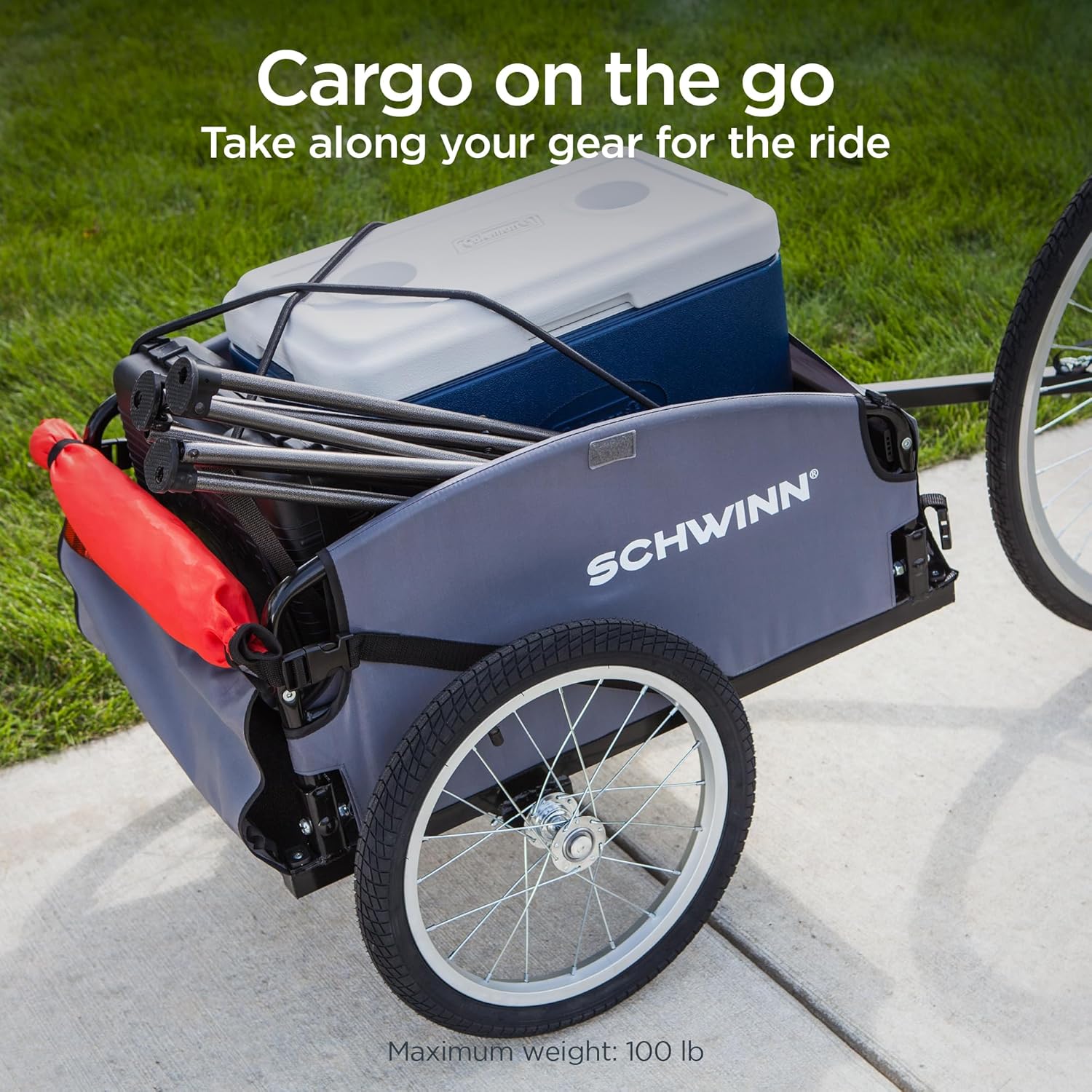
Schwinn
$179.99
In stock on Amazon
Check price on AmazonFabric-Bed Trailers (Burley Nomad, VEVOR)
Fabric-bed trailers are the most popular format by unit volume, and the dominant buyer anxiety across this category is trailer sway — the side-to-side oscillation that develops at speed, especially when loaded asymmetrically. Aggregated VEVOR owner reviews specifically and repeatedly call out the absence of sway as a defining positive. That pattern is not a coincidence; VEVOR’s hitch geometry and wheelbase appear tuned to dampen oscillation, and it has become a differentiator owners notice unprompted.
The Burley Nomad is the touring-validated option in this format. Per the Burley Design Nomad Cargo Trailer product specification sheet, the rated capacity is 100 lb, and the trailer folds to a compact profile suitable for closet or under-bench storage — a meaningful consideration in apartment contexts. Owner accounts document multi-day bikepacking loads that include a tent, sleeping bag, food for three days, and cooking gear reaching the 90–95 lb range. The textile sides provide enough structure for soft goods while collapsing flat for storage. Electric Bike Review’s cargo hauling accessories overview identifies the Nomad as one of the more versatile fabric-bed options for riders who want a single trailer to serve both touring and daily errand use.
Fabric sidewall durability is a legitimate concern addressed directly in the FAQ below, but the short version is: quality coated nylon outperforms expectations when wheels are properly aligned and the trailer sees regular but not abusive use.
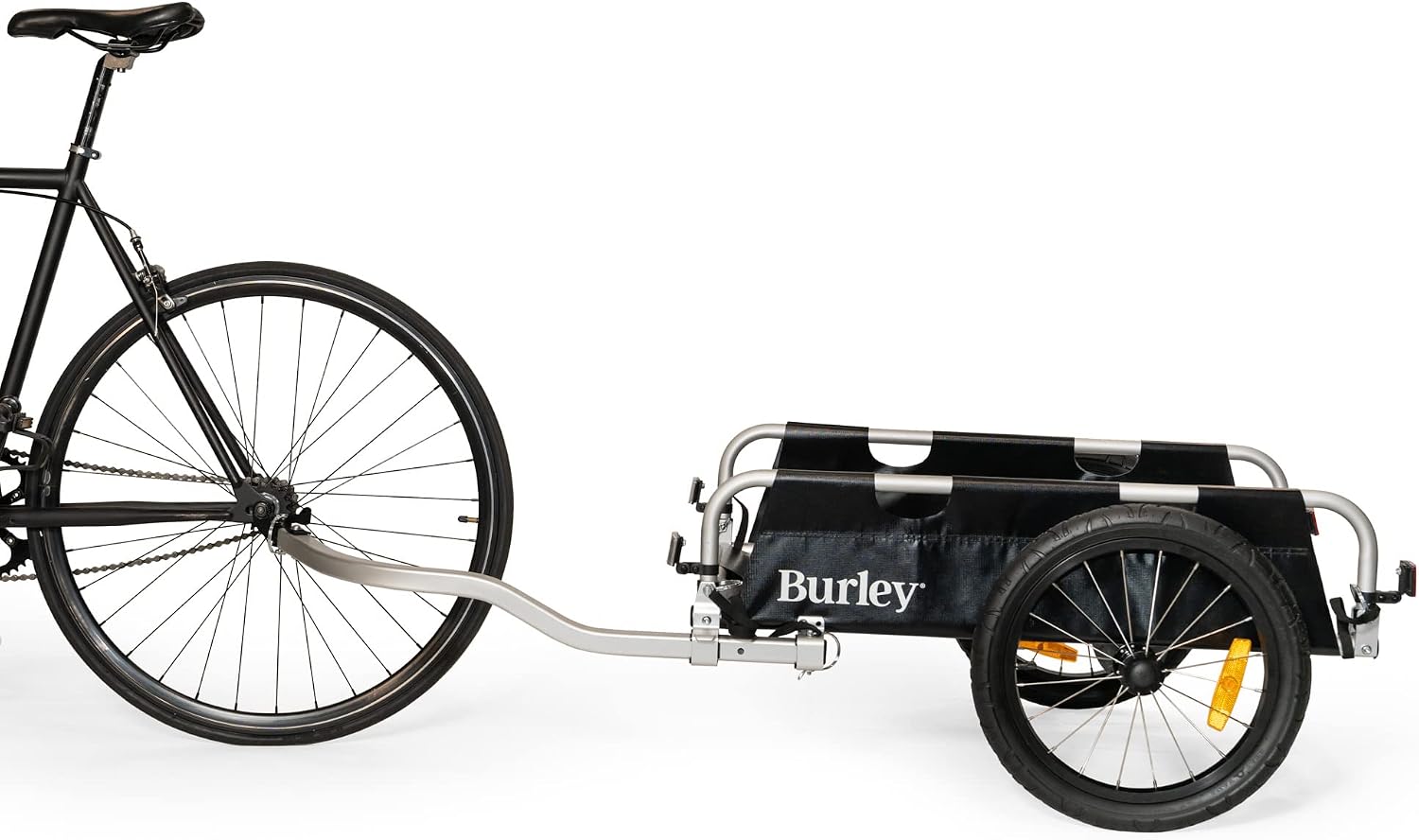
Burley FLATBED
$319.95
In stock on Amazon
Check price on AmazonThe Schwinn Porter vs. Daytripper: An Underserved Comparison
This comparison deserves its own section because the confusion in the market is real and recurring. Schwinn Porter owners make an unprompted and notably specific point in verified purchase reviews: most of the online reviews they found before buying actually described the cheaper Daytripper variant, not the Porter. The two products share a brand name and a similar silhouette, but Porter reviewers consistently cite improvements in frame rigidity, closure quality, and hitch security that justify the price differential.
The practical consequence: if you searched “Schwinn cargo trailer review” before arriving here, there is a meaningful chance the articles you read described Daytripper performance being attributed to Porter. Per the Schwinn Porter Cargo Trailer product specification document, the Porter’s reinforced frame tolerates heavier consistent loads more predictably than the Daytripper’s spec sheet supports, and the closure system — a real durability point on any fabric trailer — is rated more favorably by Porter owners compared to Daytripper feedback.
Bicycling.com’s cargo trailer buying guide advises readers cross-shopping within a brand family to verify the exact model name against the review source before trusting performance comparisons. That guidance applies here directly.
Decision rule: If you are cross-shopping Schwinn and the price gap between Daytripper and Porter is within your budget, confirm which product any review you read actually covers before weighting its conclusions.
Side-by-Side Format Comparison
| Format | Typical Mfr.-Rated Capacity | Approx. Empty Weight | Folds Flat? | Key Weakness |
|---|---|---|---|---|
| Removable Box (PEXMOR) | 100 lb | ~22–26 lb | No (rigid box) | Plastic brittleness over time |
| Open Flatbed (Burley Flatbed) | 100 lb | ~22 lb | Partial | Load containment is DIY |
| Fabric Bed — Burley Nomad | 100 lb | ~18–20 lb | Yes | Sidewall wear near wheels |
| Fabric Bed — VEVOR | 88–100 lb | ~20 lb | Yes | QC variance on lower-tier units |
Sportneer — $13.99 Removable-box format (PEXMOR, Aosom): lowest entry price, highest in-store convenience, plan for box replacement or rebuild around year two.
Schwinn — $179.99 Open flatbed format (Burley Flatbed): mid-range pricing, maximum load flexibility, requires DIY containment system via crates or cargo net.
Burley FLATBED — $319.95 Fabric-bed format (Burley Nomad): premium pricing, best storage footprint, touring-validated capacity, and the format most recommended by Electric Bike Review’s cargo hauling accessories overview for dual touring-and-errand use.
All capacity figures are drawn from published manufacturer specification sheets for Burley Design (Nomad and Flatbed), PEXMOR, and VEVOR. Empty weights are approximate based on published specs and may vary by configuration.
If X, Then Y: The Decision Framework
If your primary goal is in-store convenience and you shop at stores where an oversized rolling container won’t create friction at checkout — go removable-box (Aosom, PEXMOR). Accept the plastic durability tradeoff and plan for a plywood rebuild around year two if you use it hard.
If you haul irregular or oversized loads — bulk items, plants, awkward shapes that don’t respect box walls — go flatbed (Burley Flatbed). Invest in a good cargo net and a set of milk crates; the system will outlast most fabric trailers under heavy daily use.
If sway anxiety is your primary concern and you’re running an e-cargo bike at 15–20 mph on paved bike paths — VEVOR’s owner-documented sway stability is a real differentiator. The fabric format folds for apartment storage as a bonus.
If you’re buying once for touring and grocery use combined — Burley Nomad. The touring load documentation from owner reviews is genuinely impressive, and 100 lb rated capacity with a folding frame covers both use cases without compromise.
If you’re cross-shopping Schwinn — read Porter reviews specifically, not Daytripper reviews, and verify which model any comparison article names as its source before trusting the data.
Frequently Asked Questions
Can I use a removable-box trailer at a grocery store without taking the whole trailer inside? Yes — this is the core design intent. Removable-box trailers (Aosom, PEXMOR) unclip the cargo container from the trailer frame, which stays locked to your bike outside. The box rides on integrated wheels and rolls through the store independently. The standalone capacity rating is lower than the full system rating, so avoid overloading the box on the return trip before reattaching it to the frame.
How do fabric sidewalls hold up against wheel contact over hundreds of miles? The failure mode owners describe is abrasion where the fabric contacts the tire during tight turns or if wheel alignment drifts slightly. Quality coated nylon — as used on the Burley Nomad, per the Burley Design Nomad Cargo Trailer product specification sheet — resists this well for 12–24 months of regular use. Lower-cost fabric starts pilling sooner. The fix when wear does appear is a patch kit; most owners report the rest of the trailer outlasts the sidewall wear by years.
Is the Schwinn Porter actually worth the extra cost over the Daytripper? Based on aggregated owner feedback, yes — specifically on frame rigidity and closure quality. The confusion in the market is that most existing review coverage describes the Daytripper. Porter owners who made the deliberate head-to-head comparison consistently report that the Porter held up better under heavier or more frequent loads. Per the Schwinn Porter Cargo Trailer product specification document, the Porter’s frame is reinforced beyond the Daytripper spec. If you are using a trailer weekly for real grocery hauls rather than occasional recreational outings, the Porter’s construction quality is the better long-term value.
What does a “100 lb capacity” trailer actually look like when fully loaded? One hundred pounds is approximately: four full grocery bags at roughly 12 lb each, a case of water at 40 lb, and a bag of dog food at 20 lb. Alternatively, it covers a week of groceries for a family of three. Burley Nomad touring owners document loads — tent, sleeping bags, and three days of food — reaching the 90–95 lb range. The weight limit is a structural rating, not a “comfortable to pedal” rating. An e-cargo bike handles near-capacity loads far more practically than a standard bicycle. Electric Bike Review’s cargo hauling accessories overview specifically flags this distinction for new e-bike cargo haulers.
Do these trailers require additional accessories to stay weatherproof? Removable-box trailers are weather-resistant by default — the hard shell keeps rain out of the cargo. Fabric-bed and flatbed trailers are not waterproof without a cover. Burley sells a compatible rain cover for the Nomad as a separately purchased accessory. VEVOR includes a basic cover in some configurations per their product listings. For the Burley Flatbed, a fitted tarp or waterproof cargo bag is a separate purchase. If you are hauling groceries in variable weather, factor $25–$60 for a cover into your total budget.
Which trailer formats fold small enough to store in an apartment? Fabric-bed trailers fold most compactly — the Burley Nomad and VEVOR both collapse to a flat profile that fits behind a door, in a closet, or under a lofted bed. Open flatbeds (Burley Flatbed) offer a partial fold that reduces footprint but do not go fully flat. Removable-box trailers cannot fold; the rigid container is the limiting factor, and most owners store the box and frame separately. If square footage is a genuine constraint, the fabric-bed format is the one designed for it.
Capacity figures and weight ratings referenced throughout this article are drawn from published manufacturer specification sheets for Burley Design (Nomad and Flatbed), PEXMOR, Schwinn (Porter), VEVOR, and Goplus. Owner sentiment is synthesized from aggregated verified purchase reviews. Category context was drawn from Bicycling.com’s cargo trailer buying guide, Electric Bike Review’s cargo hauling accessories overview, and BikeRadar’s cargo bike and trailer category coverage. No products were physically tested by this publication.