May 31, 2026 • Neil Hayes • 10 min reading time • Prices verified June 25, 2026
Phone Mounts, Locks, and Pumps: Building a Zero-Regret E-Bike Accessories Kit Under $100
If you’ve just picked up an e-bike — an electric bicycle with a motor that assists your pedaling — you’ve probably already discovered that the bike itself is only part of the equation. You still need a way to see your map, keep the tires inflated, and stop someone from walking off with a vehicle that might represent $1,500 to $4,500 of your money. Those three problems — navigation, inflation, and security — map directly to three accessory categories: phone mounts, pumps, and locks. Done right, you can solve all three for under $100 combined, without compromising on the things that actually matter day to day. This guide walks through the tradeoffs, names specific products worth considering, and is honest about where budget options fall short so you can make the call that fits your situation.
Why the “Under $100 Kit” Framing Actually Makes Sense
Cargo and commuter e-bikes already demand a long list of supplementary spending — panniers (saddlebags that clip to a rear rack), lighting, helmets, child seats. Accessories that individually seem modest add up fast. The $100 ceiling forces a useful discipline: every item has to earn its slot.
The good news is that in 2026, the three categories above have genuine options in the $15–$40 range that owners describe positively over multi-year ownership windows — not just “it works fine for now.” That long ownership tail is the real signal worth hunting for in the accessory space, where one-time reviewers dominate and durability is hard to judge from a single ride.
A note on security framing before we go further: no lock in this price range (or honestly, most price ranges) makes your e-bike theft-proof. The honest job of a budget or mid-range lock is to raise the effort threshold high enough that an opportunistic thief chooses a different target. Knowing that going in changes how you shop and how you use what you buy.
Phone Mounts: The One Accessory You’ll Touch Every Single Ride
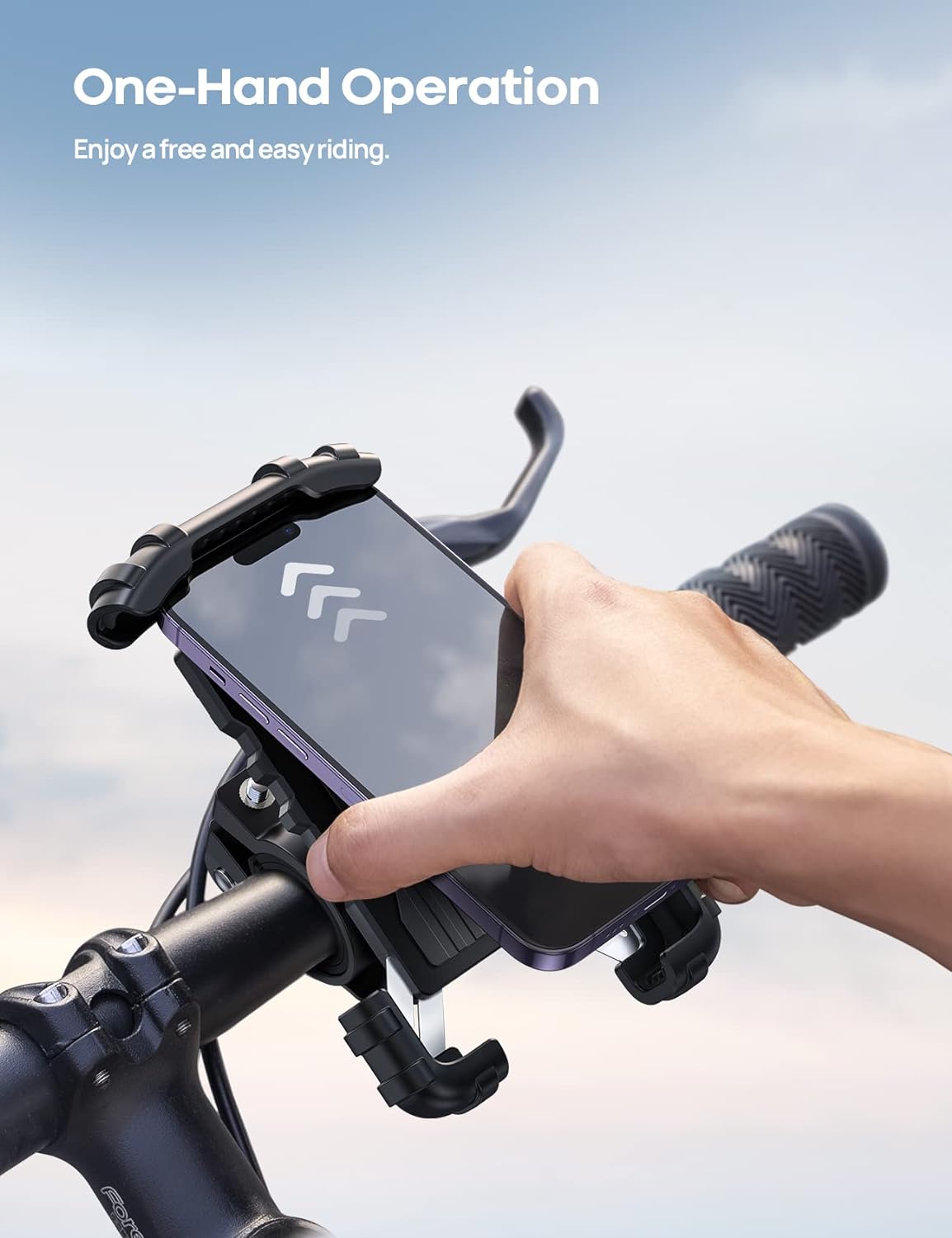
A bike phone mount clamps to your handlebar and holds your phone at eye level so you can glance at navigation without looking down or stopping. On an e-bike specifically, this matters more than on a standard bicycle: you’re covering more ground per hour, often in mixed traffic, and many e-bike displays don’t have built-in GPS maps.
What to look for: Handlebar diameter compatibility is the first filter. Most road and commuter bikes use a 22mm bar; cargo e-bikes and scooters often run 25.4mm or even 31.8mm bars (a slightly fatter tube that provides more steering leverage on heavier bikes). A mount that doesn’t specify compatibility with larger diameters is a gamble you don’t want to lose.
The Lamicall bike phone mount is one of the more frequently cited examples of the long-ownership pattern described above. Reviewers on aggregated platforms consistently note multi-year use without the grip loosening or the plastic cradle cracking — candor that’s genuinely rare in a category where most reviewers write from week-one impressions. Bicycling magazine’s buyer’s guide for phone mounts notes that secure cradle-style mounts (where the phone is held on all four corners rather than just squeezed from the sides) outperform clamp-only designs on vibration-heavy surfaces, which is directly relevant to cargo e-bikes that may be carrying load weight and hitting rougher pavement.
Fat handlebar note: The Lamicall mount lists compatibility up to 35mm handlebars in its published spec, which covers most cargo e-bike and scooter bars. Verify your bar diameter before ordering — it’s usually in your bike’s owner manual or stamped on the stem clamp.
Budget floor: Mounting solutions exist well below $20, but at that price point, the plastic cradle mechanisms tend to develop play within a few months of UV exposure and vibration. For a $3,000+ e-bike, a $25–$30 mount that owners describe as still solid after years is a reasonable insurance premium.
Pumps: The Dual-Use Case Nobody Talks About Clearly Enough
Here’s the split that matters for e-bike riders specifically: a home floor pump (a tall, standing pump with a pressure gauge) is the right tool for regular tire maintenance — topping up pressure before a ride takes thirty seconds and keeps rolling resistance and pinch flat risk in check. A portable mini pump or CO₂ inflator is your emergency roadside rescue kit.
These are different tools solving different problems. The mistake is buying only one and expecting it to do both jobs well.
Wirecutter’s Best Bike Pumps guide (updated 2025) makes this split explicit: floor pumps win on gauge accuracy and effort-per-stroke at home; mini pumps win on portability but require significantly more strokes and have lower practical pressure ceilings for high-volume e-bike tires.
The Fanttik X9 Ace and HOTO mini pump both appear in the “does both jobs adequately” conversation, and owners describe a specific dual-use pattern: kept at home for situations where the floor pump is inconvenient, and carried on longer rides for emergencies. That’s a useful positioning — not “replace your floor pump” but “cover the gaps your floor pump can’t.”
The Fanttik X9 Ace publishes a maximum pressure rating of 150 PSI and includes a car-valve (Schrader) adapter, making it the more versatile pick if you also need to top up a car tire in a pinch. The HOTO mini pump is more compact and lighter, which owners appreciate for carrying, but its car-tire use is practically limited to very low starting pressures. If car-tire inflation is a genuine use case for you, the Fanttik’s specs align better with that task.
By the numbers:
| Tool | Best use | PSI ceiling (mfr. rated) | Weight range |
|---|---|---|---|
| Floor pump (standard) | Daily home maintenance | 160 PSI+ | 2–4 lbs |
| Fanttik X9 Ace | Dual: home convenience + ride carry | 150 PSI | ~7 oz |
| HOTO mini pump | Compact ride carry | 100–120 PSI | ~4 oz |
Can a mini electric pump fully replace a floor pump? For daily maintenance on standard 700c road tires (narrow tires typically found on commuter bikes), borderline — it’s slow and the gauge accuracy at lower pressures is less reliable than a dedicated floor pump. For high-volume cargo e-bike tires at 20–50 PSI, the mini pump is more competitive but still slower. If you ride daily, buy both: a floor pump lives in your apartment or garage, the mini pump lives in your pannier or seat bag.
Locks: Matching Security Level to Actual Risk
Locks are where honest framing matters most, because the gap between “feels secure” and “is secure” can represent several thousand dollars of exposure.
The Sportneer combination cable lock exemplifies the “quick stop” tier. Reviewers are refreshingly candid: this lock is appropriate for running into a store for ten minutes in a low-theft-risk environment. Forum discussions on cycling communities are consistent that cable locks — even thick ones — can be cut with basic tools in under thirty seconds. PeopleForBikes’ 2024 urban cycling behavior report notes that theft deterrence correlates strongly with perceived effort, which means a cable lock does its job against the casual opportunist but provides minimal resistance to anyone carrying a tool.
That’s not a reason to dismiss cable locks entirely — it’s a reason to use them correctly. For a kid’s bike at a suburban trailhead, a Sportneer lock is appropriate. For a $3,500 RadWagon 4 left outside a downtown building for two hours, it isn’t.
The Master Lock Python occupies an interesting secondary-lock niche. Reviewers consistently flag it as not a primary theft deterrent for serious urban environments, but praise its flexibility for securing gear to roof racks and cargo bikes — lashing panniers, helmets, or ancillary equipment to a frame so they can’t be grabbed. That’s a real and underserved use case. If you’re running a cargo e-bike with external gear, a Python-style flexible cable lock as a secondary tether for accessories makes practical sense alongside a proper primary lock.
What commuters with higher-value bikes should know: BikeRadar’s 2025 lock security ranking places Sold Secure Gold-rated U-locks and chain locks as the minimum standard for leaving an e-bike unattended in an urban environment for more than a short stop. Sold Secure is an independent UK certification body that tests locks against real attack methods. A U-lock from Kryptonite or Abus rated at this tier runs $50–$80 and will consume most of a $100 budget on its own — which is the honest tradeoff. Spend more on the lock, spend less on the mount and pump, or accept that you’re building a “quick stop” kit rather than an “overnight urban parking” kit.
Best security-to-weight ratio for commuters: A mid-weight U-lock (around 2 lbs) paired with the Sportneer cable as a secondary wheel-locking device outperforms either alone. The U-lock secures frame to rack; the cable loops through the rear wheel and the U-lock shackle. Total setup cost can stay near $60–$70 leaving room for mount and pump.
Panniers: Worth Mentioning Even Though They Stretch the Budget
Pannier bags — bags designed to clip onto a rear rack using a hook-and-rail system — aren’t always included in “accessories kit” roundups, but they’re the difference between using your e-bike for real errands and just riding it. KEMIMOTO panniers appear in owner discussions with a specific credibility signal: reports of surviving snow storms and overnight camping trips with dry contents. That elevates them past the “grocery run” category into genuine all-weather utility — relevant for cargo e-bike owners who are using their bike as a car replacement rather than a fair-weather toy.
Rack compatibility note: Panniers do not fit all racks universally. The hook width and rail diameter vary between brands and generations. Most panniers are designed for standard Tubus/ISO-compatible racks; some cargo e-bike proprietary racks (Tern, Yuba, certain RadWagon generations) require brand-specific bags or adapters. Check your rack’s rail diameter (typically 8mm or 10mm) against the pannier’s hook specification before ordering.
Frequently Asked Questions
Can a mini electric pump fully replace a floor pump for daily tire maintenance? For most e-bike riders doing daily maintenance, no — floor pumps deliver faster inflation, more accurate pressure gauges, and less physical effort. Mini pumps are emergency and convenience tools, not replacements.
How secure is a combination chain lock for leaving an e-bike outside? Combination cable and chain locks in the budget tier are appropriate for short, visible stops in lower-risk environments. For urban overnight parking or leaving a high-value e-bike unattended, a Sold Secure Gold-rated U-lock is the minimum standard worth considering. ElectricBikeReview.com’s security guidance consistently reinforces this tiering.
Will the Lamicall mount fit fat handlebars on cargo e-bikes and scooters? Per the published Lamicall spec, compatibility extends to 35mm handlebars, which covers most cargo e-bike and scooter bars. Measure your bar diameter first — it’s the one spec check worth doing before adding to cart.
Is the Fanttik or HOTO pump better for someone who also wants to inflate car tires? Based on published specs, the Fanttik X9 Ace at 150 PSI with a Schrader adapter is the more viable option for car tire use. The HOTO is lighter and more packable but practically limited for car tires starting at very low pressure.
What lock combination gives the best security-to-weight ratio for commuters? A mid-weight U-lock (Sold Secure Gold or equivalent) for frame-to-rack security, paired with a secondary cable through the rear wheel, gives the best tradeoff between weight, coverage, and actual theft deterrence without hitting the weight of full chain locks.
Do pannier bags fit all rear racks or do you need to check compatibility first? You need to check. Rack rail diameter (8mm vs. 10mm is the most common split) and hook width vary. Proprietary racks on cargo bikes like certain Tern and RadWagon models may need brand-specific bags or adapters. Confirm the spec before ordering.
The Decision Rule
If you’re building this kit from zero: prioritize the lock budget proportionally to your actual parking situation. A bike that lives in a secured garage and only gets locked at low-risk suburban stops can get by with a lighter cable setup and leave budget for a better pump. A bike that parks on urban streets for an hour or more daily needs a real U-lock as the anchor investment, with mount and pump filling the remaining budget. The mount and pump categories have solid options under $30 each; the lock is where honest spending decisions live.