June 1, 2026 • Neil Hayes • 9 min reading time • Prices verified June 25, 2026
Hauling Your E-Bike on a Car Rack: Why Fat Tires and Heavy Batteries Change Everything
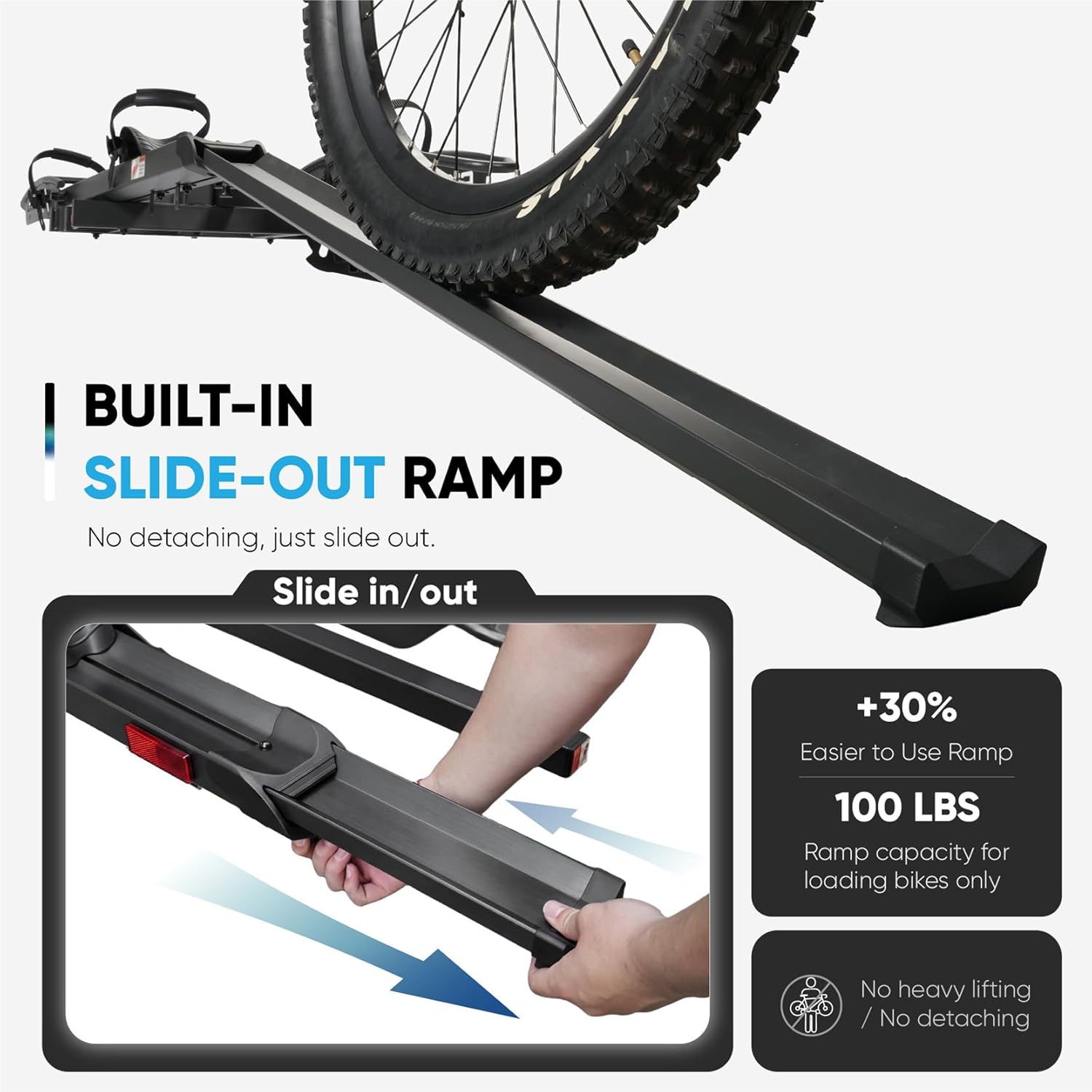
If you have ever tried to slide a standard road bike onto a hitch rack — that metal arm bolted to your car’s trailer hitch receiver — you know it’s a five-second job. Now try the same move with a 70-pound electric cargo bike. Suddenly the rack arm flexes, the wheel trays are too narrow for the fat tires (tires wider than roughly 2.4 inches), and the rack’s stamped weight limit sticker is staring back at you with serious skepticism. A hitch rack is the platform that mounts to the receiver on your vehicle’s rear hitch and holds bikes during transport; most racks sold through 2022 were engineered around acoustic bikes averaging 25–30 lbs. E-bikes — bicycles with integrated electric motors and battery packs — have rewritten those assumptions almost overnight.
This guide is for the rider who already owns, or is about to buy, an e-bike in the 50–90 lb range and needs to figure out which hitch rack can actually handle the job. We’ll walk through the weight and geometry variables that matter most, map them to the rack categories worth considering, and close with a clear decision rule so you can stop second-guessing the spec sheets.
| EDITOR'S PICKSwagman E-Spec Pro Hitch Mount… | Mid-tierYoung Electric E-Bike Rack with… | Budget pickCRAVOT CyberRack E2 Hitch 2 E-B… | |
|---|---|---|---|
| Weight per Bike | 80 lbs | — | — |
| Total Capacity | — | 200 lbs | 200 lbs |
| Fat Tire Max | — | Up to 5 in | Up to 5 in |
| Tilt Feature | ✓ | — | — |
| Locking Hooks | ✓ | — | — |
| Ramp Included | — | ✓ | ✓ |
| Price | $478.78 | $299.99 | $254.15 |
| See on Amazon → | See on Amazon → | See on Amazon → |
Why E-Bike Weight Is a Different Problem Than You Think
The number on a rack’s weight rating isn’t just a marketing hedge — it corresponds to real engineering tolerances in the rack arm, the hitch receiver insert, and the wheel cradle attachment points. Per PeopleForBikes’ e-bike growth and fleet weight trend report, the average electric cargo bike sold in the U.S. market now weighs between 55 and 80 lbs fully equipped; long-tail cargo bikes like the Tern GSD S10 or Rad Power Bikes RadWagon 4 sit at the heavy end of that range, often at 65–77 lbs before you add any cargo accessories. A Riese & Müller Load 75 tips the scale past 80 lbs in some configurations.
Most standard platform hitch racks — the kind with two fold-down trays that the bike wheels rest in — are rated for 35 to 60 lbs per bike. The word “per bike” matters: a two-bike rack rated at 60 lbs per bike has a total rack load capacity that may still be only 120 lbs, which leaves almost no margin for a pair of mid-range e-bikes. Exceed the per-bike rating and you are stressing the pivot welds and the hitch insert in ways the manufacturer explicitly disavows.
Bicycling’s hitch rack buyer’s guide identifies three compounding issues specific to e-bikes that a simple weight number doesn’t capture:
- Center of mass. A rear hub motor and a down-tube battery pack move a bike’s center of gravity lower and further back than a standard bike. On a tilting rack arm, that shift increases rotational torque on the attachment point during cornering and braking.
- Tire width. Fat tires (2.5 inches and above) and cargo bike tires (typically 20×4.0 or 24×3.0) won’t seat properly in wheel trays designed for 1.75–2.4-inch tires, creating lateral rock under highway vibration.
- Frame geometry. Step-through and cargo longtail frames often lack a straight top tube — the horizontal bar most strap-style racks grip. A frame adapter (a clamp-on bar that bridges irregular geometry) adds weight and another failure point.
The Three Rack Categories Worth Evaluating
1. Heavy-Duty Platform Racks (60–80 lb per-bike rating)
This is the segment purpose-built for the current e-bike market, and it’s where most buyers at the $350–$800 price range will land.
The Kuat NV 2.0, per Kuat’s published NV 2.0 specification sheet, is rated at 60 lbs per bike and includes 4.5-inch-wide wheel trays that accommodate fat tires up to 5 inches. The integrated ratcheting arm — the grip that locks against the bike’s top tube — adjusts for step-through geometry without a separate adapter. Owners in long-run forum discussions consistently note that the folding mechanism remains smooth after repeated hitch engagement, which matters if you’re loading a 70-lb bike solo: you want the rack arm locked flat before you start maneuvering the bike.
The Saris SuperClamp EX, per Saris’ product page and weight rating notes, pushes the per-bike limit to 70 lbs and uses a dual-clamp cradle system that grips at two points along the wheel rather than relying on a single top tube strap. For step-through cargo bikes or bikes with integrated rear racks that make top-tube access awkward, reviewers at Bicycling and Electric Bike Review both call out this dual-wheel-cradle approach as meaningfully more stable than single-strap alternatives.
The tradeoff: heavy-duty platform racks weigh 45–65 lbs themselves. If your hitch receiver is on a smaller crossover or wagon, check the vehicle’s tongue weight rating (the maximum downward force allowed on the hitch ball or receiver) before assuming any rack is compatible. Tongue weight is where e-bike transport math gets tight fast.
2. Folding/Compact Platform Racks with High Weight Ratings
The Thule EasyFold XT 2 occupies a narrower but important niche: per Thule’s EasyFold XT 2 owner documentation and FAQ, it’s rated to 130 lbs total (roughly 65 lbs per bike), folds to a compact footprint for garage storage, and ships with 3.15-inch wheel trays that accommodate most mid-fat tire sizes. The integrated rear ramp — a fold-out slope that lets you roll a heavy bike up rather than lift it — addresses the single most common physical complaint about loading 70+ lb bikes solo.
The tradeoff is price: street price in mid-2026 sits around $700–$750 for the two-bike version, which is a meaningful premium over the base Kuat or Saris options. For riders who store their rack indoors between trips, the fold-down design genuinely earns that premium. For riders who leave the rack on the hitch full-time, the folding feature is mostly sunk cost.
3. Hitch-Mounted Tray Racks with Ramp Accessories
A growing number of buyers pair a standard heavy-duty rack with an aftermarket loading ramp — a lightweight aluminum channel that leans against the rack and lets you roll the bike up rather than press-and-pivot it. Published rack documentation from both Kuat and Thule notes compatibility with their respective ramp accessories. This split approach can shave $150–$200 off the upfront cost compared to an integrated-ramp rack, but it adds a second piece of gear to manage at the trailhead.
By the Numbers: Weight and Tire Clearance Quick Reference
| Rack | Per-Bike Rating | Wheel Tray Width | Integrated Ramp | Approx. Street Price (2026) |
|---|---|---|---|---|
| Kuat NV 2.0 (2-bike) | 60 lbs | 4.5 in | No (add-on available) | ~$500 |
| Saris SuperClamp EX (2-bike) | 70 lbs | 4.25 in | No | ~$450 |
| Thule EasyFold XT 2 | ~65 lbs | 3.15 in | Yes | ~$725 |
Specs drawn from published manufacturer documentation. Verify current pricing and in-stock availability before purchase.
The Hitch Receiver and Vehicle Side of the Equation
The rack is only half the system. The receiver class stamped on your vehicle’s hitch determines which racks physically fit and how much load the vehicle side of the connection can handle.
- Class I / Class II receivers (1.25-inch opening): rated for tongue weights of 100–200 lbs depending on vehicle and installer. Most e-bike-rated racks require a Class III receiver (2-inch opening, 300–500 lb tongue weight rating). A Class I/II hitch is a hard stop for most heavy-duty e-bike racks.
- Class III receivers (2-inch opening): the standard for SUVs, trucks, and most minivans. This is what the racks above assume.
- Adapters from 2-inch to 1.25-inch: exist, but they add clearance and reduce tongue weight capacity. Electric Bike Review’s cargo bike weight and geometry roundup specifically flags hitch adapters as a risk point for heavy e-bikes — the adapter itself becomes the weakest link in a chain you’re loading to its limit.
If you’re buying a rack to haul a 70-lb cargo bike and your vehicle has only a Class I receiver, the honest answer is: the rack upgrade you need starts with a hitch upgrade, not a rack purchase.
Anti-Sway, Sway, and Road Vibration
Standard bikes on a rack sway slightly at highway speeds; most riders accept this. E-bikes sway more, for two reasons: higher mass amplifies oscillation at the same speed, and integrated rear racks, panniers, or child seat mounts on cargo bikes act as sail area catching crosswind gusts. Rack manufacturers address this with integrated anti-sway cradles — typically a rubber-lined clamp that grips the frame rather than just cradling the wheel. Kuat’s NV 2.0 spec sheet and Saris’ SuperClamp product documentation both list anti-sway arm mechanisms as standard features on their current platforms.
In practice, owners consistently report that the anti-sway clamp is only as good as its tightening mechanism: over time, a plastic ratchet can lose tension and allow creep. Metal cam-lever clamps (found on premium versions of both the Kuat and Thule racks) draw consistently better long-run reviews than plastic ratchets in this regard.
The Decision Rule: If X, Then Y
If your e-bike is under 60 lbs and has tires narrower than 3 inches, nearly any current heavy-duty platform rack rated at 60 lbs per bike — including the Kuat NV 2.0 or Saris SuperClamp EX — covers your needs without paying the premium for an integrated ramp.
If your e-bike is 60–75 lbs or has tires between 3 and 5 inches, prioritize rack specs in this order: per-bike weight rating first, wheel tray width second, anti-sway mechanism third. The Saris SuperClamp EX or Thule EasyFold XT 2 are the two racks that reviewers and published specs consistently point to in this range.
If your e-bike is above 75 lbs (Riese & Müller Load, some fully loaded RadWagon builds), you are operating at or above the rated capacity of most consumer racks. At this weight, the Thule EasyFold XT 2 at ~65 lbs per bike is technically marginal; check whether your specific vehicle’s tongue weight rating leaves any safety margin, and consider whether a specialized e-bike transport platform — or a small trailer — is the more honest tool for the job.
If your vehicle has only a Class I or Class II hitch, solve the hitch before the rack. No amount of rack engineering compensates for an undersized receiver under a 70-lb bike at highway speeds.
The rack market has caught up to the e-bike weight reality faster than most riders expect — the gap is usually between what the rider assumes their old rack can handle and what the spec sheet actually says. Close that gap before you’re closing a hatchback on a flexed rack arm in a trailhead parking lot.