May 27, 2026 • Neil Hayes • 10 min reading time • Prices verified June 25, 2026
The E-Bike Hitch Problem: Why Your Trailer Won't Attach and How to Fix It
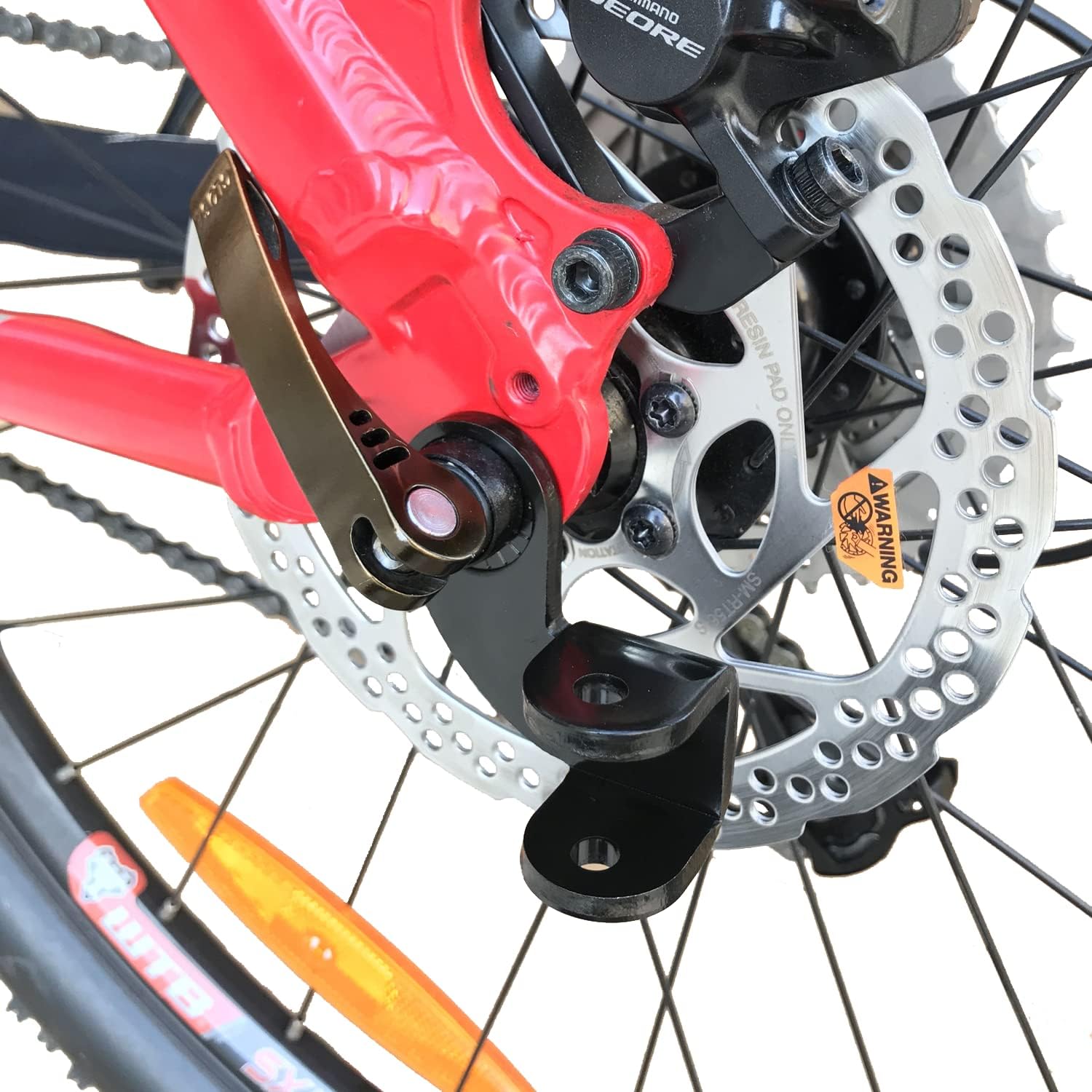
You’ve bought a child or cargo trailer — the kind that clips onto the rear axle of your bike — and now you’re standing in the garage staring at a gap between the hitch (the small metal connector that bolts to your bike’s rear wheel axle) and the trailer’s coupler (the socket or clamp on the trailer’s arm that snaps onto that hitch). They don’t line up. Or the coupler won’t close. Or the trailer droops at an angle that looks genuinely dangerous. If your bike is an e-bike — an electrically assisted bicycle — there’s a good chance the problem isn’t user error. It’s a design gap that appeared as e-bikes scaled up faster than trailer hardware standards could follow. This guide explains exactly why the mismatch happens, how to identify which version of the problem you have, and what hardware solves each scenario.
| EDITOR'S PICK[Rhino USA Ratchet Straps Tie Do…](https://www.amazon.com/dp/B01N7P7EOX?tag=greenflower20-20) | Mid-tier[Coupler Attachments for Instep…](https://www.amazon.com/dp/B07BBNWJ3J?tag=greenflower20-20) | Budget pick[Titanker Upgraded Bike Trailer…](https://www.amazon.com/dp/B07BBNWJ3J?tag=greenflower20-20) | |
|---|---|---|---|
| Type | Ratchet strap | Trailer coupler | Trailer hitch |
| Compatibility | General cargo | Instep/Schwinn | Schwinn/Instep/Burley |
| Qty | 4-pack | 1 | 1 |
| Length | 15 ft | — | — |
| Rating | 1,823 lb | — | — |
| Price | $36.90 | $11.26 | $9.49 |
| See on Amazon → | See on Amazon → | See on Amazon → |
Why E-Bikes Break the Old Hitch Playbook
Traditional bike trailers were engineered against a two-decade-old reference platform: a quick-release rear axle (a 9mm or 10mm hollow skewer that clamps the wheel in place) on a non-disc-brake steel or aluminum frame. That standard worked fine when trailers were sold alongside hybrid bikes at big-box stores.
Then three things changed simultaneously. First, thru-axles — larger-diameter solid axles (typically 12mm) that thread directly into the frame dropouts, providing stiffer wheel retention — became standard on performance and cargo e-bikes. BikeRadar’s thru-axle vs. quick-release explainer notes that 12mm thru-axles are now the dominant spec on mid-drive and hub-motor cargo bikes. Second, disc brakes replaced rim brakes across the category, and a disc rotor on the non-drive side of the rear wheel occupies exactly the space where a traditional hitch coupler arm is designed to sit. Third, folding e-bikes — Tern GSD, Lectric XP, RadWagon — introduced axle configurations that angle away from the frame plane, so even a correctly-sized hitch ends up cocked at the wrong angle.
The result: a buyer purchasing a Burley D’Lite or Thule Chariot Cross for a RadRover 6 Plus or Tern GSD S10 frequently arrives at an incompatibility that neither the trailer brand nor the e-bike brand proactively warned them about. According to the PeopleForBikes E-Bike Market Report 2025, cargo and utility e-bikes now represent over 30% of all e-bike sales — millions of bikes in the field that don’t fit the hitch geometry that most trailers ship with.
Diagnosing Your Specific Problem
Before buying anything, identify which failure mode you’re dealing with. There are four distinct issues that get lumped together as “the hitch doesn’t fit”:
1. Axle diameter mismatch. Your hitch is sized for a 9mm QR axle, but your e-bike has a 12mm thru-axle. The hitch simply won’t seat — or worse, it seats loosely and wobbles. Burley’s published hitch compatibility documentation lists separate SKUs for 9mm QR and 12mm thru-axle fitment; the 12.2mm hitch (often marketed specifically as a thru-axle hitch) exists for this reason.
2. Disc brake clearance conflict. The traditional hitch arm routes through the space between the frame dropout and the spokes. On a disc-equipped wheel, the rotor sits in that same zone. Owners across multiple hitch product categories consistently flag this as a surprise failure — they received the right axle-diameter hitch but couldn’t install it without rotor contact.
3. Folding or angled axle geometry. Several folding cargo e-bikes use axle ends that protrude at a slight inward or outward angle rather than perpendicular to the frame. A standard hitch installed on these bikes sits at a skew relative to the trailer arm, causing the trailer to track at an angle or load the coupler joint asymmetrically. Owner feedback within Tern GSD and Lectric XP communities specifically calls out this problem. The Booyah angled hitch exists specifically because of this failure pattern — its design rotates the attachment point to compensate for axle angles that deviate from perpendicular, and owners of folding-frame e-bikes report it as the practical solution when the axle plane doesn’t match the standard hitch orientation assumption.
4. Seat-post hitch failure under load. Some buyers turn to seat-post-mounted hitches as a workaround when axle installation is impossible. This approach introduces a documented failure mode: on single-axle trailer configurations under significant load, the cantilevered force on the seat post causes lateral flex and eventual joint failure. Seat-post hitches are appropriate for light, balanced loads on conventional frames, and should not be treated as a universal workaround for axle incompatibility on loaded cargo setups.
The Hardware Solutions, Matched to the Problem
For 12mm thru-axle bikes (RadRover, most mid-drives): The Burley 12.2mm thru-axle hitch is the spec-correct solution. Burley’s own hitch compatibility documentation lists it as compatible with 12mm thru-axle dropouts, and owner reports published by Electric Bike Review confirm fitment on RadRover 5 and 6 Plus models. Note: it does not automatically solve a disc clearance conflict — check rotor clearance before ordering.
For folding e-bike axle geometry (Tern GSD, Lectric XP Cargo): The Booyah angled hitch. The Booyah’s design rotates the attachment point to compensate for axle angles that deviate from perpendicular. Tern GSD owners consistently cite the angled hitch as the fix that made their trailers track straight — this is a case where third-party hardware filled a gap the bike manufacturer never addressed.
For disc brake clearance: There is no universal hardware fix — this is a fitment judgment call. On bikes where the rotor occupies the hitch arm channel, the right path is to confirm with your bike’s manufacturer whether a thru-axle hitch with a specific arm routing exists for your model, or whether a different hitch arm profile clears the rotor. The Bicycling.com cargo bike trailer buying guide recommends confirming disc-to-hitch clearance before finalizing any hitch purchase — a step that is easy to skip when ordering online but saves a frustrating return.
For cross-brand coupler compatibility (Burley hitch + InStep trailer, or vice versa): This is a separate problem from axle fitment. Trailer couplers (the socket on the trailer arm) and trailer hitches (the ball or cylinder on the bike) are not universally standardized across brands. Burley hitches are designed for Burley coupler geometry. InStep trailers use a different coupler socket. They are not interchangeable without an adapter, and mixing them risks the coupler failing to lock — which is a safety failure, not an inconvenience. The rule of thumb: match hitch and coupler from the same manufacturer unless an explicit cross-brand adapter is documented by one of the two manufacturers.
By the Numbers
| Problem | Likely Root Cause | Hardware Fix |
|---|---|---|
| Hitch won’t seat on axle | 9mm hitch on 12mm thru-axle | Burley 12.2mm thru-axle hitch |
| Trailer tracks at an angle | Folding or angled axle geometry | Booyah angled hitch |
| Coupler won’t lock | Cross-brand hitch/coupler mismatch | Match brand or source documented adapter |
| Trailer droops or swings under load | Seat-post hitch overloaded | Return to axle mount; seat-post hitch is not a cargo solution |
The “Second Hitch” Use Case Nobody Talks About
A purchase pattern worth naming explicitly: across aggregated buyer reviews of Burley hitches, a notable subset of buyers purchased a second hitch not because the first one failed, but because leaving a single hitch installed on one household bike created friction when two adults wanted to use the trailer with different bikes. The hitch installation and removal process — while not technically complex — involves tools and takes several minutes, and many buyers found that the practical barrier of “switching the hitch” meant the trailer simply didn’t get used on one bike.
The fix is obvious once you see the pattern: own one hitch per bike that will ever tow the trailer. At roughly $20–$40 per hitch depending on axle spec, the second or third hitch is among the highest ROI accessories in the trailer ecosystem. If you’re equipping a household with two e-bikes for cargo use, budget for two hitches from the start and save yourself the negotiation.
The DIY Gusset Problem: When the Coupler Arm Itself Fails
One scenario worth flagging for anyone running a loaded trailer at the upper end of its rated capacity over a long period: after approximately a year of regular loaded use, coupler arms can show measurable bending at the attachment point. Some owners have fabricated a metal gusset — a reinforcing plate bolted across the bend point — to restore rigidity and continue using the trailer.
This is useful information for any cargo setup. Trailer couplers are rated for specific loads, and real-world vibration, road irregularities, and e-bike speeds (which tend to be higher than those of conventional bikes) accelerate metal fatigue at stress concentration points. If you’re running a cargo trailer near its published weight limit regularly, inspect the coupler arm every few months. Bending is a warning sign that arrives before fracture — and it’s far better to catch it during a garage inspection than mid-ride.
Frequently Asked Questions
Will the Burley 12.2mm hitch fit a RadRover or other popular e-bike? Based on Burley’s published hitch compatibility documentation, the 12.2mm hitch is designed for standard 12mm thru-axle dropouts. The RadRover 6 Plus uses a 12mm thru-axle, and owner reports in the Electric Bike Review long-term survey of Rad Power Bikes confirm fitment. Verify your specific model year’s axle spec before ordering — Rad Power Bikes has used both QR and thru-axle configurations across generations.
What is the difference between a trailer coupler and a trailer hitch? The hitch is the hardware that bolts to your bike — typically a ball, cylinder, or pin that attaches at the rear axle. The coupler is the socket or clamp on the trailer arm that locks onto the hitch. They must be mechanically matched; different brands use different geometries.
Can I use an InStep hitch with a Burley trailer, or vice versa? Not reliably, and not without a documented adapter. The coupler-to-hitch geometry differs between brands. Mixing them risks a coupler that appears to lock but can disengage under load — a genuine safety risk with children or cargo in the trailer.
Why does my trailer swing or drop instead of tracking straight? The most common cause is either an angled axle installation (the hitch is cocked relative to the frame) or a coupler that isn’t fully seated. On folding e-bikes, an angled hitch like the Booyah is often the fix. Also confirm the coupler locking mechanism is fully engaged — partial engagement allows play.
Do I need a different hitch for a disc brake e-bike? Potentially yes. Disc rotors occupy the space where traditional hitch arms route. Check the rotor-to-dropout clearance on your specific bike before ordering, and confirm the hitch arm profile in the product documentation won’t contact the rotor. The Bicycling.com cargo bike trailer buying guide flags this as one of the most commonly overlooked compatibility checks.
Is it safe to leave the hitch permanently mounted on my bike? Manufacturers generally permit permanent installation. The practical consideration is rear-object clearance — a hitch ball protrudes several centimeters behind the dropout and can catch on objects when parking or loading in tight spaces. Some owners remove the hitch pin or ball when not towing; others leave the full assembly in place. There is no published safety objection to permanent mounting, but check your bike’s documentation for any warranty language around aftermarket axle attachments.