August 17, 2026 • Neil Hayes • 10 min reading time • Prices verified June 25, 2026
Cargo Bike Trailers for Heavy Loads: 100-lb to 220-lb Capacity Compared
Cargo Bike Trailers for Heavy Loads: 100-lb to 220-lb Capacity Compared
If you’ve ever watched a cargo bike roll past hauling what looks like a week’s worth of groceries, lumber scraps, or a dog the size of a small horse, you’ve seen the payload difference a proper trailer makes. A cargo trailer — a two-wheeled cart that hitches to your bike’s rear axle — extends your hauling ability far beyond what any rear rack can carry. The critical spec everyone should understand before buying is payload capacity: the maximum weight, in pounds, the trailer is rated to carry safely. Budget trailers top out around 100 lbs. Purpose-built heavy-haulers reach 220 lbs or more. That range sounds simple, but choosing the wrong side of it at speed is a genuine safety issue, not just a comfort problem.
This comparison covers the realistic market for buyers in mid-2026 who are past the “do I need a trailer?” stage and are now asking “which one won’t let me down when fully loaded?” We’ll name the tradeoffs explicitly, show the numbers that matter, and end with a clear decision framework.
How Payload Capacity Actually Works — and Why the Number Isn’t the Whole Story
Manufacturers test trailers to a rated load, but that rating assumes several things that may not match your situation: level pavement, moderate speed (typically under 15 mph), evenly distributed weight, and a coupler matched to your axle. Exceed any of these variables and the effective safe load drops.
BikeRadar, in its guide “How to Choose a Cargo Bike Trailer” (2024), notes that trailer stability is a function of three interacting factors: wheel track width (wider equals more stable), center-of-gravity height (lower cargo equals safer), and hitch geometry. A trailer rated at 150 lbs with a narrow wheel track and a high-sided box may behave worse at 100 lbs than a 220-lb-rated flatbed at 180 lbs — because the flatbed keeps cargo low and wide.
Bicycling’s 2025 “Best Bike Cargo Trailers” buyer’s guide reinforces this point, observing that rated capacity figures are only meaningful in the context of a trailer’s full geometry. A high payload number paired with a narrow stance is not a straightforward upgrade over a lower-rated trailer with a wider track.
By the numbers — the trailers covered here:
| Trailer | Rated Capacity | Wheel Track | Hitch Type | Tier |
|---|---|---|---|---|
| Schwinn Porter | 100 lb | ~28 in | Universal axle mount | Budget |
| Retrospec Rover | 100 lb | ~27 in | Universal axle mount | Budget |
| VEVOR Cargo Trailer | 150 lb | ~30 in | Universal axle mount | Mid-tier |
| Goplus Heavy Duty | 165 lb | ~30 in | Universal axle mount | Mid-tier |
| Bakcou Cargo | 200 lb | ~32 in | Axle mount (extension req’d) | Premium |
| Heavy-Haul flatbeds (220-lb class) | 220 lb | ~34 in | Universal / ball hitch | Premium |
Specs drawn from published manufacturer listings as of Q2 2026.
Trailer-by-Trailer: What Owners Actually Report
Schwinn Porter and Daytripper
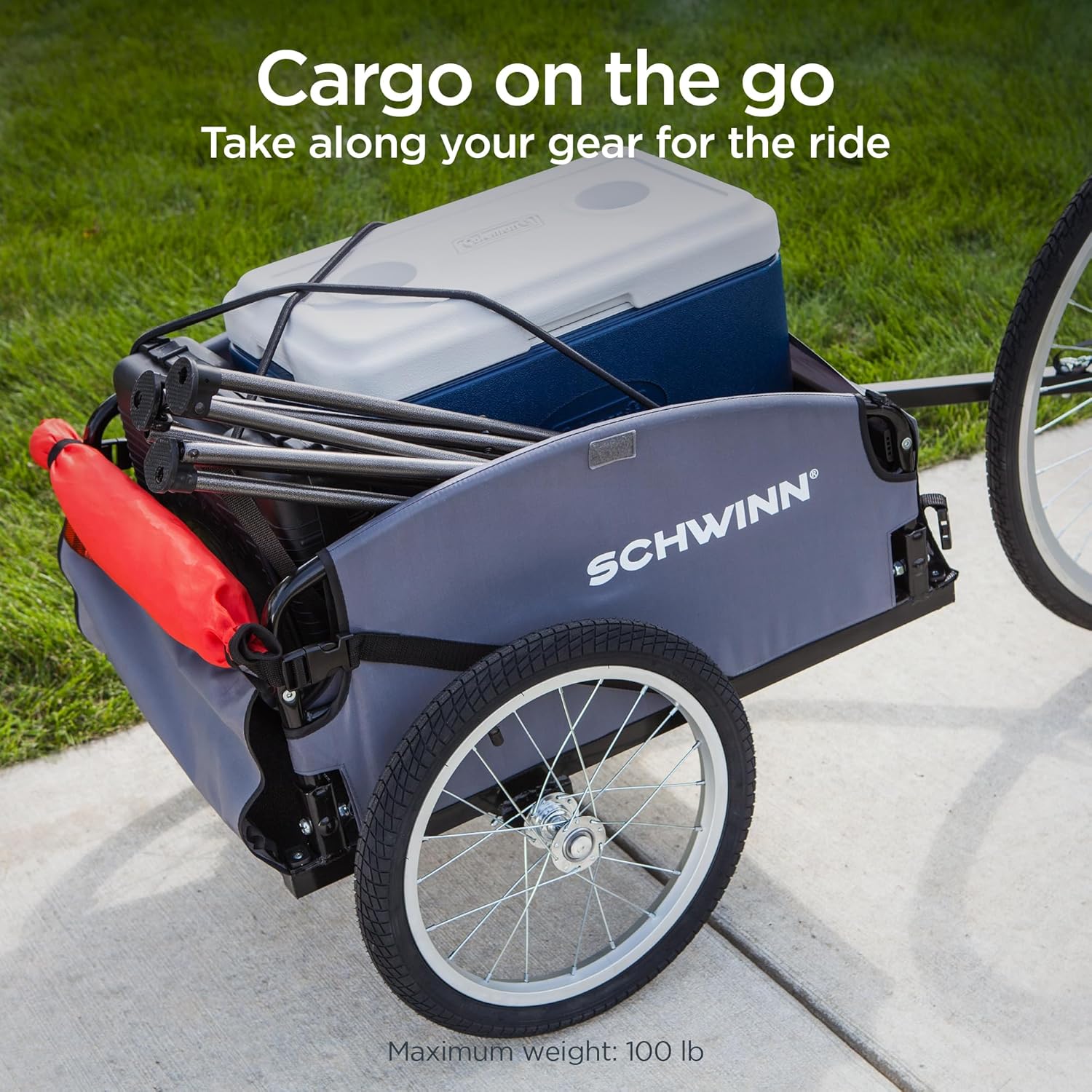
These two share a platform but are meaningfully different in execution — a distinction that online photos consistently fail to communicate. The Schwinn Porter (the cargo-optimized version) earns owner praise for build quality that exceeds what the entry-level price implies. The steel frame feels more substantial in person, and the cargo box is more rigid than competitors at the same price point. One pattern that recurs across owner feedback: buyers describe the trailer as noticeably better in hand than in product photographs.
The Schwinn Daytripper, by contrast, receives more mixed feedback. Most complaints center on a straightforward confusion: online listings show both trailers looking nearly identical, so buyers expecting Porter quality sometimes receive Daytripper construction. Confirm the exact model name before ordering — the distinction matters.
Payload ceiling is 100 lbs for both, which is honest for grocery runs and moderate cargo loads but a real limit if you’re thinking about hauling equipment, supplies, or anything approaching a full load of building materials.
Sportneer
$13.99
In stock on Amazon
Check price on AmazonRetrospec Rover
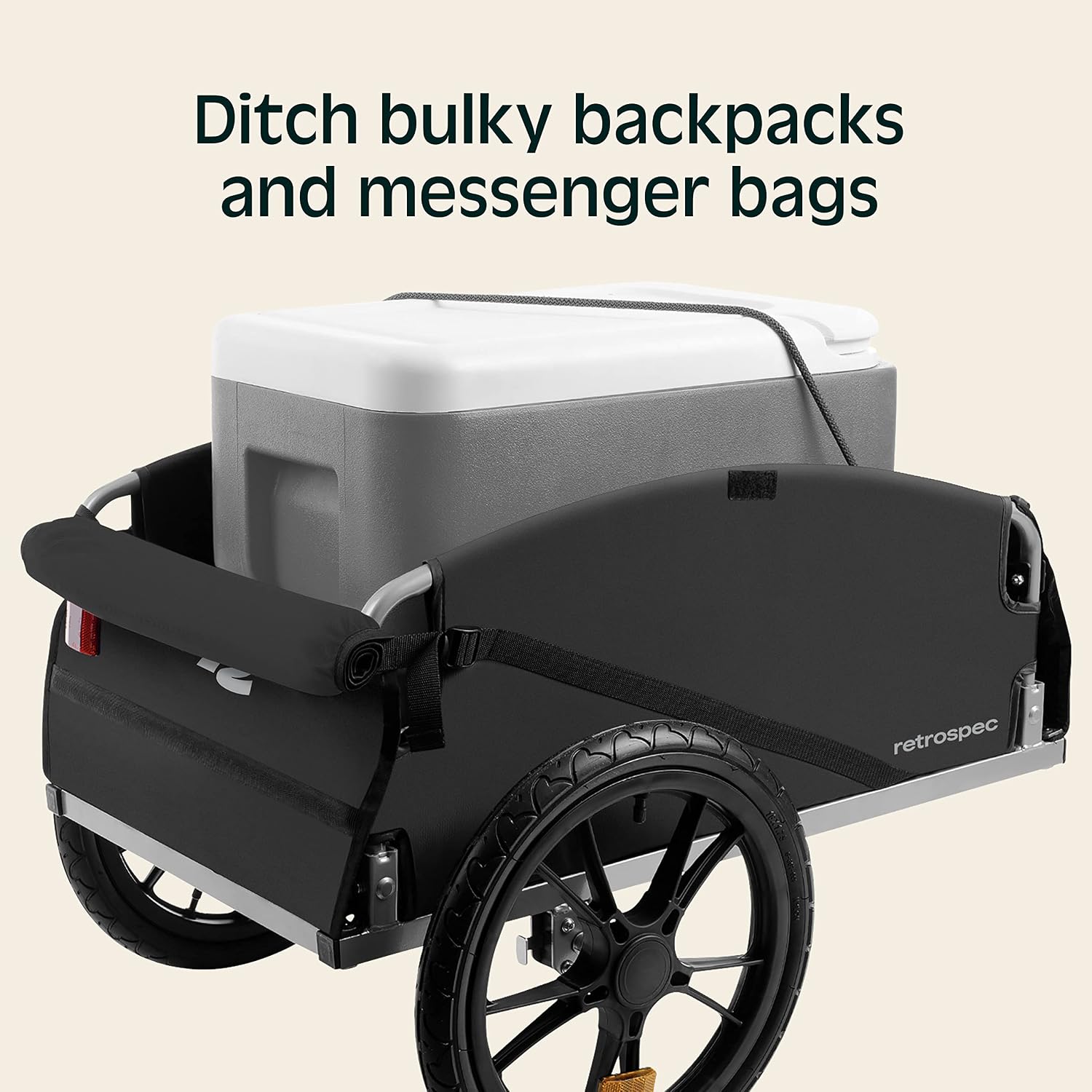
The Retrospec Rover lands in the same 100-lb capacity tier but earns consistent praise for a different reason: its folding frame. Owners who live in apartments, store bikes in tight garages, or commute to workplaces where storage is limited report that the fold-flat design is a genuine daily-use quality-of-life feature rather than a marketing claim. Bicycling’s 2025 “Best Bike Cargo Trailers” buyer’s guide highlights the Rover as a standout in the fold-and-store category for urban riders, noting it as a practical solution for cyclists who cannot dedicate permanent garage space to a fully assembled trailer.
At 100 lbs rated capacity, it shares the Schwinn’s ceiling. The tradeoff is that the folding mechanism adds a few pounds to the trailer’s own weight, which matters if you’re frequently loading it onto a cargo bike with weight limits of its own.
Sportneer
$13.99
In stock on Amazon
Check price on AmazonVEVOR Cargo Trailer
The VEVOR is where the conversation shifts from light cargo to serious cargo. Rated at 150 lbs, it steps up in both capacity and wheel track width, and owner-reported stability at load is a consistent theme across reviews. Owners describe towing as nearly silent with minimal detectable sway — a meaningful real-world indicator, because sway-free towing at working load is exactly what you want from a trailer in this class.
The VEVOR is also one of the few trailers in this price range that owners specifically flag as suitable for e-bike use. Electric Bike Review, in its “Cargo Hauling with E-Bikes: Trailer Compatibility Guide” (2024), notes that any trailer used with a Class 2 or Class 3 e-bike — which can sustain 20 to 28 mph under assist — should have a wheel track of at least 28 to 30 inches and a rated capacity meaningfully above the intended working load. The VEVOR’s 30-inch track and 150-lb rating position it squarely within those parameters.
Retrospec
$159.99
In stock on Amazon
Check price on AmazonGoplus Heavy Duty
The Goplus steps to 165 lbs rated capacity and offers more cargo platform area than the VEVOR. On paper it’s a compelling step up. In practice, the most consistent pattern in aggregated owner reviews is a frustrating one: missing hardware out of the box. Multiple buyers have reported receiving trailers short a bolt, a nut, or — in several cases — a coupler component. This is a fixable problem, but it warrants a genuine warning rather than a footnote.
Build quality once assembled is generally well-regarded. The missing-hardware pattern appears to be a fulfillment issue rather than a design flaw, but it recurs often enough that a practical recommendation follows: if you buy a Goplus, do a complete hardware audit before assembly. Keep the packing list, photograph box contents on arrival, and contact support immediately if anything is missing.
Retrospec
$159.99
In stock on Amazon
Check price on AmazonBakcou Cargo Trailer
The Bakcou is the most capable trailer in this roundup by rated capacity at 200 lbs, and it is clearly designed for buyers who need to move serious weight. Owners loading it with hunting gear, tools, or bulk supplies report it handles the weight well. But there is a hard speed-related safety issue that deserves prominent attention: without axle extensions installed, the Bakcou can tip at higher speeds.
This is not a fringe complaint. Multiple buyers discovered this firsthand. The physics are straightforward — a narrow effective track width relative to the trailer’s loaded height creates a tipping moment at speed. BikeRadar’s “How to Choose a Cargo Bike Trailer” (2024) addresses this directly, explaining that the wider the effective track relative to loaded center-of-gravity height, the higher the tipping threshold. The fix exists: axle extensions are available and recommended by Bakcou. But the factory configuration without them is not safe for e-bike speeds or downhill runs with a full load. Treat axle extensions as a required purchase when buying the Bakcou for heavy work, not an optional upgrade.
Schwinn
$179.99
In stock on Amazon
Check price on AmazonMatching the Trailer to Your Setup: The Decision Framework
People for Bikes, in its “Urban Cargo Cycling Infrastructure Report” (2025), notes that cargo bike trailers are being used across a wider speed and load range than manufacturers originally anticipated — particularly as e-bikes become the dominant platform for cargo cycling. That context matters for your choice, because a trailer selected for a slow, human-powered city bike may be the wrong tool entirely on a Class 3 e-bike commuting at 25 mph.
If you’re hauling under 80 lbs at low speed on a non-motorized bike: The Schwinn Porter or Retrospec Rover are honest, capable choices. The Porter wins on raw build quality; the Rover wins on storage convenience. Don’t overspend on capacity you won’t use.
If you’re hauling 80 to 130 lbs, especially on an e-bike: The VEVOR is the clear standout. Owner-reported stability, wider track, and 150-lb headroom give you real margin above your working load — which is exactly where you want to be. Towing at 90% of rated capacity is how trailers fail; towing at 65 to 70% is how they last.
If you need 150 to 200 lb capacity: The Goplus gets you there on paper at lower cost, but budget for a hardware audit and potential sourcing of missing components. The Bakcou gets you to 200 lbs with the right stability profile — but only with axle extensions installed. Factor that cost and make the decision with eyes open.
Frequently Asked Questions
Can I use these trailers with an e-bike? Yes, but match the trailer to your e-bike’s speed class. Class 1 e-bikes (20 mph pedal assist) are compatible with most trailers reviewed here. Class 2 and Class 3 bikes put real dynamic stress on trailers at load. Electric Bike Review’s “Cargo Hauling with E-Bikes: Trailer Compatibility Guide” (2024) recommends at least 150-lb rated capacity and a 30-inch minimum wheel track for Class 3 use. The VEVOR and Bakcou (with extensions) are the safer choices at higher speeds.
What happens if I exceed the weight rating at speed? Trailer sway initiates, and at sufficient speed it becomes a tank-slapper that can throw the bike. Payload ratings assume moderate speed and level ground — add a descent and the effective safe load drops. Always build in margin: if you plan to carry 120 lbs, buy a 150-lb trailer.
Do these trailers tip or sway when loaded unevenly? Yes. Uneven lateral loads shift the center of gravity toward one wheel and reduce the effective tipping threshold. Load heavy items as low and centered as possible. VEVOR owners specifically report minimal sway even with imperfect loads, likely due to track width.
Are the tires on budget trailers air-filled or solid? Most trailers in the 100-lb class ship with solid foam-fill or hard plastic tires. The VEVOR, Bakcou, and Goplus typically include pneumatic (air-filled) tires, which absorb road shock and protect cargo better. Confirm before ordering — solid tires perform acceptably on smooth pavement and poorly on anything rougher.
Does the universal coupler actually fit my specific bike axle? Usually, but not always. Standard quick-release axles and 12mm thru-axles require different adapters. Most couplers include a basic adapter set. Measure your axle diameter before ordering, and confirm that your model includes the correct adapter. The Bakcou’s axle extension requirement is a specific case where the standard coupler configuration is insufficient for safe high-speed use.
How do I secure cargo on an open flatbed or low-sided trailer? Ratchet straps anchored to the trailer’s tie-down points are the standard approach. Cross-strap from opposite corners for lateral stability. For loose or irregular cargo, a cargo net over ratchet straps adds a secondary retention layer. Never rely on trailer sides alone for containment at load — even high-sided trailers can shift cargo on a hard corner.
Published spec data sourced from manufacturer listings current as of Q2 2026. Owner experience patterns drawn from aggregated review analysis; individual results vary by load, speed, and terrain. Editorial citations: Bicycling, “Best Bike Cargo Trailers,” 2025; BikeRadar, “How to Choose a Cargo Bike Trailer,” 2024; Electric Bike Review, “Cargo Hauling with E-Bikes: Trailer Compatibility Guide,” 2024; People for Bikes, “Urban Cargo Cycling Infrastructure Report,” 2025.