June 6, 2026 • Neil Hayes • 9 min reading time • Prices verified June 25, 2026
When 88 Pounds Isn't Enough: High-Capacity Cargo Trailers for Serious Hauling
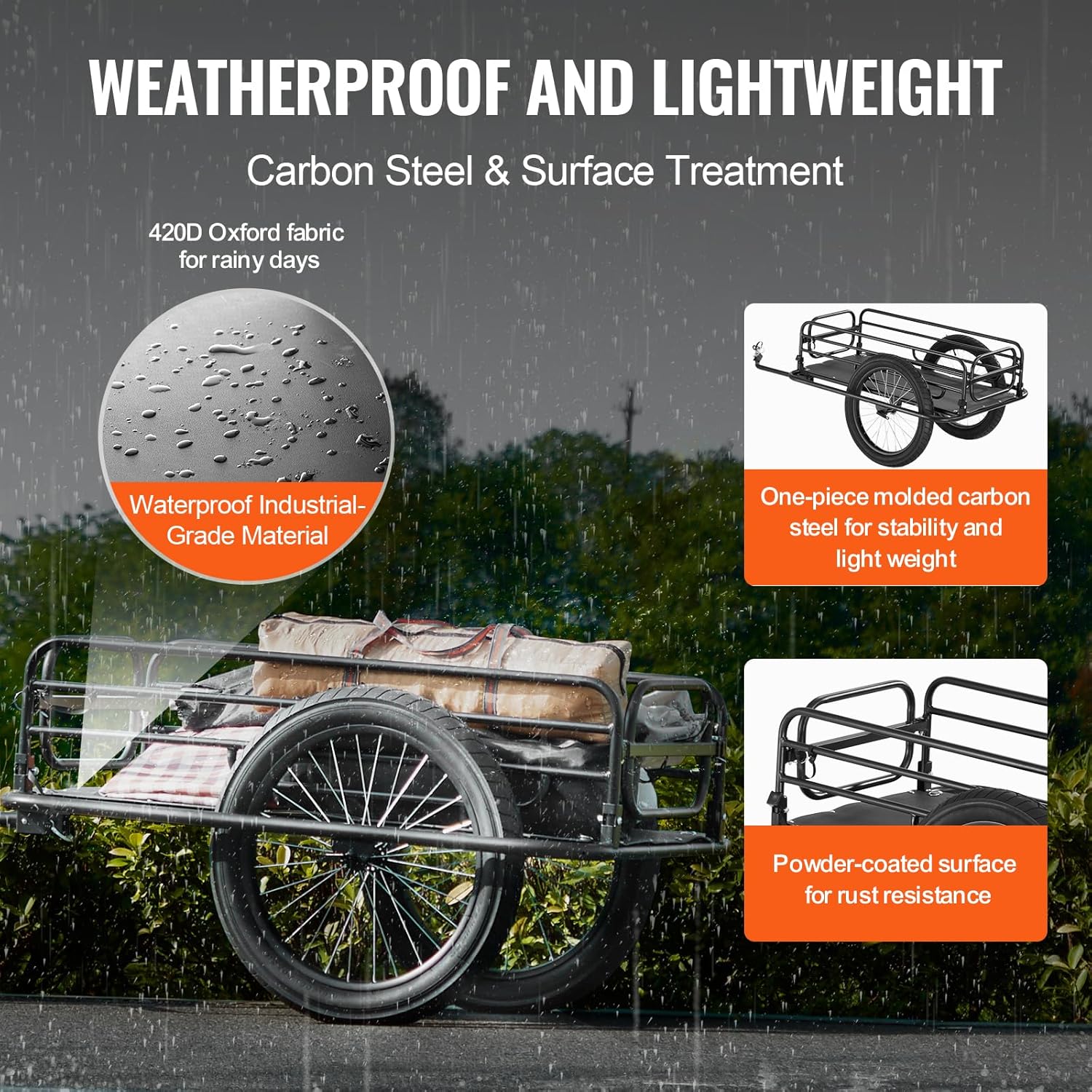
Most standard bike trailers — the kind you see hitched to family SUVs at trailheads or parked outside grocery stores — are rated to carry somewhere between 66 and 100 pounds. That ceiling works beautifully for two kids, a week of groceries, or a camping weekend’s gear. But when you’re hauling construction materials to a community garden, running a small business out of a cargo bike, doing urban deliveries across a city grid, or simply living car-free in a way that means everything comes home by bike, that limit starts feeling less like a spec number and more like a hard wall you hit every single week. This guide is for riders who’ve already hit that wall. We’ll break down what “high-capacity” actually means in trailer terms (rated load versus practical load, frame geometry, hitch type), compare the trailers purpose-built for serious work, and give you a clear decision framework so you can match the right trailer to your actual use case — not just the one with the biggest number on the box.
| EDITOR'S PICK[Bakcou - Folding Cargo eBike Tr…](https://www.amazon.com/dp/B0BX8HRKKG?tag=greenflower20-20) | Mid-tier[Rambo Bikes Aluminum Bike Trail…](https://www.amazon.com/dp/B01BY7HTX8?tag=greenflower20-20) | Budget pick[Ktaxon Bike Cargo Trailer](https://www.amazon.com/dp/B0DXBTCDSX?tag=greenflower20-20) | |
|---|---|---|---|
| Capacity | 150-200 lbs | 300lbs | 220 lbs |
| Wheel Size | 20" x 3" | 16" | 20" |
| Frame Material | — | 6061 Aluminum | — |
| Folding | ✓ | — | ✓ |
| Hitch Included | ✓ | — | ✓ |
| Liner Included | Canvas | — | — |
| Price | $367.48 | $349.99 | $115.99 |
| See on Amazon → | See on Amazon → | See on Amazon → |
What “High-Capacity” Actually Means — and Where Specs Mislead You
The 88-pound (40 kg) figure you see on most mainstream cargo trailers isn’t arbitrary. It’s an industry-common threshold that traces back to EN 15918, the European standard governing bicycle trailer construction and load testing. But once you move into the working-cargo segment, specs fragment fast, and comparison shopping gets genuinely complicated.
Rated capacity vs. usable capacity is the first gap to understand. A trailer rated at 150 lbs may achieve that number with load distributed evenly across its full cargo deck — but real-world loads aren’t even. A stack of reclaimed 2x4s concentrates weight toward the back. Bags of soil or mulch shift under braking. Rated capacity tells you what the frame can bear in a lab condition; usable capacity is what you can safely haul on a bike path with a camber and a pothole.
Tongue weight — the downward force the trailer hitch places on your bike’s rear axle — is the second number most buyers ignore until it causes problems. Per BikeRadar’s heavy-duty cargo trailer roundup, trailers with low, centered cargo platforms transfer tongue weight more favorably than tall-sided box designs. High tongue weight on a lightly loaded rear axle causes shimmy above 15 mph and, on electric cargo bikes, can trigger torque sensor misreadings.
Hitch compatibility is the third variable. The near-universal “axle-mount” hitch (attaches to the rear wheel’s quick-release skewer or thru-axle) works on most bikes, but high-capacity trailers increasingly use proprietary frame-mount hitches or require a specific receiver block. If you’re running a Tern GSD, a Rad Power RadWagon, or a custom-built cargo bike with a non-standard dropout, verify hitch compatibility before anything else. Manufacturers including Tout Terrain and Carla Cargo publish explicit compatibility matrices — use them.
The Trailers Worth Evaluating Above 100 Lbs
This is where the market genuinely thins out. Below 100 lbs, you have dozens of options. Above it, you’re looking at a handful of purpose-built platforms, a couple of European commercial designs, and the DIY fabrication route.
Carla Cargo — The Benchmark for Commercial Hauling
The Carla Cargo trailer (German-manufactured, increasingly available via North American dealers as of early 2026) carries a manufacturer-rated capacity of 200 kg — 440 lbs — with an optional electric motor assist integrated into the trailer’s own rear axle. That motor senses tongue-weight pull and adds matching torque, which solves the tongue-weight problem at the source rather than engineering around it. Spec sheets from Carla Cargo document a 1,000-watt hub motor, 48V battery, and a claimed range of 25–40 km under load depending on terrain.
Owners in European urban delivery operations — documented in fleet reviews aggregated by PeopleForBikes’ urban cargo cycling infrastructure report — consistently describe the assisted model as transformative for loads above 150 lbs. The unassisted version, rated the same at 440 lbs but without motor assist, is more affordable and still structurally capable; it’s the right tool when your route is flat and your cargo bike already has substantial motor output.
The tradeoff: The Carla Cargo is wide — 80 cm cargo platform — which puts it at the edge of many shared-use path width standards. If your route includes narrow gates, tight parking structures, or multi-use trails with signage restrictions, measure before you commit.
Tout Terrain Sidecar — Stability-First Design
Tout Terrain’s Sidecar (documented in Tout Terrain’s own specification sheets) takes a fundamentally different structural approach. Rather than a two-wheel trailing design, it mounts as a parallel sidecar on the bike’s left side, shifting the load’s center of gravity inboard rather than behind. Rated at 80 kg (176 lbs) — lower than the Carla Cargo — but with a platform geometry that owners in long-haul reviews describe as dramatically more stable under asymmetric loads (think: one heavy item on one side of a conventional trailer).
BikeRadar’s cargo trailer coverage notes the Sidecar’s compatibility is narrower than axle-mount designs; it requires a specific frame-mount bracket and works best with bikes that have clean left-side rear-triangle clearance. That rules out some e-cargo bikes with integrated rack systems. Where it fits, though, riders handling fragile or awkward loads — bakery deliveries, potted plants, photography equipment — consistently prefer the sidecar’s predictable handling over any two-wheel trailer in this weight class.
Burley Coho XC and Travoy — The Accessible Middle Ground
Burley’s Coho XC is rated at 60 lbs (27 kg) — technically below our threshold — but earns a mention here because it’s the trailer most riders consult as a baseline when shopping up. The Travoy, per Burley Design’s published specification sheet, steps up to 60 lbs cargo plus frame-integrated modular bags that can effectively extend utility without adding rated structural load.
If you’re sitting at the 88-lb ceiling and considering your next step, the Burley platform tells you what you’re leaving behind in terms of hitch simplicity, trail clearance, and sub-$600 price points when you move into true high-capacity territory. That comparison is worth being honest about.
Croozer Cargo — Mid-Market with Real Numbers
The Croozer Cargo (German brand, distributed in North America) is rated at 100 kg (220 lbs), sits closer to the Carla Cargo’s capacity but without motor assist, and prices at roughly half the Carla Cargo’s MSRP as of mid-2026. Electric Bike Review’s cargo-trailer pairing guide notes the Croozer Cargo hitches cleanly to most mid-drive e-cargo bikes and is one of the few high-capacity trailers explicitly tested (by the manufacturer) with Bosch mid-drive torque sensors without triggering false assists.
For small-business operators — market vendors, mobile repair shops, urban delivery fleets on a budget — aggregated owner reviews across cycling forums consistently position the Croozer Cargo as the pragmatic first step into serious commercial hauling.
By the Numbers
| Trailer | Rated Capacity | Motor Assist | Approx. Price (2026) | Best For |
|---|---|---|---|---|
| Carla Cargo (assisted) | 440 lbs / 200 kg | Yes (1,000W, 48V) | $3,200–$3,800 | Commercial delivery, steep terrain |
| Carla Cargo (unassisted) | 440 lbs / 200 kg | No | $1,800–$2,200 | Flat-route commercial, high volume |
| Croozer Cargo | 220 lbs / 100 kg | No | $900–$1,100 | Small-business, e-bike compatible |
| Tout Terrain Sidecar | 176 lbs / 80 kg | No | $1,400–$1,700 | Fragile/asymmetric loads, stability |
Prices based on North American dealer listings current as of May 2026. Import availability varies by region.
Pairing a High-Capacity Trailer to Your Bike — What Actually Limits You
Bicycling.com’s cargo buyer’s guide makes a point that’s easy to miss in spec-sheet comparisons: your bike’s rear axle rating, not the trailer’s capacity, is often the real ceiling. Most standard aluminum cargo bikes have rear axle load ratings of 25–50 kg for the rack itself; that’s separate from the trailer hitch load, but high tongue weight from a maxed-out trailer still transfers upward force into the dropout and frame.
The practical implication: if you’re planning to run a Carla Cargo at or near its 200 kg capacity, you want a bike purpose-built for it — a Tern GSD, a Riese & Müller Load, or a custom-fabricated steel cargo frame. Running a standard commuter e-bike with a high-capacity trailer and regularly hauling 300+ lbs will stress components outside their design envelope, regardless of what the trailer’s spec sheet says.
Electric Bike Review’s pairing guide recommends this sequence for serious haulers:
- Confirm your bike’s rear dropout and axle rating with the manufacturer — not the dealer, the manufacturer.
- Calculate your gross vehicle weight: bike + rider + trailer + cargo. Most urban e-cargo setups run 500–700 lbs total once loaded.
- Match motor output accordingly. For loads above 400 lbs gross, mid-drive motors rated at 85 Nm or higher torque are the documented sweet spot for hill-handling without motor thermal cutoff.
If X, Then Y — The Decision Framework
After mapping the options above against real use cases and owner-reported patterns, here’s how the decision actually shakes out:
If your loads are under 150 lbs and terrain is mixed: The Croozer Cargo is the rational choice. It covers most real-world non-commercial use cases, hitches to the broadest range of bikes, and doesn’t require a motor upgrade to run effectively.
If you’re running a delivery operation or hauling routinely above 200 lbs on anything but flat ground: The Carla Cargo with motor assist is the only purpose-built solution in this weight class that doesn’t require you to fabricate your own platform. The price is steep; the operational math on a commercial route justifies it quickly. PeopleForBikes’ 2025 urban cargo report documents fleet operators recovering the cost difference versus two-trailer setups within 8–14 months of daily use.
If your loads are awkward, fragile, or heavily asymmetric: The Tout Terrain Sidecar is worth the compatibility homework. The handling advantage on fragile cargo is real and consistently reported — you don’t have to take that on faith when dozens of bakery and floristry operators have documented it in professional cycling forums.
If you’re not yet sure: Rent before you buy. As of 2026, Carla Cargo and Croozer both operate dealer demo programs in major North American metro areas. Hauling 180 lbs of gear through a real neighborhood for a weekend will answer questions that no spec sheet can.
The 88-pound ceiling is an engineering artifact of the mass-market trailer segment — a sensible limit for the use case those trailers were designed for. Beyond it, the tools exist, the specs are published, and the owner community is vocal about what works. You just have to be willing to do the homework before you commit.