June 23, 2026 • Neil Hayes • 10 min reading time • Prices verified June 25, 2026
Mini Electric Bike Pumps for Cyclists: Do They Actually Replace Your Floor Pump
If you’ve ever knelt beside a bike on a damp driveway, squinting at a tiny analog gauge while a toddler tugs your sleeve, you already understand the appeal of a mini electric pump — a battery-powered, handheld device about the size of a thick TV remote that inflates bicycle tires at the press of a button and stops automatically when it hits your target pressure. No hand-pumping, no guesswork. You set a number, press go, and the pump beeps when it’s done. Two devices have dominated the conversation in cycling forums and review aggregators over the past two years: the Fanttik X9 Ace and the HOTO Mini Air Pump. Both cost roughly the same. Both promise portability. But owners describe meaningfully different experiences depending on how — and how often — they actually use them. This article breaks down where the specs line up, where they diverge, and which one fits your situation.
What “Portable” Actually Means Here (Hint: Not Your Jersey Pocket)
Let’s start with the tension that runs through nearly every review of both pumps: the word portable is doing a lot of heavy lifting in the marketing copy, and real owners push back on it consistently.
Across aggregated reviews on major retail platforms and in roundups by BikeRadar’s mini electric pump coverage, reviewers make a consistent clarification: portable means car glovebox, pannier bag, or backpack — not cycling jersey pocket, not saddle bag. The Fanttik X9 Ace is roughly the footprint of a large smartphone but noticeably thicker and heavier. The HOTO is more compact, but it’s still not a jersey-pocket object. One frequently cited HOTO review specifically flags the non-obvious power mechanism: the pump turns on by swinging the hose out from the body, not by pressing a conventional button. That’s genuinely useful information that doesn’t appear in the product listing but prevents real frustration when you’re standing in a parking lot at 6 a.m. wondering why the thing won’t turn on.
The practical takeaway: If your use case is “I want something in my kit bag when I drive to a trailhead or throw it in the cargo bay of my Tern GSD before a group ride,” both devices are genuinely useful. If you’re imagining something that lives in a jersey pocket for roadside flats on a solo century, you’ll want a CO₂ inflator or a quality hand pump instead — and Bicycling Magazine’s buyer’s guide for pumps makes exactly this distinction.
Where Each Pump Actually Shines: User Profiles from the Review Record
The clearest pattern across aggregated owner sentiment is that these two pumps attract slightly different buyers — not because of dramatic spec differences, but because of how they fit into a rider’s routine.
Fanttik X9 Ace owners tend to describe a shop-and-occasional-ride use case. The reviews skew toward people who want a backup device at home or in a vehicle, something more convenient than their floor pump for quick top-offs but not necessarily something they carry daily. Owners mention using it to check and top off multiple bikes before a weekend group ride — the 3-to-5-bike scenario appears repeatedly and unprompted. That’s a genuine sweet spot: you want accurate pressure across a mixed fleet (road bike, cargo bike, kids’ trailer tires) without dragging the floor pump outside and re-coiling the hose five times.
HOTO Mini owners skew toward daily riders who prioritize size above almost everything else. Reviews describe commuters and urban cyclists who want the smallest possible device that still delivers accurate auto-shutoff inflation. The HOTO’s form factor is the deciding factor for this group, even if they accept slightly shorter battery life per charge to get there.
The family-household use case deserves its own paragraph because it shows up so consistently it’s almost a product category unto itself. Households with three to five bikes — adults’ bikes, kids’ bikes, cargo trailer — are among the most enthusiastic mini electric pump advocates in the review record. The ability to do a full pressure check on the whole fleet in under ten minutes before a family outing, without the physical effort of a floor pump on every tire, is genuinely compelling. Outside Online’s portable pump coverage in 2025 specifically identifies multi-bike households as the demographic most likely to see daily value from the category.
By the Numbers
| Spec | Fanttik X9 Ace | HOTO Mini Air Pump |
|---|---|---|
| Max pressure (road / Presta) | 150 PSI | 150 PSI |
| Max pressure (Schrader / car) | 150 PSI | 120 PSI |
| Charging interface | USB-C | USB-C |
| Valve compatibility | Presta + Schrader | Presta + Schrader |
| Approx. inflations per charge | ~15–20 (road, 100 PSI) | ~10–15 (road, 100 PSI) |
All figures from manufacturer-published specifications; per-charge inflation counts reflect owner-reported real-world estimates aggregated across retail reviews, not controlled testing.
The USB-C charging detail is worth pausing on. Across both products’ review records, buyers mention it positively and unprompted — a signal that the previous generation of mini electric pumps, which used proprietary magnetic charging cables, created genuine frustration. USB-C means you can charge from the same cable as your phone, your Garmin, your Wahoo — whichever ecosystem you’re already carrying. It’s a small thing that reviewers consistently treat as a meaningful upgrade.
Accuracy, Pressure Settings, and the Floor Pump Question
Here’s the honest answer to the article’s headline: no, a mini electric pump does not replace your floor pump — and most owners who think it through don’t actually want it to.
Floor pumps (track pumps with a large barrel and a stable base) remain the gold standard for two reasons: they generate high volume per stroke at low effort, making full-inflation from zero much faster in terms of elapsed time, and their large analog or digital gauges tend to be more consistent and easier to read for precise pressure setting. Road Bike Rider’s tire pressure accuracy overview notes that precision matters most at the higher end of road bike pressures (90–130 PSI), where a 5 PSI variance meaningfully affects rolling resistance and handling.
Mini electric pumps, including both the Fanttik X9 Ace and HOTO, use auto-shutoff technology — you dial in a target PSI, and the pump stops at that number. Owners report that both devices are reasonably accurate at road bike pressures, with most reviews describing results within 2–4 PSI of the set point. That’s acceptable for a top-off but may not satisfy a rider who carefully calibrates pressure to weight and conditions. For mountain bike and cargo bike applications where pressure targets are lower (typically 20–50 PSI), accuracy complaints nearly disappear from the review record.
The floor pump isn’t going anywhere if you care about precision at the high end. What the mini electric pump adds is the convenience layer: checking and correcting pressure before a ride without dragging the floor pump out, handling the multi-bike household scenario, and having something in the cargo bag that can manage a slow leak discovered mid-ride at a parking lot rather than a remote trail.
Frequently Asked Questions
Can a mini electric pump fully inflate a flat tire from zero, or only top off?
Both the Fanttik X9 Ace and HOTO can inflate from zero — they’re not limited to top-offs by design. However, owners consistently note that full inflation from a flat takes meaningfully longer than with a floor pump, and battery drain is substantially higher for zero-to-full inflations. Treat zero-to-full inflation as a genuine emergency capability, not the primary use case. For a standard road tire from flat to 100 PSI, expect 3–5 minutes of run time depending on tire volume.
Will these pumps fit in a standard cycling jersey pocket or small saddle bag?
No — and this is the most consistent gap between marketing and reality in the review record. Both devices are too large and too heavy for a jersey pocket, and they exceed the dimensions of most standard saddle bags. Plan for a frame bag, handlebar bag, pannier, or cargo pocket. BikeRadar’s mini electric pump roundup makes this point explicitly and suggests CO₂ inflators or compact hand pumps as the genuine jersey-pocket solution.
How many full inflations can I get per charge on the Fanttik X9 Ace or HOTO?
Manufacturer figures and owner reports both suggest the Fanttik X9 Ace delivers approximately 15–20 road-bike inflations (around 100 PSI) per full charge. The HOTO runs closer to 10–15 at the same pressure. Both figures drop if you’re inflating from flat rather than topping off, and both improve on lower-pressure applications like cargo or mountain bike tires. USB-C charging on both means a top-up from a power bank is simple.
Do both pumps work with Presta valves on road bikes and Schrader valves on e-bikes?
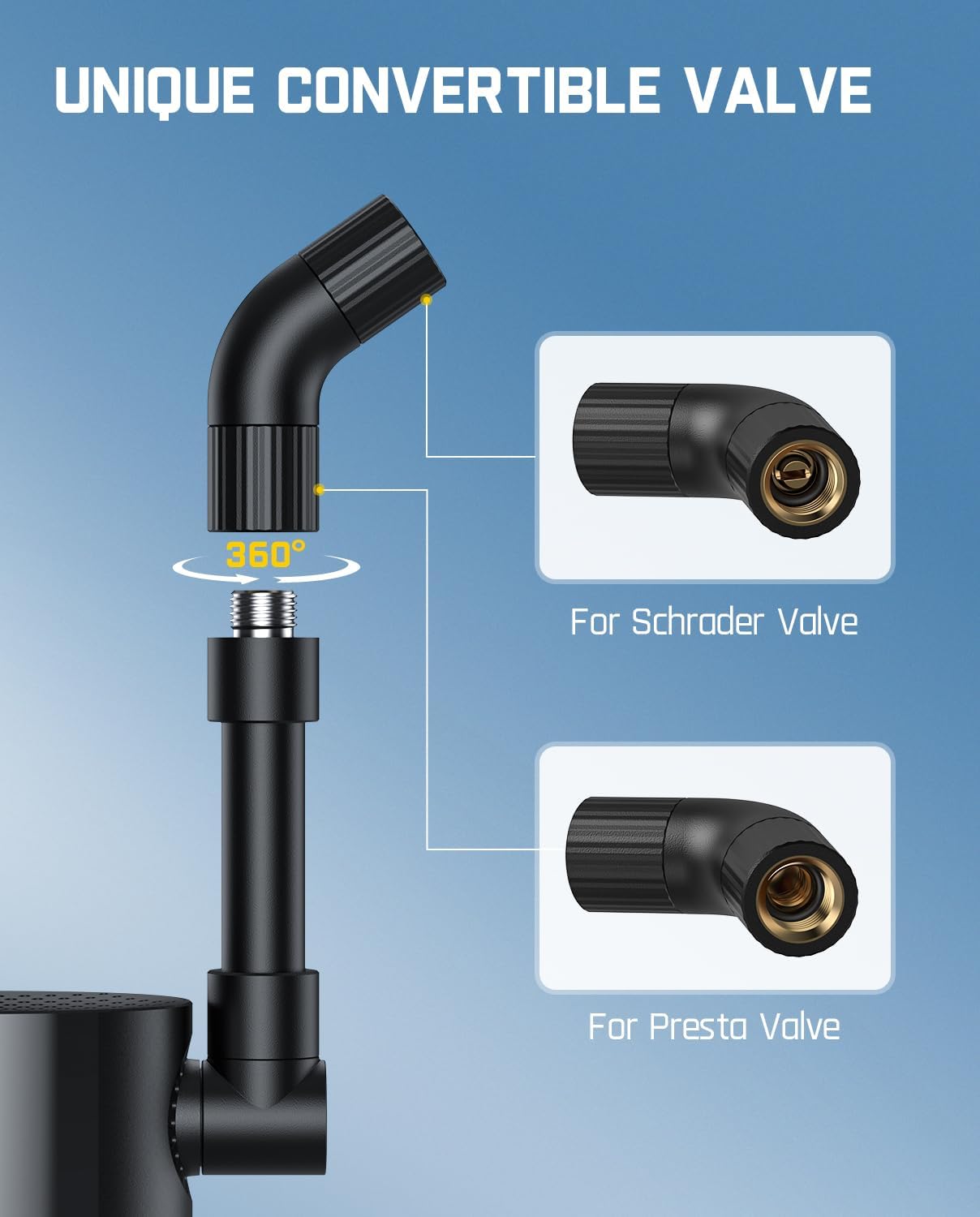
Yes. Both the Fanttik X9 Ace and HOTO include adapters for both Presta (the narrow, threaded valve common on road and cyclocross bikes) and Schrader (the wider, car-style valve found on most e-bikes, kids’ bikes, and mountain bikes). Owners of mixed-fleet households — road bike plus cargo e-bike plus trailer — report that valve switching is straightforward on both devices. The adapters are small, so storing them attached to the pump or in a designated pouch is worth building into your routine before you lose one.
Can I use these to inflate car tires in an emergency?
Technically yes, with caveats. Both pumps are rated to 150 PSI, which covers passenger car tire pressures (typically 30–36 PSI). The HOTO’s manufacturer listing specifies 120 PSI maximum for Schrader applications, so verify your model’s spec. Owner reports of car-tire inflation describe it as slow — expect 8–12 minutes to bring a low car tire up to pressure — and note that battery drain is significant for a high-volume application like a car tire. It works; it’s not efficient. Keep it as a genuine last resort, not a substitute for a purpose-built car tire inflator.
Is a mini electric pump accurate enough to set precise tire pressure for road cycling?
For most riders, yes — within a usable range. Owners report that both pumps hold accuracy to within roughly 2–4 PSI of the set point at road pressures, which is adequate for recreational riding and most training. For riders who are dialing in pressure to within 1 PSI based on weight, temperature, and surface — the kind of precision that matters in racing or for riders with strong positions on tire pressure optimization — a high-quality floor pump with a calibrated gauge remains the better tool. Use the mini electric pump to maintain a range, then fine-tune with your floor pump before events where it matters.
The Decision Frame: If X, Then Y
If your household has three or more bikes and you want faster pre-ride pressure checks: either device earns its place. The Fanttik X9 Ace’s slightly higher per-charge capacity makes it a better fit if you’re topping off five bikes regularly.
If you’re a daily urban commuter who wants the smallest possible device in a bag that’s already full: the HOTO’s size advantage is real, and the trade-off in battery capacity is likely acceptable at the pressure ranges most commuters use.
If you’re managing a cargo e-bike fleet or outfitting a small delivery operation: the Schrader-first workflow and multi-bike stamina of the Fanttik X9 Ace fit better, and USB-C charging simplifies the logistics of keeping devices topped off across a fleet context.
If your primary need is roadside flat repair on solo rides: neither of these is your best option. A CO₂ inflator or quality mini hand pump — as Bicycling Magazine’s buyer’s guide recommends for that specific scenario — is faster, lighter, and doesn’t depend on a charged battery.
Neither pump replaces your floor pump. They replace the inconvenience of your floor pump in specific situations — and for most households that own more than two bikes, that’s a trade worth making.