September 9, 2026 • Neil Hayes • 11 min reading time • Prices verified June 25, 2026
Mini Electric Bike Pumps for the Road: Accuracy, Battery Life, and When to Leave the Floor Pump at Home
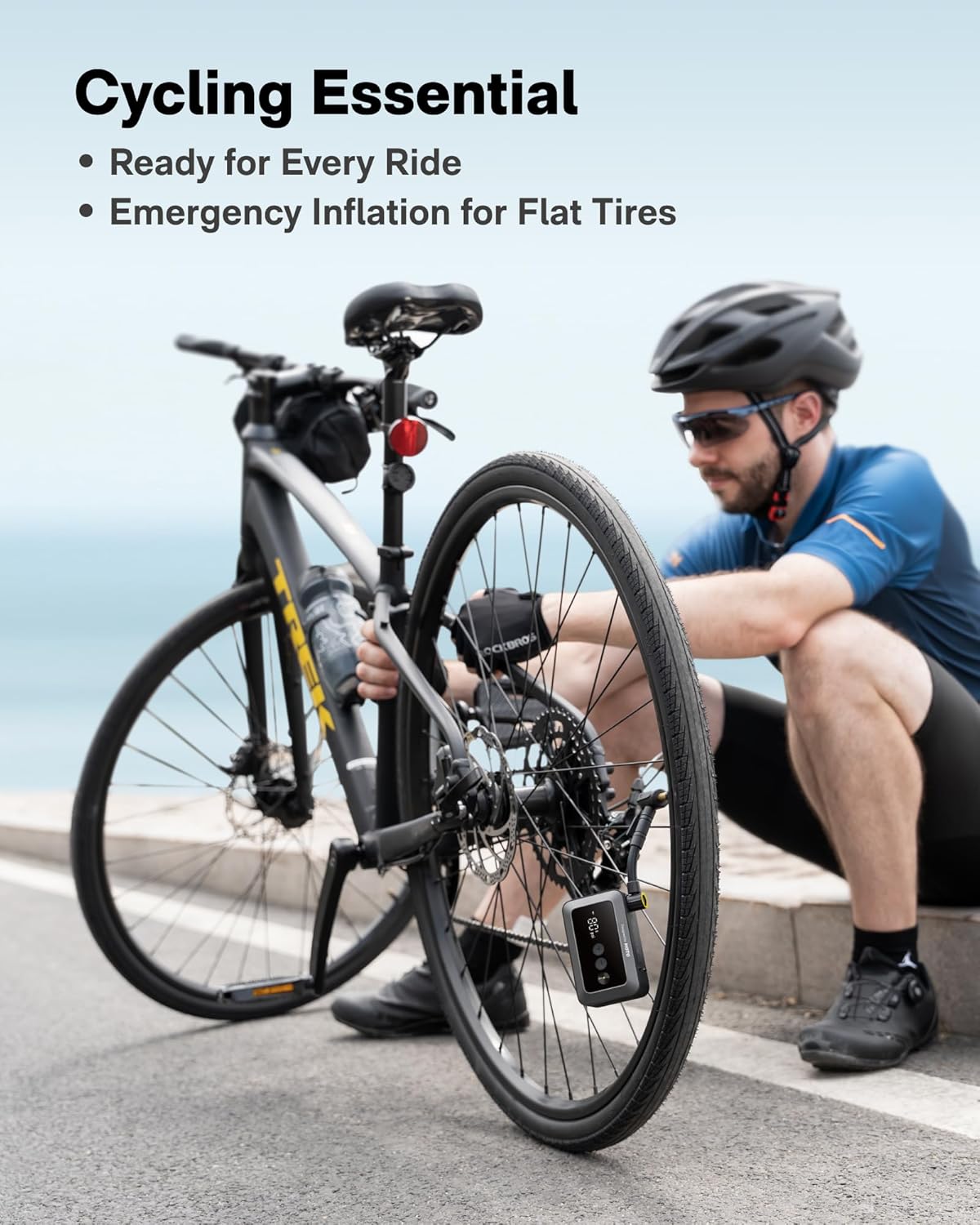
A bike pump is exactly what it sounds like — a device that forces air into a tire until it reaches the right pressure, measured in PSI (pounds per square inch). For decades, cyclists chose between a bulky floor pump for home use and a tiny manual hand pump for roadside emergencies. Mini electric pumps are a newer third option: battery-powered, roughly the size of a thick marker or small power bank, and capable of inflating a tire automatically to a target pressure before shutting off. They’ve been dismissed as gadgets. They shouldn’t be. Owner reviews on both the Fanttik X9 Ace and the HOTO pump — two of the most discussed models in the mid-range tier — suggest that accuracy and usability have matured to a point where the “emergency-only” label deserves a hard look. This article breaks down what aggregated owner experience actually shows, where each pump fits in a cargo-bike or multi-bike household, and the decision rules that matter before you buy.
How Accurate Are Mini Electric Pumps? What Owner Testing Shows
The single most important thing most buyers get wrong about mini electric pumps is assuming the onboard pressure gauge is decorative. It isn’t — at least not on the current generation of better-made units. The comparison below breaks each pump into its own H3 section so the differences in accuracy evidence are clear.
Fanttik X9 Ace: Quantified Precision Against a Reference Gauge
One particularly methodical owner review of the Fanttik X9 Ace describes inflating six tires across three different bikes and cross-checking the pump’s onboard gauge reading against a calibrated precision reference gauge at each stop. The finding: the Fanttik’s readings landed within 1 PSI of the reference gauge across all six tires. For context, Bicycling.com’s buyer’s guide titled “The Best Bike Pumps” identifies ±2 PSI as “good” accuracy for any portable pump. Landing within 1 PSI is exceptional for a device in this form factor.
That accuracy matters more than it might seem. If you’re running a cargo bike — say, a Tern GSD or a RadWagon 4 — at rated capacity with a child seat or a loaded cargo box, tire pressure directly affects handling stability, rolling efficiency, and load-bearing performance. ElectricBikeReview.com’s cargo bike maintenance coverage consistently notes that under-inflation under load is one of the most common and easily preventable causes of sluggish performance and premature tire wear. A pump you can trust to 1 PSI isn’t a gadget; it’s a precision maintenance tool.
Beyond accuracy, the Fanttik works across footballs, car tire top-offs, and cart tires in addition to bikes. For a family running a cargo bike, a bike trailer, a cargo cart, and a car, that breadth is a real convenience multiplier. One reviewer uses the Fanttik X9 Ace as a primary household pump rather than an emergency backup — a meaningful shift in how these devices are categorized.
HOTO
$39.87
In stock on Amazon
Check price on AmazonHOTO Pump: Build Quality That Exceeds Expectations at This Price Point
The HOTO pump earns its own praise on accuracy, though reviewers tend to reach for words like “consistent” and “repeatable” rather than quantifying results against a reference gauge. What’s more notable in HOTO reviews is the build quality commentary — reviewers keep returning to language that’s unusually emphatic for a pump in this price tier. Phrases like “not just good, not just OK, but great” recur in a way that suggests the tactile experience — the feel of the housing, the button feedback, the nozzle connection — exceeds expectations in a way specs alone don’t predict.
The HOTO’s 120 PSI ceiling covers virtually every bike tire application outside of track cycling. For cargo bikes, trailers, and family bikes that typically run 15–80 PSI depending on tire width and load, it is more than sufficient. Reviewers flag the HOTO as particularly satisfying for users who want a pump that feels like a finished product rather than a prototype — an important consideration if you’re handing it to a family member or a co-worker and need them to get it right on the first try.
HOTO
$39.87
In stock on Amazon
Check price on AmazonSide-by-Side Specifications: Fanttik X9 Ace vs. HOTO Pump
Both pumps occupy the mid-range tier on price. Neither qualifies as budget (where accuracy sacrifices are common) nor as a premium workshop tool. That positioning is appropriate for their target user: the serious everyday rider or cargo-bike household that wants dependable maintenance capability without floor-pump logistics.
| Specification | Fanttik X9 Ace | HOTO Pump |
|---|---|---|
| Max pressure | 150 PSI | 120 PSI |
| Gauge accuracy | Within 1 PSI (owner testing vs. reference gauge) | Consistent; no published deviation spec |
| Valve compatibility | Presta / Schrader | Presta / Schrader |
| Charge interface | USB-C | USB-C |
| Primary strength | Quantified accuracy; multi-application versatility | Build quality; tactile finish; ease of use |
HOTO
$39.87
In stock on Amazon
Check price on AmazonBattery Life and Volume: How Many Tires Per Charge?
Battery life on mini electric pumps is expressed in a way that can mislead buyers: manufacturers typically quote a number of “standard road bike tires” per charge, assuming roughly 700c × 23–25mm tires inflated from flat to around 100 PSI. Your real-world number varies significantly by starting pressure, tire volume, and target PSI.
For a household running cargo bikes and trailers, here’s the practical math:
- A standard road tire (700c × 25mm) takes roughly 1–1.5 minutes to inflate from flat.
- A cargo bike tire (20 × 4” fat tire, as on many e-cargo bikes and longtails) holds approximately 3–4× the air volume of a road tire, so inflation time — and battery draw — scales accordingly.
- A Burley D’Lite bike trailer runs 16” tires typically inflated to 35–45 PSI; those are low-volume and low-pressure, so they’re easy on the battery.
- A Thule Chariot Cross runs 20” tires at similar pressures — again, low relative battery draw.
Owners of the Fanttik X9 Ace consistently report completing 4–6 standard bike tires on a single charge, with the caveat that fat-tire e-bikes push that number toward the lower end. One reviewer specifically calls out inflating multiple tires in a single session without recharging — which aligns with using it as a primary shop pump rather than a backup. BikeRadar’s feature “Mini pump vs floor pump: which do you need?” notes that the shift from “emergency backup” to “primary pump” is the real story with the current generation of electric mini pumps, and owner sentiment on both the Fanttik and the HOTO tracks with that framing.
For fat-tire cargo bikes specifically — think Lectric XP Cargo, Riese & Müller Load 75, or the RadWagon 4 with wider tires — expect 2–3 full inflations per charge when topping off from genuinely low pressure. If you’re doing routine maintenance top-offs (adding 10–15 PSI to a tire that isn’t flat), you’ll get considerably more cycles before needing to recharge. Both pumps charge via USB-C, which means any laptop charger, power bank, or standard wall adapter works — no proprietary cable to lose.
Valve Access, Adapter Orientation, and the Short Nozzle Problem
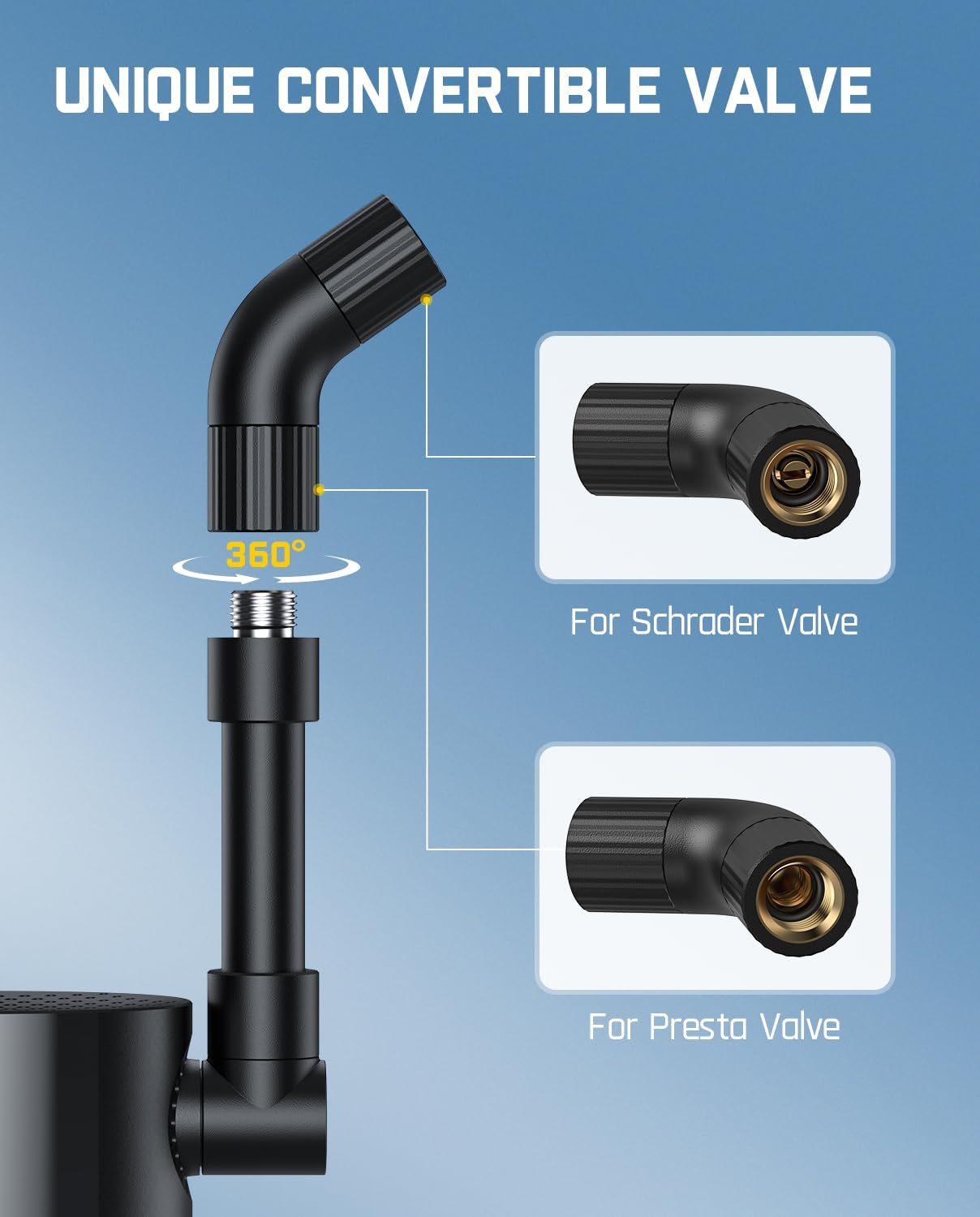
Both the Fanttik X9 Ace and the HOTO pump handle Presta and Schrader valve switching — the two most common valve types on bikes. Presta valves (the narrow ones with a locking nut at the top, common on road and many cargo bikes) require a different adapter orientation than Schrader valves (the wider, car-style valves found on many trailers and some cargo bikes).
Here’s where both pumps accumulate the most friction in reviews: the nozzle is short, and on some wheel and fork configurations that shortness creates awkward access. Deep-dish rims, chainstays that crowd the rear valve, and certain fork designs can make getting a solid, square connection to the valve stem genuinely fiddly. This is a geometry constraint of packing pump hardware into a compact form factor — not a defect — but it’s worth knowing before your first use rather than discovering it roadside.
The most common user complaint on both pumps is adapter orientation error on Presta valves. The adapter needs to be seated correctly to seal; if it’s reversed or partially engaged, air escapes and the pump reads incorrectly or fails to build pressure. This is user error, not product failure, but it’s common enough to address directly.
Correct Presta adapter procedure:
- Unscrew the Presta valve’s small top nut completely (counterclockwise) before attaching anything.
- Confirm the adapter is in Presta mode (check your specific pump’s markings — they differ by model).
- Press the nozzle on straight and perpendicular to the valve stem, not at an angle.
- Lock or twist the nozzle until you feel resistance — a partial connection will bleed air immediately.
Getting this right once makes every subsequent inflation straightforward. Getting it wrong once is the engine behind most one-star reviews of otherwise capable pumps.
Floor Pump vs. Mini Electric: The Real Decision Frame
BikeRadar’s feature “Mini pump vs floor pump: which do you need?” frames the choice as a question of workflow, not raw capability — and that framing holds up against owner evidence. Here is the actual decision tree:
If you’re inflating bikes at home before every ride: A quality floor pump is faster, requires no charging, and gives you a large analog gauge that’s easy to read at a glance. It belongs at home.
If you’re a cargo-bike commuter who parks at a workplace or at school pickup: Carrying a USB-C-charged pump the size of a water bottle is more realistic than carrying a floor pump. The Fanttik’s 1 PSI accuracy means you’re not compromising on maintenance quality to gain convenience.
If you run a trailer alongside a cargo bike: The multi-application flexibility of the Fanttik (bike tires, trailer tires, car tires, sports balls, cart wheels) makes it a household utility item, not just a cycling accessory. That breadth changes the cost justification entirely.
If you’re on a cyclekart build or small shop workflow: The ability to top off cart tires, pneumatic wheels, and other inflatables with the same device that maintains your bikes is a genuine convenience. Reviewers who work across multiple vehicle types call this out specifically as a reason to choose the Fanttik over a bike-only pump.
If you have fat-tire e-bike tires and you’re inflating from flat frequently: Carry a backup. A CO2 cartridge — a small canister of compressed gas that inflates a tire nearly instantly — remains sensible for roadside use not because the pump fails, but because CO2 is instantaneous and the mini pump takes 3–5 minutes on a large-volume tire. For a roadside flat in rain or traffic, speed matters in a way that routine maintenance doesn’t.
PeopleForBikes’ urban cycling adoption reporting documents cargo bike use expanding significantly in family and small-business delivery contexts — exactly the use case where a versatile, accurate mini pump delivers more value than a traditional floor-pump-plus-emergency-hand-pump approach.
Frequently Asked Questions
Can a mini electric pump actually replace a floor pump for daily use? Based on owner reports, the Fanttik X9 Ace can function as a primary pump for a multi-bike household — one reviewer uses it as exactly that, rather than keeping it for emergencies. The practical limits are inflation time (slower than a floor pump) and battery life on high-volume tires. For a family running cargo bikes and trailers, the convenience often outweighs those limits.
How accurate are the onboard pressure gauges on the Fanttik and HOTO pumps? Owner testing of the Fanttik X9 Ace, cross-referenced against a precision reference gauge across six tires on three bikes, found readings within 1 PSI — exceptional for a portable pump, and better than the ±2 PSI threshold Bicycling.com’s buyer’s guide “The Best Bike Pumps” identifies as “good” for portable pumps. The HOTO receives consistent accuracy praise in reviews, though no quantified deviation data against a reference gauge is available in the owner records surveyed.
How many bike tires can I inflate on a single charge? Owners report 4–6 standard road tires per charge on the Fanttik X9 Ace. Fat-tire cargo bikes pull that number toward 2–3 full inflations, or considerably more if you’re only topping off rather than inflating from flat.
Do these pumps work on fat-tire e-bike tires? Yes, but inflation takes longer and draws more battery. For a 4” wide cargo bike tire at 15–20 PSI, expect 3–5 minutes per tire. Carry a CO2 cartridge as a roadside backup if you’re running this tire profile and need emergency inflation speed.
What is the correct adapter orientation for Presta valves? Unscrew the Presta valve’s top nut fully before attaching, confirm the adapter is in Presta mode, press the nozzle on straight (not at an angle), and lock it until you feel resistance. The most common failure mode in reviews is partial engagement — the nozzle feels connected but isn’t sealed.
Should I still carry a CO2 cartridge as a backup if I have a mini electric pump? For road rides and cargo bike commutes: yes, especially on fat tires. CO2 provides near-instant inflation for a roadside flat, which matters in bad weather or traffic. The mini pump handles maintenance and routine top-offs; CO2 handles true emergencies where speed is the priority.