June 29, 2026 • Neil Hayes • 9 min reading time • Prices verified June 25, 2026
Building a Practical Rear Rack Setup: Racks, Panniers, and Baskets That Earn Their Keep
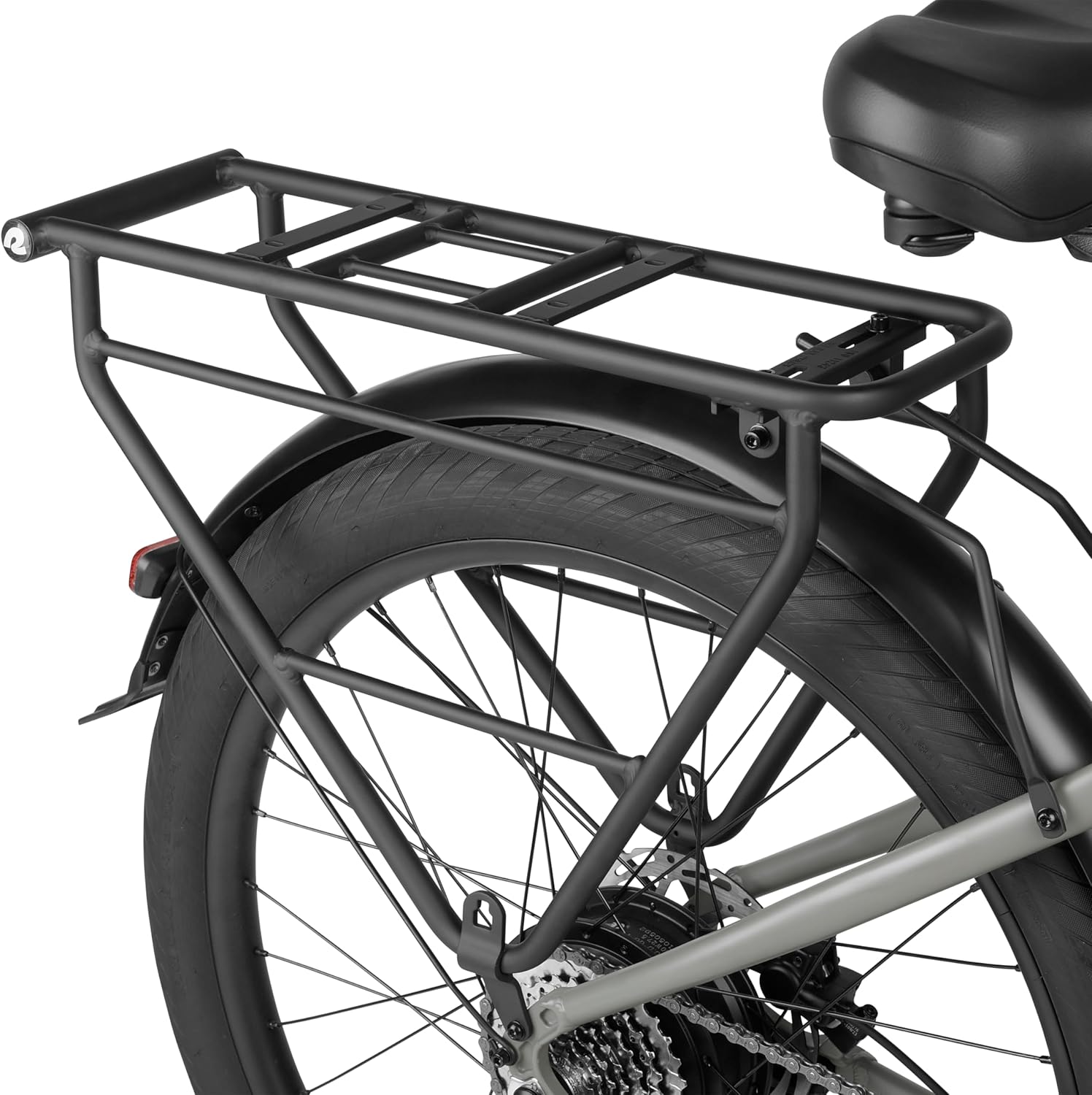
A rear bike rack is exactly what it sounds like: a metal platform bolted to the back of a bicycle that lets you carry things without stuffing them in a backpack or balancing a grocery bag on your handlebars. Panniers (pan-EARS) are the bags that clip or hook onto the sides of that rack — think saddlebags for a bicycle. Baskets mount on top. Together, these three components make up a rear hauling system, and getting that system right determines whether your bike becomes a genuine errand-runner or an overloaded frustration. This guide walks through how to match rack, pannier, and basket to your actual load needs, with specific decision points for commuters, grocery haulers, and light cargo cyclists who’ve outgrown a backpack but haven’t committed to a full cargo bike.
| EDITOR'S PICK[Retrospec Haul Electric Bicycle](https://www.amazon.com/dp/B0D3N1ZW5Y?tag=greenflower20-20)… | Mid-tier[ROCKBROS Bike Rack Bag Bicycle](https://www.amazon.com/dp/B0C1VJG5L1?tag=greenflower20-20)… | Budget pick[ROCKBROS Rear Bike Rack Quick R](https://www.amazon.com/dp/B08LCQXJXG?tag=greenflower20-20)… | |
|---|---|---|---|
| Type | Bike Rack | Pannier Bag | Bike Rack |
| Capacity | 55 lb | 13 L | — |
| Material | Aluminum | — | — |
| Rain Cover | — | ✓ | — |
| Compatibility | Electric Bike | E-bike | — |
| Price | $79.99 | $33.91 | $31.58 |
| See on Amazon → | See on Amazon → | See on Amazon → |
Why the Rack Is the Decision That Constrains Everything Else
The rack is the structural foundation. Everything downstream — bag compatibility, load capacity, mounting points — flows from which rack you choose. Most riders treat the rack as an afterthought and buy whatever’s cheapest at the local shop. That’s the wrong order of operations.
The three variables that actually matter at spec-selection time:
-
Maximum rated load — almost every quality rack is rated at 25 kg (55 lbs) or lower. A few touring racks push to 30 kg. If you’re regularly hauling groceries for a family, a work laptop plus tools, or deliveries for a small business, confirm the rated load before anything else. Exceed it and you’re voiding the warranty and risking a catastrophic failure mid-ride.
-
Mounting standard — most racks use either ISO 11243 (the standard dropout-and-seat-stay bolt pattern) or a proprietary system (common on e-bikes and cargo bikes from brands like Tern and Riese & Müller). Mismatching these means nothing fits or stays put.
-
Strut length and seat-stay clearance — discount racks frequently lack adjustability, which means they don’t fit frames with wide tires or unusual geometry. Bicycling magazine’s 2025 rack roundup specifically flags this as the most common fit failure point for riders trying to upgrade on a budget.
By the Numbers: Rack Tier Comparison
| Tier | Price Range | Rated Load | Typical Fit Range | Common Brands |
|---|---|---|---|---|
| Entry | $25–$60 | 18–22 kg | Road / hybrid, standard clearance | Axiom, Topeak TRX series |
| Mid | $65–$120 | 25 kg | Most frames, limited e-bike | Thule Pack ‘n Pedal, Bontrager |
| Touring / Cargo | $130–$220 | 25–30 kg | Wide tire, cargo-ready, e-bike compatible | Tubus, Surly, Salsa |
| E-Bike OEM / Integrated | $150–$350 | 25–30 kg | Brand-specific (Tern, Riese & Müller) | MIK HD, Tern Atlas |
Wirecutter’s 2025 pannier guide notes that the most common reader regret is buying panniers first, then discovering the rack they already owned lacks the lower stabilizer rail those panniers require. Buy the rack spec sheet first; match panniers to it second.
Panniers: Volume, Weather Protection, and Attachment System
Panniers live or die on three criteria: volume (liters of usable space), weather resistance (waterproof vs. water-resistant vs. neither), and how they attach to the rack. All three interact with your use case in ways that aren’t obvious from a product listing.
Volume and Shape
The standard single pannier runs 15–22 liters per bag. A matched pair gives you 30–44 liters total — roughly equivalent to a large hiking daypack, split across both sides of the wheel. That’s enough for a full grocery run for one or two people, a change of clothes plus work gear, or a moderate tool kit.
Where shape matters more than riders expect: panniers that taper toward the bottom fit closer to the wheel and reduce the tendency to catch a heel on the forward swing of your pedal stroke. BikeRadar’s 2024 buyer’s guide identifies this “heel strike” problem as the top ergonomic complaint from commuters using wider, box-shaped panniers on bikes with shorter chainstays (the tube connecting the bottom bracket to the rear wheel axle).
If you’re hauling anything rigid — a laptop, a camera, framed artwork — look for a pannier with a stiffened back panel. Soft-walled bags work for clothing and groceries but will deform around anything that has corners.
Weather Resistance: The Honest Tier Breakdown
- Water-resistant (treated nylon or polyester): Handles light rain and splash. Adequate for fair-weather commuters who occasionally get caught out. Not adequate for daily riding in Seattle or Amsterdam-style conditions.
- Waterproof (roll-top or welded seam construction): Genuinely keeps contents dry in sustained rain. Ortlieb’s Back-Roller Classic is the canonical example here — owners consistently report dry contents even after multi-hour rides in heavy rain, per aggregated reviews on BikeRadar and Wirecutter.
- Weather-resistant with a rain cover: A middle path — lighter and often cheaper than fully waterproof, but adds complexity (the cover has to be packed somewhere when not in use).
If you’re commuting year-round in a variable-weather climate, the math strongly favors a fully waterproof pannier. The cost difference between water-resistant and waterproof at the mid-tier runs about $40–$80 per pair. One ruined laptop or soaked camera body costs more.
Attachment Systems
This is where compatibility with your rack choice comes back in. The three dominant systems:
- Hook-and-rail (Ortlieb, most generic bags): Two hooks over the top rail, a lower stabilizer hook on the bottom rail. Simple, universal on standard racks, easy to remove. Requires that bottom stabilizer rail — which some entry-level racks omit.
- Klickfix (Rixen & Kaul): A proprietary click-mount system. Fast, nearly rattle-free, but only works on racks with the Klickfix adapter. Growing in popularity on commuter-oriented bikes.
- MIK (Multi Interface Kickstand) and MIK HD: Common on Tern and certain cargo-oriented bikes. Integrates panniers, baskets, and child seats into a single adapter standard. If you’re on a Tern GSD or similar platform, MIK-compatible bags unlock a significantly cleaner mounting experience.
Outside Online’s 2025 comparison of cargo bike vs. pannier setups observes that riders who commit to a single ecosystem — one brand’s rack paired with that brand’s bags and accessories — consistently report fewer rattles, less troubleshooting, and faster loading than riders who mix and match.
Baskets: When Simplicity Wins
A rear basket (mounted flat on top of the rack, sometimes called a “trunk bag platform”) is the most underrated option in this category. For grocery haulers, farmers’ market regulars, and anyone who loads and unloads multiple times a day, a rigid basket beats panniers on pure convenience.
The practical case for a basket over panniers:
- No attachment system to learn or fail. You put things in it.
- Easier to load tall or awkward items (a bouquet of flowers, a wine bottle, an oddly shaped takeout order).
- Often cheaper: a quality wicker or powder-coated steel basket runs $35–$90 vs. $80–$200+ for a pannier pair.
- Weather protection is zero, which is the tradeoff. You’re adding a crate to a bike, not a weatherproof cargo hold.
The standard basket mounting uses bungee cords or integrated straps. Better setups use a quick-release mount — Wald, the American basket manufacturer, makes rack-mount baskets with integrated bungee hooks that owners consistently describe as “the most useful $40 I’ve spent on my bike” in cycling forum aggregates cited in Bicycling magazine’s 2024 commuter gear roundup.
For mixed-weather use, the basket-plus-reusable-bag approach (drop a canvas tote or waterproof bag inside the basket) covers most needs without the cost of full panniers. It’s not elegant, but it’s functional and fast.
Where baskets fall short:
- Narrow tires and lightweight road bikes: the weight sits high on the rack, affecting handling more than side-loaded panniers do.
- Long-distance touring: panniers distribute weight lower and more symmetrically.
- Security: an open basket offers zero theft resistance. A pannier with a lockable zipper or roll-top closure is meaningfully more secure in urban environments.
People for Bikes’ 2024 cargo cycling research summary notes that in urban cycling populations, theft of unsecured cargo from open baskets is the second most commonly cited deterrent to bike commuting (behind lack of secure parking). If you’re locking up in high-foot-traffic areas, factor that into your basket vs. pannier calculus.
Putting It Together: The Decision Framework
By this point you’ve likely self-sorted into one of a few configurations. Here’s the explicit if/then:
If your primary use is daily commuting with a laptop, work gear, and occasional groceries: → Mid-tier rack rated 25 kg, single 20-liter waterproof pannier (one side), or a matched pair if you regularly carry 15+ lbs. Ortlieb Back-Roller Classic or Thule Shield Pannier are the consistently well-reviewed options in this tier. Budget $130–$200 for the rack-and-bag system.
If your primary use is grocery runs, farmers’ market, or family errand cycling: → Mid-tier rack plus a Wald-style basket for open loads, with a secondary compression strap. Add a second hook-mount pannier on the far side if you regularly hit 20+ lbs of cargo. Total outlay: $80–$140.
If you’re on an e-bike or cargo bike with a proprietary rack standard (Tern, Riese & Müller): → Stay within the manufacturer’s ecosystem. MIK HD-compatible bags are the path of least resistance. Mixing third-party racks onto proprietary frames voids load ratings and creates integration problems that owners in long-run reviews consistently flag as not worth the savings.
If you’re building out a small-business delivery or cargo operation (even at small scale): → Touring-class rack (Tubus or equivalent, 30 kg rated), high-volume panniers in the 20–25 liter per side range, and an integrated basket or trunk bag for top-of-rack overflow. Budget $250–$400 for the full system before bags; this is capital equipment that should outlast two or three bikes if maintained.
If you’re outfitting a bike for a child or teen: → Verify the rack’s rated load before adding any rider-transport accessories. Standard rear racks are not rated for human passengers. If carrying a child is part of the use case, you’re looking at a dedicated cargo bike or trailer solution — not a rack-and-pannier system.
The honest summary: a rear rack setup is one of the highest return-on-investment upgrades available to a utility cyclist. The floor for a functional system is around $80–$100 (entry rack, basket or inexpensive hook panniers). The ceiling for a genuinely durable, weather-proof, ecosystem-integrated setup is $300–$450. Most commuters land in the $130–$200 range and cover 80% of use cases without compromise. The spec work is worth doing once — matching rack load rating to attachment standard to bag system — so you’re not rebuilding it six months later.