October 31, 2026 • Neil Hayes • 11 min reading time • Prices verified June 25, 2026
Rear Bike Racks That Actually Fit Fat-Tire and E-Bikes: A Practical Fitment Guide
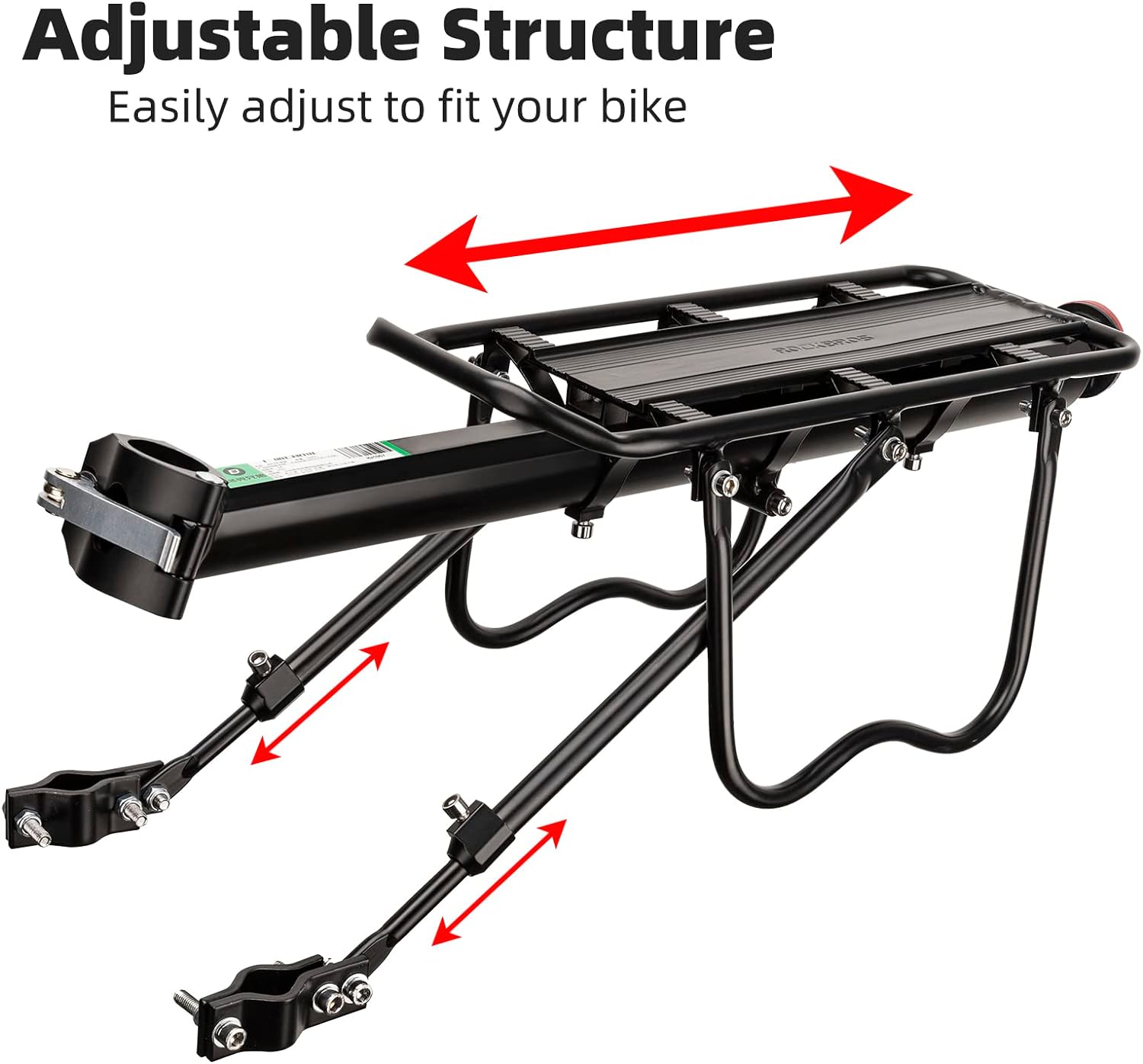
A rear bike rack is the flat metal platform bolted above your rear wheel that lets you carry groceries, panniers (saddlebags that hang off the sides of the rack), child seats, or cargo bags. On a standard road or commuter bike, buying a rack is mostly painless — the frame geometry, tire clearance, and mounting points are predictable. But fat-tire bikes (those with tires 3.8 inches wide or wider, built for traction on sand, snow, or rough terrain) and e-bikes (electric-assist bicycles) break almost every assumption that rack manufacturers build their products around. Wider tires eat into the space where rack stays (the angled support arms that run from the rack platform down to the axle) need to live. E-bike frames often have fender mounts, motor cables, and integrated lighting that block standard attachment points. If you’ve already looked at one rack that “didn’t fit” without knowing exactly why, this guide is written for you.
By the end, you’ll know what specs to check before you buy, which racks owners have confirmed work on real fat-tire and e-bike builds, how to think about weight limits for actual use, and how to avoid the spoke-contact problem that plagues pannier users who skip one detail.
| EDITOR'S PICKRetrospec Haul Electric Bicycle… | Mid-tierROCKBROS Bike Rack Bag Bicycle… | Budget pickROCKBROS Rear Bike Rack Quick R… | |
|---|---|---|---|
| Cargo capacity | 55 lb | — | — |
| Product type | Rear rack | Rack bag | Rear rack |
| Aluminum frame | ✓ | — | — |
| E-bike rated | ✓ | ✓ | — |
| Rain cover | — | ✓ | — |
| Quick release | — | — | ✓ |
| Price | $79.99 | $33.91 | $31.58 |
| See on Amazon → | See on Amazon → | See on Amazon → |
Why Fat Tires and E-Bike Frames Break Standard Racks
The core problem is geometry, and it compounds in two places.
Stay width at the dropout. Most racks ship with stays designed to clear a tire up to about 2.1–2.4 inches wide. Fat-tire bikes run 3.8 to 4.9 inches of tire. That extra width means the rack’s lower stays — which need to angle inward to reach the axle mounting bolts (the “dropouts”) — physically hit the tire sidewall or the fender before they reach the attachment point. Some racks include adjustable or replaceable stay arms to compensate. Many don’t, and the product listing won’t tell you.
Frame mount compatibility. Standard racks rely on two anchor points: the dropout eyelets at the axle and a pair of braze-on eyelets (threaded mounting bosses welded into the seat stay tubes) positioned mid-frame. E-bikes frequently route motor cables along the chainstay, occupy the seat-stay eyelets with fender hardware, or use a thru-axle (a bolt that runs fully through the hub) rather than a quick-release skewer — and thru-axle dropouts require different rack hardware than quick-release dropouts. BikeRadar’s guide “How to choose the right rear rack for your bike,” published on BikeRadar.com, notes that thru-axle compatibility is one of the most under-disclosed specs in mid-tier rack listings, a gap that generates a disproportionate share of returns.
Seat-post mounting as a workaround. When frame eyelets are blocked or absent, some racks clamp directly to the seat post (the tube your saddle sits on). This solves the frame-mount problem but introduces its own tradeoffs: seat-post racks typically have lower weight limits (often 25–33 lbs versus 50–55 lbs for frame-mounted racks), and the rack height is fixed relative to your saddle, not your wheel — meaning if you raise your saddle for a better pedaling position, the rack rises with it and may tilt or shift the load angle. More on that in the FAQ section below.
By the Numbers: Rack Specs That Actually Matter
| Spec | Minimum to look for | Why it matters |
|---|---|---|
| Tire clearance (stated) | 4.0 in / 26x4.0 explicitly noted | Most racks only say “wide tire compatible” — that’s vague |
| Max load rating | 55 lbs for grocery/errand use | See real-world math below |
| Stay adjustability | Yes (extendable or swappable arms) | Essential for tires 4.0 in+ |
| Thru-axle adapter included | Yes or available | Required for most modern e-bikes |
| Rail spacing (platform width) | 130–150 mm | Hard-shell clip bags have fixed clamp widths |
Three Racks With Confirmed Fat-Tire Fitment
Retrospec Haul Rack
ROCKBROS
$33.91
In stock on Amazon
Check price on AmazonOne of the more instructive ownership data points in this category comes from a Lectric XP Cargo owner — documented in the long-term ownership discussion thread on ElectricBikeReview.com (“Lectric XP Cargo accessory compatibility notes”) — who reported that the factory OEM (original equipment manufacturer) rack’s 30-pound weight limit was the specific failure point that sent them searching for an aftermarket replacement. The Retrospec Haul rack became their solution. A separate owner documents a more demanding use case: mounting the Haul on a bike with 4.9-inch tires using a DIY (do-it-yourself) bracket fabricated from hardware store stock — a solution that required modifying the lower stay attachment point but produced a stable result.
This is the kind of real-world edge-case experience that almost never appears in a product listing, and it matters because 4.9-inch tires represent the widest mainstream fat-tire spec and the one most likely to require creative mounting. The Retrospec Haul is worth researching if you’re running tires in that range and are comfortable with minor fitment work. Per aggregated owner reviews collected on Retrospec Bicycles’ product page (2024–2025), the platform dimensions and adjustable stay design are the primary reasons owners with oversized tires gravitate toward this rack over budget alternatives.
Budget Aluminum Fat-Tire Rack
ROCKBROS
$31.58
In stock on Amazon
Check price on AmazonThe aluminum rack in this tier earns a specific callout in owner reviews for explicitly fitting a 26x4.0 fat tire — a piece of information that is genuinely unusual because most racks at this price point either don’t disclose maximum tire width at all or describe compatibility vaguely. If your bike runs 26x4.0 tires and you want a low-cost starting point without the risk of a guessing game, this category of rack is worth shortlisting. Published load ratings at this tier typically run 40–50 lbs; owners report it handles grocery-weight loads without complaint. When shopping this tier, filter explicitly by stated tire clearance rather than relying on “fat tire compatible” marketing language, which is applied inconsistently across the category.
ROCKBROS Rear Rack
ROCKBROS
$33.91
In stock on Amazon
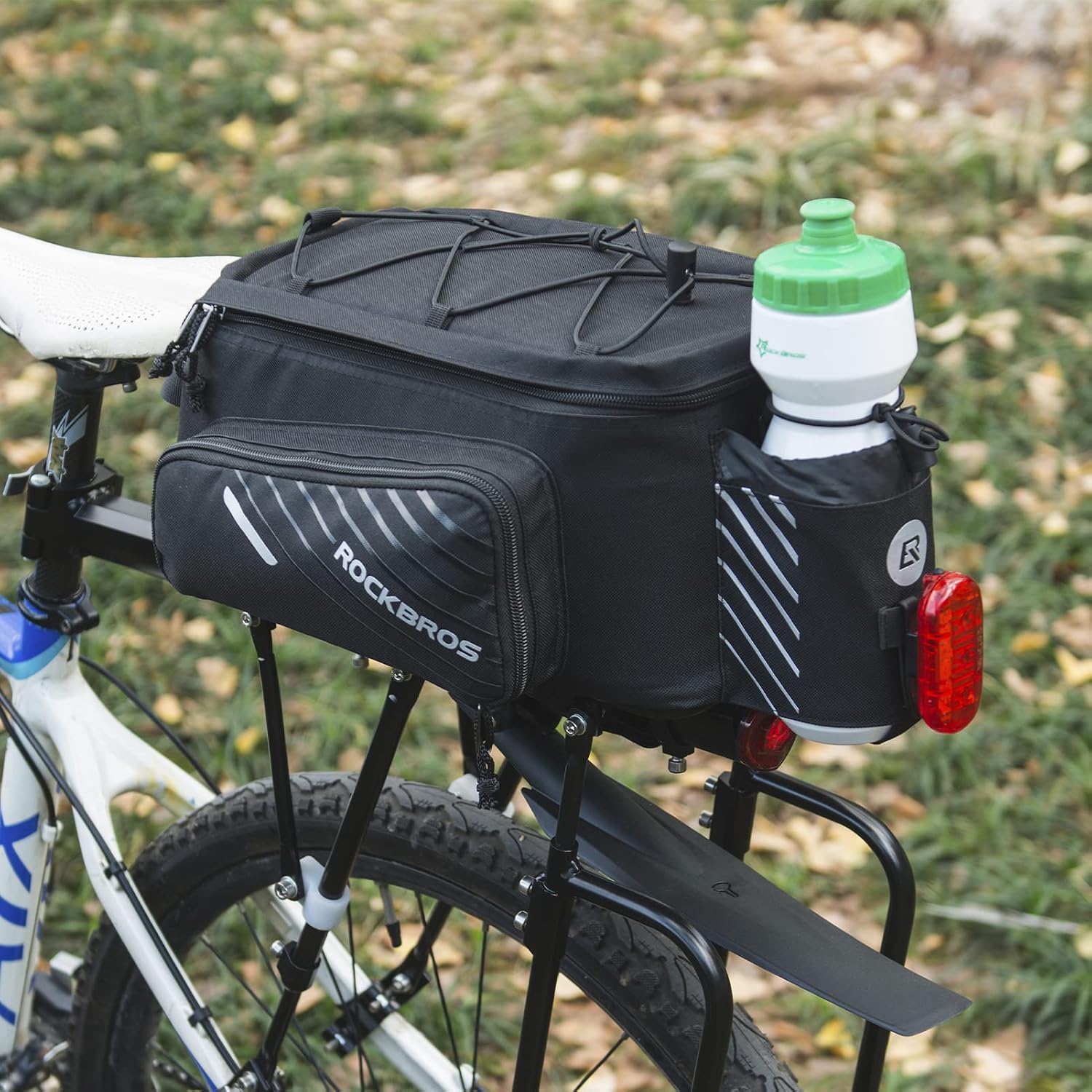
Check price on AmazonROCKBROS occupies mid-price territory, and the ownership pattern across aggregated reviews (ROCKBROS Official, 2023–2025) reflects a consistent theme: owners describe years of grocery-run use with no structural complaints. That durability signal matters in a product category where failure modes tend to be sudden — a stay weld cracking under load — rather than gradual. Per ROCKBROS published specs and owner review aggregation, the rack handles routine cargo use reliably. That’s not a headline specification, but it’s the kind of evidence that matters when you’re committing to a rack as a daily-driver accessory rather than an occasional-use item. Owners running e-bikes report that confirming thru-axle adapter availability before purchase is the one friction point in an otherwise straightforward install.
The Pannier Spoke Problem — and How to Prevent It
If you’re adding panniers (saddlebags) to your rack, spoke contact is the risk that shows up consistently in owner reviews and that product listings almost never address proactively.
The mechanical issue is straightforward: a pannier that hangs loose or flexes inward during cornering or braking can brush against the rotating spokes of your rear wheel. At low speed this is annoying; at speed it can catch and jam, with serious consequences for wheel integrity and rider stability.
KEMIMOTO pannier owners provide a useful case study here, drawn from KEMIMOTO’s aggregated owner review data (KEMIMOTO Official, 2024). Several owners note they initially hesitated after reading reviews that mentioned spoke contact as a problem. Their own experience, however, was different — and they identify the reason: the KEMIMOTO pannier includes a stiff backing board (a rigid internal panel on the wheel-facing side of the bag) that keeps the bag’s profile fixed rather than allowing it to sag inward toward the spokes. The mechanism is simple: a rigid backing maintains the bag’s stand-off distance from the wheel regardless of how full or heavy the bag is. A soft-sided bag without internal structure can flex unpredictably, especially when cornering weight shifts the load.
The practical takeaway: when evaluating panniers, look specifically for bags with rigid or semi-rigid backing panels on the wheel-facing side. This is a structural feature, not a brand preference.
For hard-shell clip-on bags, owner reports highlight a different but related problem: a previous budget bag wobbled unacceptably through turns and stops, and the owner identified cinch tightness — how firmly the bag’s mounting hooks clamp to the rack rail — as the actual variable, not the brand. A hard-shell bag clipped loosely to the rack will rock laterally even if the bag itself is rigid. The fix is mechanical: check that the mounting hooks engage fully around the rack rail and that any cinch mechanism (a locking lever or tightening strap at the top hook) is fully engaged before riding. Hard-shell bags also require a minimum rack rail width — typically 130–150 mm between the two parallel rails on the rack platform — to seat their fixed-width clamps. Confirm your rack’s rail spacing matches the bag’s clamp width before purchasing either component.
Frequently Asked Questions
Will a standard rear rack fit a 4.0-inch or 4.9-inch fat-tire e-bike without modification? Usually not without some fitment work. A 4.0-inch tire is at the edge of what racks with adjustable stays can accommodate; owners report success, but confirming the stay geometry clears your specific tire before purchase matters. A 4.9-inch tire almost always requires either a rack with extended adjustable stays, a DIY bracket modification at the lower attachment point, or a rack explicitly listed as compatible with that tire width. Per aggregated owner reports on the Retrospec Haul (Retrospec Bicycles, 2024–2025), the 4.9-inch case is solvable but not plug-and-play.
Does attaching a rack to the seat post force me to raise my saddle? No — but it links the rack height to your saddle height. If you later raise your saddle (a common adjustment as fit evolves), the rack rises with it, potentially shifting the platform angle and the load distribution. Frame-mounted racks don’t have this dependency. For ergonomic flexibility, a frame-mount is the better long-term choice if your frame supports it.
What is the real weight limit I should plan around for grocery and errand use? A typical grocery run — two full bags — runs 20–35 lbs depending on what you’re carrying. PeopleForBikes’ “E-bike load standards and cargo capacity overview,” published on PeopleForBikes.org, notes that rated capacity and practical daily-use capacity aren’t the same thing; consistently loading a rack to its rated maximum compresses the safety margin for road vibration and sudden load shifts. For errand use, treat 55-lb-rated racks as your minimum and plan to stay under two-thirds of rated capacity on a regular basis. A 30-lb-limit OEM rack — the Lectric XP Cargo case described above, sourced from ElectricBikeReview.com — leaves almost no margin for a real grocery haul.
How do I stop my pannier from hitting my spokes? Two mechanisms prevent spoke contact: a rigid backing board on the pannier (keeps the bag’s profile fixed) and full engagement of the mounting hook’s cinch or locking mechanism (prevents lateral rocking). Check both before your first ride. If your pannier doesn’t have a rigid backing, a thin piece of aluminum sheet or rigid foam cut to size and inserted into the bag’s wheel-facing pocket accomplishes the same result.
Can I mount both a child seat and panniers on the same rack? Sometimes, depending on the rack’s platform length and the child seat’s footprint. Child seats typically mount to the front portion of the rack platform and extend back over the wheel. Low-rider panniers (which mount to a separate low-mount rail below the rack platform) don’t conflict with the top platform at all and are the cleanest solution when both cargo types are needed. Standard side panniers on a rack occupied by a child seat will conflict on most consumer racks — the seat’s mounting hardware occupies the rail space the pannier hooks need.
What rack rail width do hard-shell clip-on bags require? Most hard-shell panniers with fixed-clamp mounting systems require a rack rail spacing of 130–150 mm (the distance between the two parallel rails on the rack’s cargo platform). This spec is frequently absent from both rack and bag listings. Measure your rack or contact the manufacturer before purchasing a hard-shell bag — a 10 mm mismatch means the clamps won’t seat, and the bag will rock regardless of how tightly you cinch the secondary straps.
Rack fitment for fat-tire and e-bike builds is a solvable problem, but it requires treating it as a systems question — tire width, frame mount availability, thru-axle versus quick-release, and pannier backing stiffness all interact. The general rule: if your tires are 4.0 inches or wider, confirm tire clearance explicitly (not just “fat tire compatible”), look for adjustable stays, and verify thru-axle adapter availability before committing. If your e-bike has blocked frame eyelets, budget for a seat-post mount but understand its load-limit and saddle-height tradeoffs. And whatever pannier you choose, the cinch mechanism and backing board stiffness matter more than the brand name on the label.