May 21, 2026 • Neil Hayes • 12 min reading time • Prices verified June 25, 2026
Transporting Your E-Bikes in a Car Without a Hitch: Wheel Straps, Cargo Carriers, and Trunk Solutions
Electric bikes — bicycles with a battery-powered motor assist — have grown dramatically heavier than the road bikes most car racks were designed for. A typical e-bike weighs 45–70 lbs, and a fat-tire cargo e-bike can push past 80 lbs. That’s a real engineering problem when your car doesn’t have a hitch receiver, the square metal socket bolted to your frame that traditional bike racks plug into. The good news: the market has caught up. There are now three credible transport categories for hitch-free or hitch-flexible e-bike hauling — trunk-mount racks with reinforced arms, hitch cargo carrier platforms that carry the bike lying flat or upright rather than hanging, and wheel stabilizer straps for van and SUV cargo-floor transport. This article maps the tradeoffs across all three, flags a documented buyer-deception issue with one popular rack category, and ends with a clear decision matrix so you can match the right solution to your specific car, bike, and trip profile.
The Three Solutions Compared
Understanding the category differences before you look at specific products saves you from the most expensive buying mistake in this space: choosing a solution that is architecturally wrong for your car or load, regardless of which brand you pick. Each of the three sections below closes with a tier marker so you can orient within the product landscape at a glance.
Trunk-Mount Racks: Low Barrier, Real Weight Limits
Trunk racks hang over your hatchback or sedan’s rear with padded hooks and nylon straps. No hitch, no installation, under $150 for most models. For standard e-bikes in the 40–55 lb range, they work. For fat-tire e-bikes or dual-motor models pushing 65–80 lbs, most trunk racks are not rated for the job.
The tilt-to-access feature is a frequently cited source of buyer frustration at this price tier. A buyer who assumes a trunk rack will tilt down to open the hatchback with bikes loaded — a reasonable assumption given that some competitors advertise this — may discover it does not. This is not a flaw unique to one brand; it is a category-wide trap. BikeRadar’s 2025 article “Hitch Rack vs. Trunk Rack: Which Is Right for Your Car?” (BikeRadar, 2025) notes that tilt-with-load capability is almost exclusively a feature of platform-style hitch racks in the $250–$450 range, not trunk racks.
The Swagman TrailV2 Plus is a pointed case study. Multiple owner accounts document that the product listing claimed tilt-with-bikes-loaded functionality, and the rack does not deliver it in practice. For a buyer who chose this model over alternatives specifically because of that feature — particularly anyone driving a hatchback who needs regular cargo access — this is a genuine deception issue, not a minor quibble. If trunk access matters to you, verify tilt-under-load capability by reading the owner Q&A on the product listing, not just the marketing copy.
Best for: Occasional short trips, bikes under 55 lbs, buyers without a hitch who cannot install one. Skip if: You need trunk access mid-trip, you’re loading solo with a heavy e-bike, or your bikes exceed 55 lbs.
Bike
$8.99
In stock on Amazon
Check price on AmazonHitch Cargo Carriers: The Platform Approach for Heavy E-Bikes
A hitch cargo carrier is a flat metal deck — a small shelf — that inserts into a hitch receiver and lets you lay bikes horizontally or stand them upright in wheel channels. This is architecturally different from a hanging rack: the load sits on the platform rather than swinging from hooks, which dramatically improves stability with heavy e-bikes.
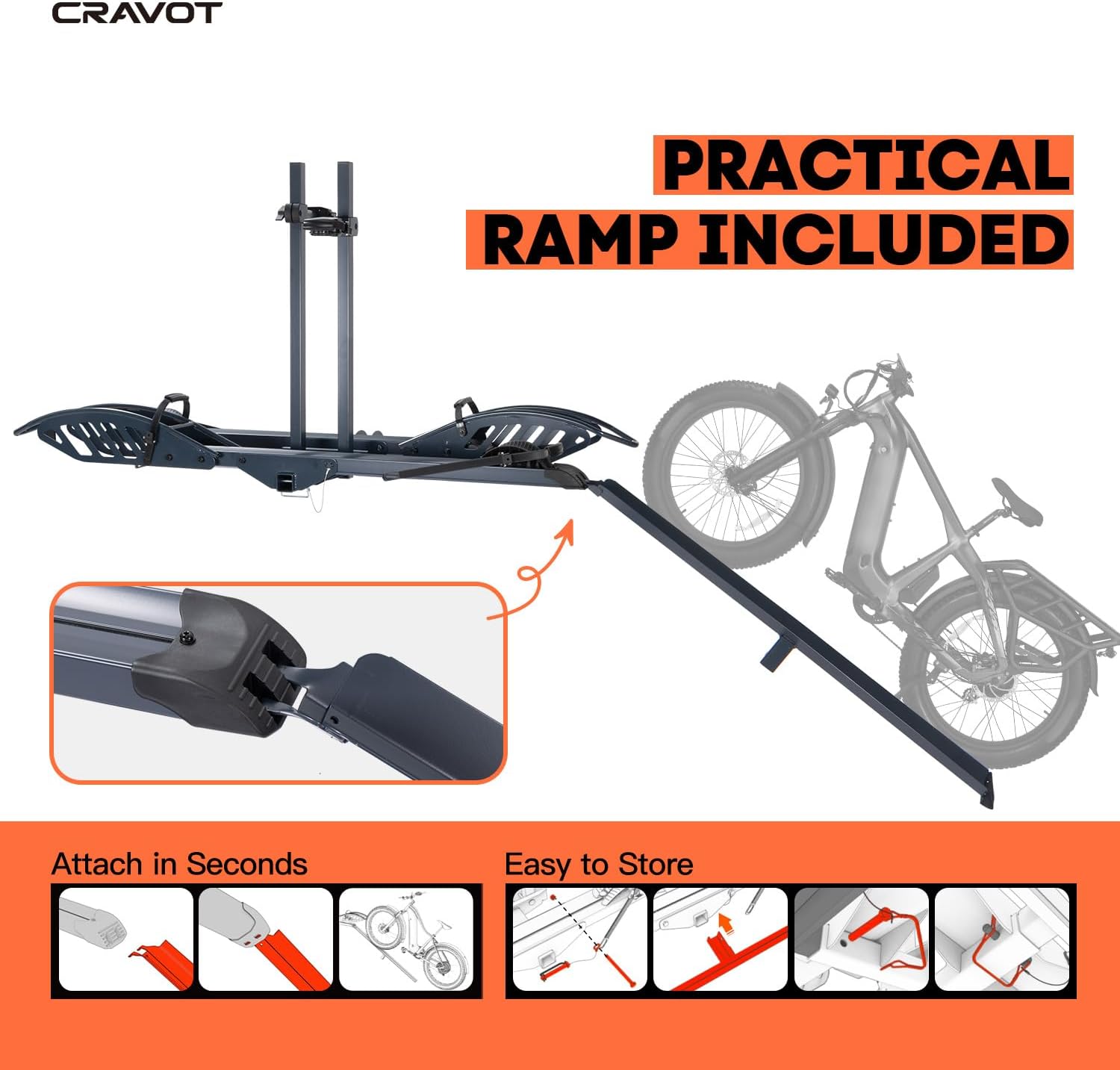
The CRAVAT CyberRack E2 has accumulated unusually detailed real-world validation across owner reviews. One owner reports completing an 800-mile road trip with zero rack movement. Another documents a 400-mile round trip with zero wobble. A third specifically calls it “senior-friendly” because of its integrated loading ramp — a meaningful accessibility data point that most rack reviews never surface. Across aggregated owner feedback, the ramp design is the differentiating feature, and it genuinely makes single-person loading of a 60+ lb e-bike feasible in a way that lifting-over-wheel-tray racks are not.
The ramp question matters more than most buyers anticipate before their first solo loading attempt. Manufacturer-rated weight capacities tell you whether a rack can hold your bike; they don’t tell you whether you can get it up there without a second person. Owners consistently report that ramp-equipped carriers shift this from a two-person job to a one-person job for bikes up to roughly 70 lbs.
One non-obvious use case worth flagging: the Wildroad hitch cargo carrier has documented use by RV travelers carrying both cargo and bikes in combination. One verified owner reports a 7,000-mile RV trip with a twin stroller on the platform alongside bikes. For cycling families who need cargo versatility — not just a bike-only rack — a flat carrier platform can do double duty in a way a wheel-tray rack cannot.
Best for: Bikes 55–80 lbs, solo loading, long highway trips, owners with a Class III hitch or willing to install one. Skip if: Your vehicle has no hitch and hitch installation is not feasible, or you need continuous trunk access.
CRAVOT
$254.15
In stock on Amazon
Check price on AmazonWheel Stabilizer Straps: The Interior and Van Solution
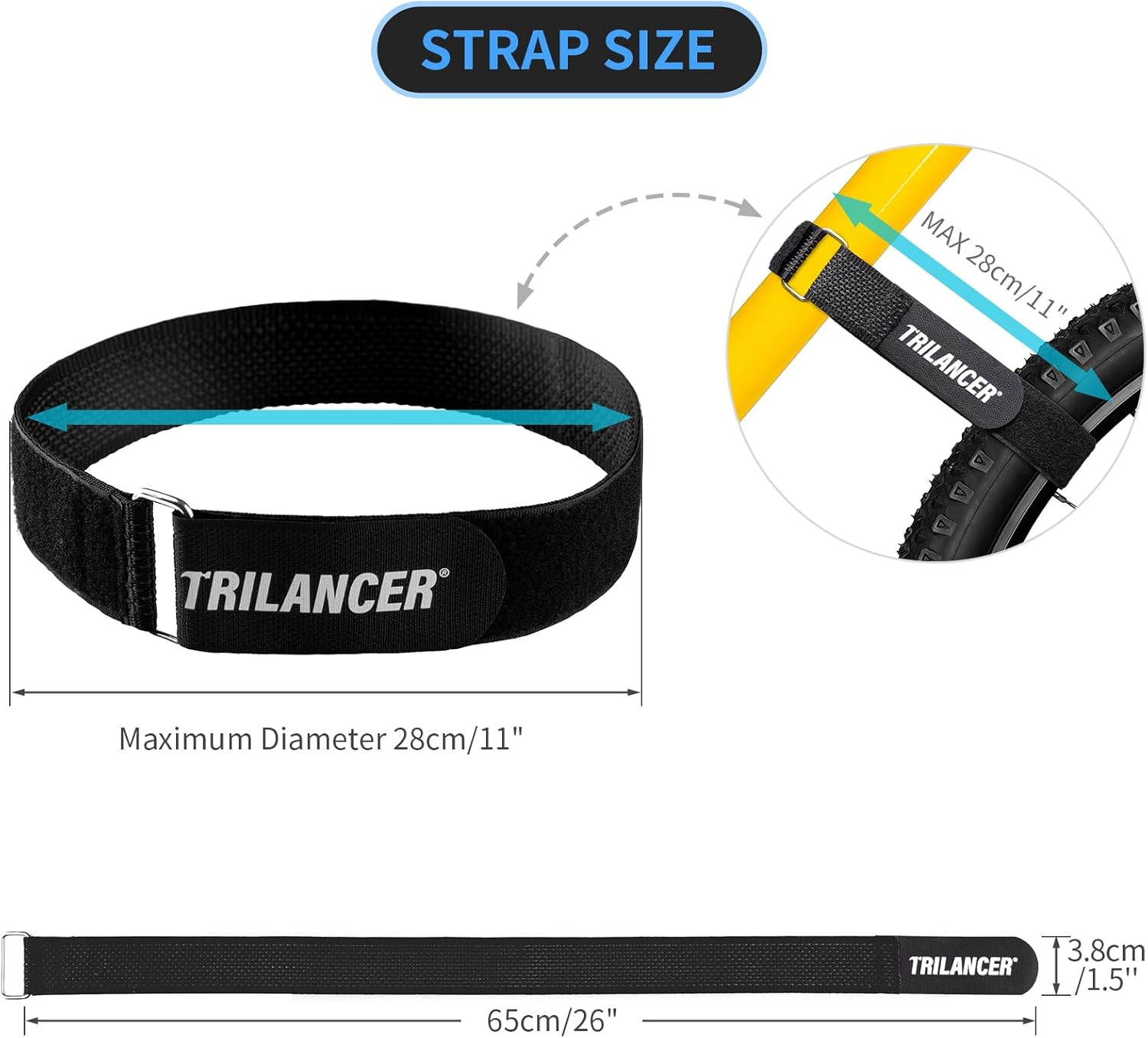
If you’re hauling e-bikes inside a van, truck bed, or SUV cargo area, wheel stabilizer straps — reinforced hook-and-loop or ratchet straps that anchor the wheels to floor tie-down points — are your primary tool. The owner-sentiment data here is colorfully diagnostic: reviewers consistently describe what they replaced with these straps as “bungee cords,” “my bike lock cable,” or other improvised lashing methods. That tells you exactly who buys these and why — people who’ve already dealt with a bike shifting at highway speed and want a purpose-built fix.
Trilancer wheel stabilizer strap owners report a notable behavior: a meaningful number of purchasers buy additional sets in different colors after their first purchase, specifically to distinguish front and rear wheel positions or to outfit multiple bikes. That’s a strong satisfaction signal, and the color-coding behavior suggests real-world multi-bike users are the core audience. Per manufacturer specifications, these straps are machine-washable — relevant for anyone doing regular trail-to-trailhead transport with muddy bikes.
OutsideOnline’s 2024 guide “How to Transport Your Bike Without a Hitch” (OutsideOnline, 2024) identifies interior cargo-floor transport as the most stable option for heavy e-bikes precisely because it eliminates hitch-extension leverage and keeps the center of gravity low. The tradeoff is interior space: two full-size e-bikes fill most van cargo floors completely.
Best for: Van owners, truck bed transport, SUV cargo floors, maximum stability at highway speed. Skip if: You need to carry passengers in the cargo area simultaneously, or your interior dimensions don’t accommodate the bike’s length.
Young
$299.99
In stock on Amazon
Check price on AmazonBy the Numbers: What Actually Fits Your Vehicle
The table below compares the three solutions across the variables that matter most for heavy e-bike transport. Use it alongside the narrative sections above — the numbers tell you what’s possible; the narrative tells you what’s practical.
| Solution | Typical Rated Capacity | Hitch Required? | Solo-Loadable (60 lb e-bike)? | Trunk Access with Bikes On? |
|---|---|---|---|---|
| Trunk-Mount Rack | 35–70 lbs per bike | No | Difficult | Rarely; verify before buying |
| Bike — $8.99 | ||||
| Hitch Cargo Carrier (ramp) | 150–500 lbs platform | Yes (1.25” or 2”) | Yes, with ramp | No (remove bikes first) |
| CRAVOT — $254.15 | ||||
| Wheel Stabilizer Straps | Floor/tie-down capacity | No | Yes | N/A (interior) |
| Young — $299.99 |
Specs compiled from published manufacturer documentation. Weight ratings cross-referenced with ElectricBikeReview.com’s 2024 transport guide “Transporting Electric Bikes: Racks, Carriers, and Tips” (ElectricBikeReview.com, 2024).
The Hitch Class Question You Cannot Skip
If you’re moving toward a hitch cargo carrier, hitch class is the decision that needs to happen first — before you pick a rack. A Class I or Class II hitch with a 1.25-inch receiver is standard on most sedans and smaller SUVs and is typically rated for 200–350 lbs tongue weight. A Class III hitch with a 2-inch receiver handles 500+ lbs and is what most cargo carrier platforms require for two heavy e-bikes.
PeopleForBikes’ 2024 e-bike transport safety guide (PeopleForBikes, “E-Bike Weight and Transport Safety Guide,” 2024) notes that two fat-tire e-bikes at 60 lbs each — 120 lbs of bike weight — plus a 35–50 lb carrier platform puts you at 155–170 lbs of tongue weight. That is safely within Class III limits but potentially over Class I/II limits when you add platform weight. Check your hitch class before ordering a platform carrier.
Jeep Wrangler owners face a specific complication: the rear-mounted spare tire blocks standard hitch rack positioning. A hitch extender — a tube that moves the rack rearward past the spare — is the standard fix, typically adding 4–6 inches of clearance. Wirecutter’s bike rack coverage “The Best Bike Racks” (Wirecutter, The New York Times Company, updated 2025) notes that extenders in the 4–6 inch range are widely available and compatible with Class III receivers, but they reduce your effective tongue weight rating by roughly 20–25%. Recalculate your load math after adding one.
Sway, Wobble, and Highway Speed Reality
Rack sway — the side-to-side pendulum motion of a loaded rack at highway speed — is the complaint that appears most frequently in owner reviews of both trunk racks and hitch-mounted platforms. The physics are straightforward: the further the load extends behind the vehicle’s rear axle, the more leverage any lateral force (crosswind, lane change) has on the rack.
BikeRadar’s 2025 analysis “Hitch Rack vs. Trunk Rack: Which Is Right for Your Car?” (BikeRadar, 2025) identifies three anti-sway interventions that owners consistently report as effective:
- Stabilizer bars or sway-control brackets bolted between the rack and the receiver reduce lateral flex; several hitch platform carriers include these as standard equipment.
- Ratchet straps from the bike frame to the rack, in addition to wheel-tray retention, reduce bike-to-rack movement independently of rack-to-hitch movement.
- Speed discipline — owners who report zero wobble on long trips consistently mention keeping highway speed at or below 65 mph with heavy loads.
The CRAVAT CyberRack E2 owners who reported 800-mile and 400-mile zero-wobble trips both mention ratchet-strap supplementation as part of their load setup. That is not a criticism of the rack — it is a best-practice protocol for any e-bike transport at highway speeds.
Frequently Asked Questions
Can a 2-inch hitch receiver handle two fat-tire e-bikes weighing 60 lbs each? A 2-inch Class III hitch receiver is rated for 500+ lbs tongue weight on most vehicles, which comfortably handles two 60 lb bikes plus a 40–50 lb platform carrier. The limiting factor is usually the vehicle’s own hitch rating, not the receiver size — check your owner’s manual or door-jamb sticker for your specific tongue weight limit.
Do e-bike hitch racks tilt down to open a trunk or hatchback with bikes loaded? Some platform-style hitch racks offer tilt-down functionality, but most do not support it with bikes loaded. Trunk-mount racks almost never do. This is a feature you must verify in the owner Q&A or spec sheet — marketing language frequently overstates or obscures it. The Swagman TrailV2 Plus situation, where the listing claimed tilt-with-load and the product does not deliver it, is a documented example of why you cannot take this on faith.
Are wheel stabilizer straps reusable and washable after muddy rides? Per manufacturer specifications for straps such as the Trilancer, yes — they are designed for repeated use and are machine-washable. Owners who do regular trail transport specifically cite washability as a purchase driver.
What hitch extender do you need for a Jeep Wrangler spare tire obstruction? A 4–6 inch Class III hitch extender clears the standard rear spare tire on most Wrangler configurations. Note that extenders reduce effective tongue weight rating by roughly 20–25%, so recalculate your load capacity after adding one. This guidance is consistent with Wirecutter’s coverage of hitch rack accessories in “The Best Bike Racks” (Wirecutter, The New York Times Company, updated 2025).
Is a ramp-equipped rack one-person loadable or do you always need help? Ramp-equipped carriers are specifically designed for solo loading of heavy bikes. Owners of the CRAVAT CyberRack E2 consistently report single-person loading of bikes in the 60–70 lb range. Without a ramp, lifting a 60+ lb e-bike into a wheel tray is a two-person job for most people.
How do you prevent rack sway and wobble at highway speeds with heavy e-bikes? Use a rack with an integrated anti-sway bar or stabilizer bracket, add ratchet straps from the bike frame to the rack in addition to wheel-tray retention, and keep highway speed at or below 65 mph with heavy loads. Owners who report trouble-free long-distance transport consistently use all three measures in combination.
The Decision Matrix: If X, Then Y
Solution fit is almost entirely determined by three variables: whether your car has a hitch, whether you need trunk access mid-trip, and whether you are loading solo.
-
No hitch, occasional short trips, bikes under 55 lbs: A trunk rack is sufficient. Verify tilt-under-load claims before buying if trunk access matters, and treat any marketing claim about tilt-with-load as unverified until confirmed in owner Q&A. The Allen Sports Deluxe 4-Bike Trunk Mount Rack is a widely available entry-level option in this category — confirm tilt behavior in the product’s owner Q&A before purchasing.
-
Have a hitch or willing to install one, bikes 55–80 lbs, loading solo: A ramp-equipped hitch cargo carrier platform is the right category. The CRAVAT CyberRack E2 has the strongest real-world validation data at highway distances among products reviewed here.
-
Van, truck bed, or SUV cargo floor: Wheel stabilizer straps are the answer. Trilancer’s multi-color purchase behavior suggests this audience buys more than one set — plan accordingly and consider a second set in a contrasting color for front/rear distinction.
-
Jeep Wrangler or spare-tire obstruction: Add a Class III hitch extender to any platform carrier solution; recalculate your tongue weight after doing so, applying the 20–25% reduction rule noted by Wirecutter’s “The Best Bike Racks” (Wirecutter, The New York Times Company, updated 2025).
-
RV or multi-use cargo trip: The Wildroad hitch cargo carrier’s documented use for combined bike and stroller transport across a 7,000-mile RV trip makes a flat carrier platform worth the investment if you’re hauling more than just bikes across long distances.
The one mistake that costs the most: buying a trunk rack or platform carrier based on a tilt-or-fold claim without verifying it in owner reviews. At e-bike weights, a rack that does not tilt with bikes loaded means unloading both bikes every time you need your trunk, on every trip, for the life of the rack. Confirm before you buy.